
QVC Group, Inc.: Reckoning with Chapter 11 and Reshaping Social Commerce
An analytical review of QVC Group’s financial distress, operational restructuring, and strategic repositioning in live social commerce.
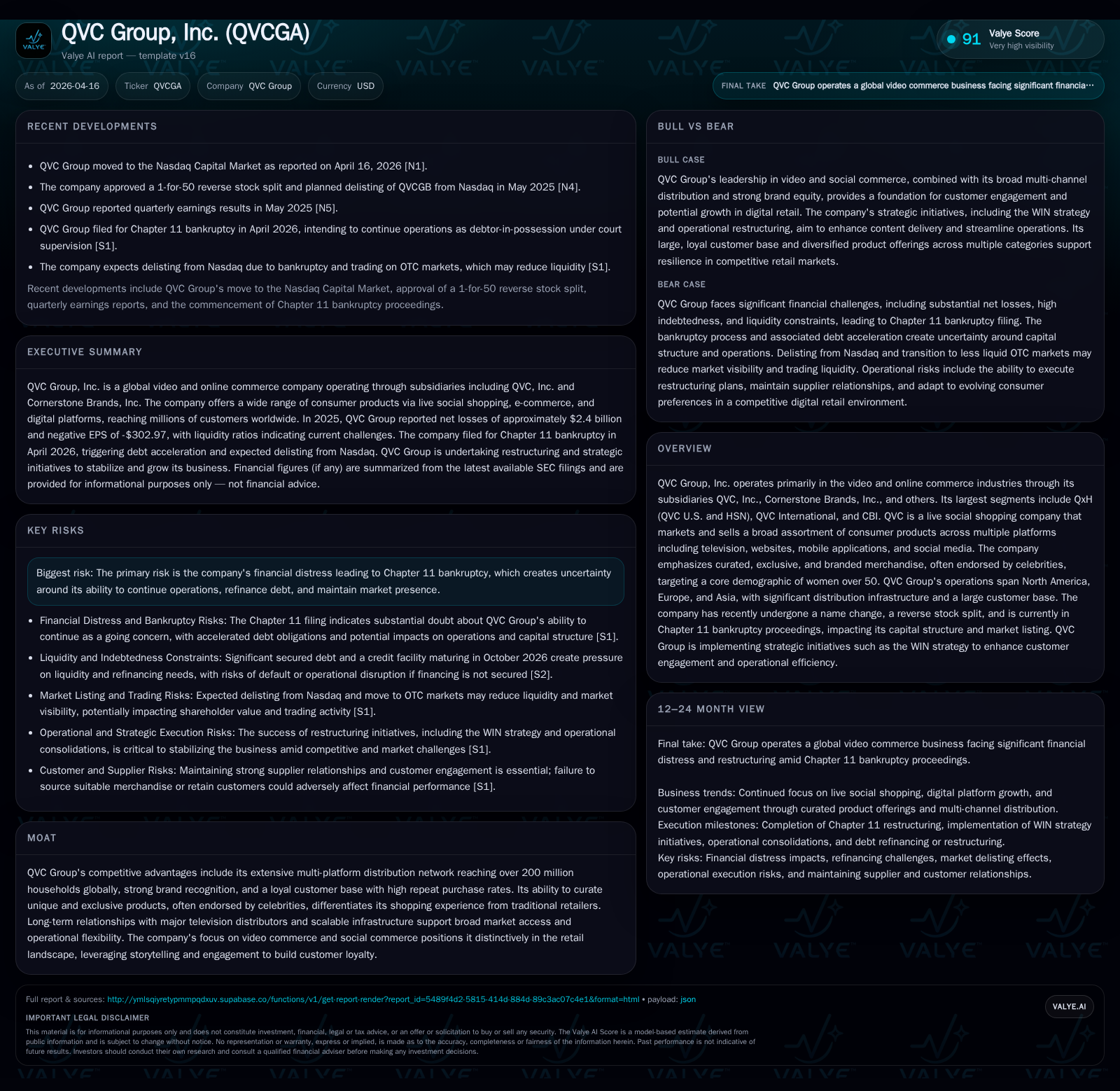
QVC Group, historically a leader in live video commerce through its flagship QxH segment and international operations, has experienced severe financial deterioration resulting in Chapter 11 bankruptcy proceedings by early 2026. The company continues to operate as debtor-in-possession while pursuing a debt restructuring plan aimed at deleveraging its balance sheet. Strategic initiatives emphasize reinforcing its curated product assortments alongside expanding digital and social commerce platforms targeted primarily at women over 50. Despite massive losses reflected in negative operating and net income through 2025, QVC maintains positive operating cash flows supported by repeat customers. Key milestones include refinancing of maturing debt and successful court approval of the restructuring plan, which will determine its viability post-bankruptcy.
Historic Performance Review: Growth Drivers and Financial Volatility
QVC Group’s financial performance exhibits significant volatility despite steady revenue levels recorded at approximately $4.376 billion as of fiscal year ended December 31, 2018 [F1]. Operating income swung from a profit of $590 million in FY2023 to a loss of about $2.1 billion in FY2025—a decline exceeding 159% year-over-year. Net income similarly deteriorated from a loss of approximately $145 million in FY2023 to a loss surpassing $2.4 billion by FY2025 [F1]. Operating cash flow remained positive at $274 million in FY2025 but declined nearly 48% compared to the prior year.
This downturn reflects elevated cost pressures including increased freight, warehousing costs, tariffs impacting product margins especially within QxH (QVC U.S. and HSN), along with restructuring charges linked to turnaround plans such as Project Athens and the WIN strategy [S1][S4][S13]. The company's segments—QxH, QVC International, and Cornerstone Brands (CBI)—offer revenue diversification but have not offset rising losses.
Capital expenditures totaled $156 million in FY2025 [F1], supporting platform investments but constrained by liquidity challenges.
Historical performance (annual)
| FY | Net ($bn) | CFO ($mm) | OpInc ($bn) | Net YoY |
|---|---|---|---|---|
| 2025 | -2.4 | 274 | -2.1 | -89.1% |
| 2024 | -1.3 | 525 | -0.8 | -789.7% |
| 2023 | -0.1 | 919 | 0.6 | +94.4% |
| 2022 | -2.6 | 194 | -2.0 |
Source: SEC companyfacts cache [F1].
Capital returns and efficiency (annual)
| FY | Div ($mm) | Buybacks ($mm) | ROE% |
|---|---|---|---|
| 2025 | 1 | 78.7 | |
| 2024 | 4 | 132.9 | |
| 2023 | 8 | 365 | -37.7 |
| 2022 | 12 | 365 | -629.6 |
Source: SEC companyfacts cache [F1].
The Chapter 11 Filing: Implications and Immediate Operational Effects
Amid liquidity pressures and breach of financial covenants—specifically net leverage ratio exceeding thresholds—QVC Group voluntarily filed for Chapter 11 bankruptcy protection in early 2026 [S1][S16]. This triggered acceleration events on indebtedness under the Credit Facility ($2.9 billion maturing October 2026) and senior secured notes ($2.146 billion due starting in 2027), aggregating approximately $5 billion outstanding principal [S5][S15].
Bankruptcy protections impose an automatic stay on creditor enforcement actions allowing continued operation as debtor-in-possession while restructuring proceeds [S1]. However, this introduces uncertainties including Nasdaq delisting following reverse stock split [N1][S6] and management distraction toward legal proceedings.
The company's liquidity position is stressed with current liabilities ($6.674 billion) exceeding current assets ($4.223 billion), yielding a current ratio near 0.63 indicative of short-term funding challenges [F1]. Management is actively negotiating refinancing or restructuring options amidst these constraints [S2][S16].
Strategic Shifts: Branding, Segmentation, and Expansion into Social Commerce
In February 2025, the company rebranded from Qurate Retail to QVC Group emphasizing its flagship brand's equity and signaling commitment toward live social shopping evolution [S1]. This aligns with the WIN strategy announced late-2024 focusing on growth through enhanced customer engagement across platforms (‘Wherever She Shops’), enriched content (‘Inspiring People & Products’), and operational agility (‘New Ways of Working’) [S12][S16].
The core demographic remains women over age fifty comprising about 73% of customers within QxH—a base generating high repeat purchase rates (~97% globally) [S4][S10]. Product assortments emphasize curated exclusives frequently featuring celebrity endorsements supporting differentiation versus traditional retailers.
Multi-channel order taking via mobile apps accounts for nearly half of all orders complemented by scalable distribution infrastructure with five domestic centers plus international facilities [S4]. Video-rich programming investments underpin competitive positioning within live interactive commerce.
Financial Structure Under Stress: Debt Profile and Liquidity Constraints
The capital structure consists primarily of senior secured notes totaling roughly $2.146 billion plus a $2.9 billion Credit Facility due October 27, 2026—all secured by first priority liens on subsidiary stock pledges [S5][S15]. Covenant breaches related to net leverage ratios (>4.5:1) absent lender waivers create cross-default risks potentially accelerating repayment obligations prematurely [S7][S9].
Operating lease liabilities approximating $500 million further constrain flexibility [S15]. Credit rating downgrades reflect heightened risk profiles amid ongoing losses limiting refinancing alternatives [S9][S14]. Ongoing lender discussions continue within bankruptcy though timing uncertainties remain ahead of maturity.
High leverage restricts working capital availability precluding additional borrowings until remediation or new capital infusion occurs—a critical factor for emergence feasibility beyond Chapter 11 protections [S15][S25].
Capital Allocation Amid Bankruptcy: Dividends, Buybacks, and Cash Flow Trends
Dividend payments fell markedly from $12 million in FY2022 to $1 million in FY2025 evidencing cash conservation amid distress [F1]. Share repurchases ceased prior due to insufficient free cash flow.
Capex spending at $156 million against operating cash flow of $274 million yields negative free cash flow near $(682) million reflecting prioritization of debt servicing over shareholder returns [F1][S8][S18].
Return on equity inverted sharply with approximate ROE near negative ~79% driven by sustained net losses compounded by negative equity nearing $(3.1) billion—highlighting balance sheet distress [F1].
Outlook Under Restructuring: What to Monitor and Potential Recovery Milestones
Success hinges on timely execution of the Chapter 11 reorganization plan aiming to deleverage via debt-for-equity swaps while maintaining business continuity pending court approval as ‘Reorganized QVC’ emerges [N1][S22][S16]. Risks include delays or failure leading to liquidation scenarios.
Key milestones include negotiation outcomes on imminent refinancing deadlines; bankruptcy plan confirmation hearings; implementation progress of WIN strategy targeting revenue stabilization; retention of loyal customer base leveraging multi-platform reach; plus resolution of regulatory matters such as consumer product safety settlements impacting HSN operations [S22][N1].
Post-emergence liquidity constraints require disciplined capital allocation focused on growth while managing residual indebtedness risks amid competitive pressures—the sustainability depending on management execution effectiveness.
This analysis is based exclusively on publicly available SEC filings, recent news disclosures, and standardized financial data without extrapolation beyond stated facts. It is provided solely for informational purposes without investment advice or recommendations.
Disclaimer: This is research-only, informational analysis and not investment advice. It may include AI-generated interpretation and general industry context. Always verify important details using primary sources.

Comments