
Q/C Technologies Advances Laser Computing Amid Strategic Transition and Financial Strains
Q/C Technologies pivots from pharmaceuticals to laser-based blockchain computing, balancing cutting-edge innovation with significant financial and execution challenges.
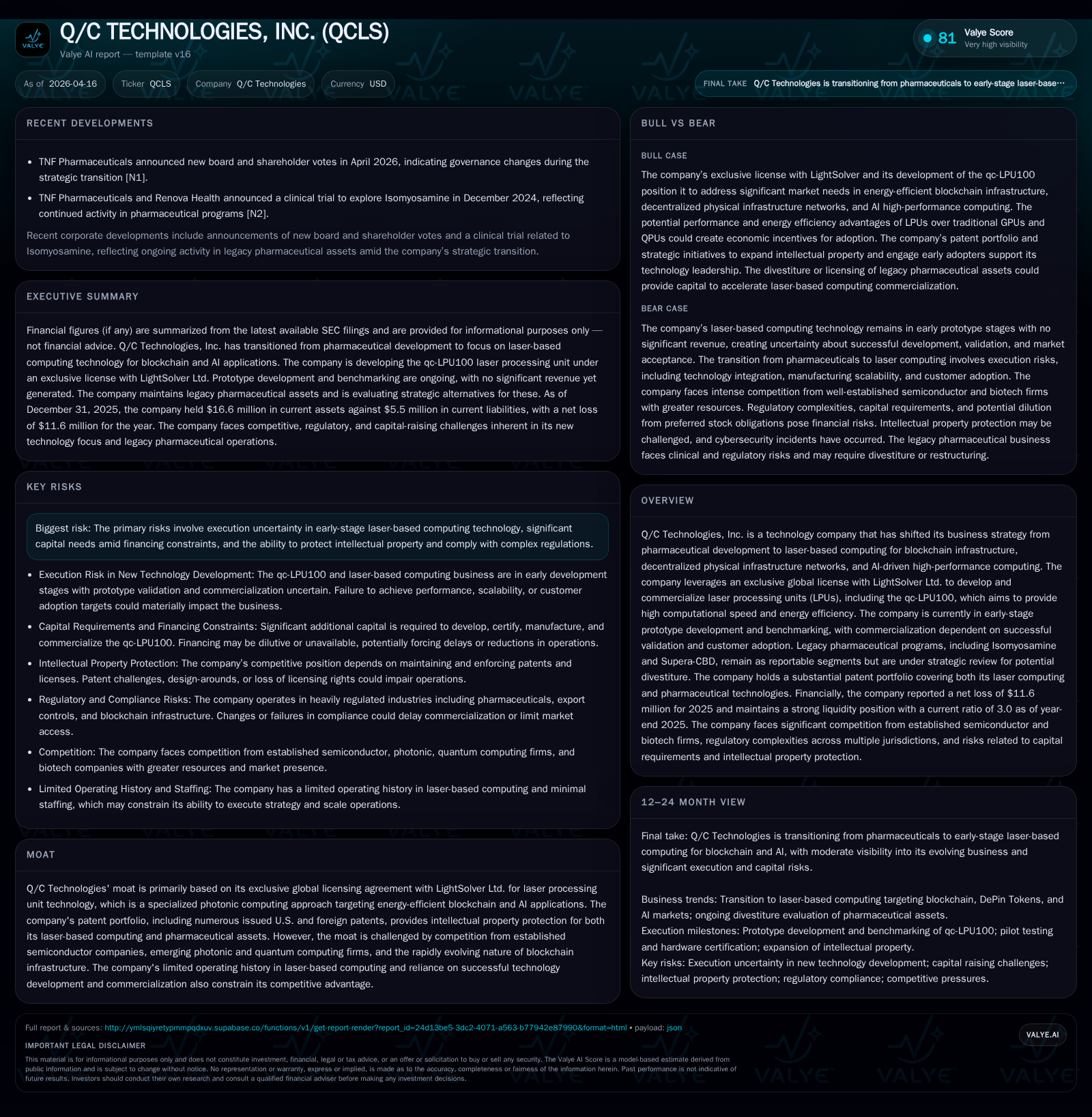
Q/C Technologies, historically a pharmaceutical company, has decisively shifted its focus to developing laser processing units (LPUs) for blockchain infrastructure and AI workloads through an exclusive license with LightSolver Ltd. This strategic pivot involves substantial R&D investment and early-stage prototype development but is accompanied by persistent operating losses and liquidity constraints. The company’s extensive patent portfolio underpins its competitive moat, yet commercialization hinges on successful technology validation, customer adoption, and additional capital raises. Legacy pharmaceutical assets remain on the books but are under strategic review for divestiture.
From Biotech Roots to Photonic Computing: A Strategic Pivot
Q/C Technologies began as a pharmaceutical developer focused on therapeutic platforms such as Isomyosamine and Supera-CBD but has undergone a pronounced strategic transformation since late 2025 [S1]. The company now centers its business model on an exclusive global license granted by LightSolver Ltd. to develop laser processing units (LPUs), launching the qc-LPU100™ as a flagship product for blockchain infrastructure and AI applications [S1]. This shift aligns with broader industry trends pushing toward energy-efficient computational technologies that address the scalability and energy cost constraints inherent in GPU-accelerated systems.
While the legacy pharmaceutical programs remain reportable segments, these are under active strategic review for divestiture to reallocate capital toward photonic computing investments [S1]. The pivot leverages quantum-class photonic processors designed to solve combinatorial optimization problems and partial differential equations critical for blockchain security enhancement and decentralized physical infrastructure (DePin) operations.
Historical Financial Performance Reflects Transition Headwinds
The company's financial trajectory underscores challenges accompanying this pivot. From FY2014 through FY2017, revenue showed volatility but trended upward—from approximately $2.11 million in FY2015 to $3.35 million in FY2017 [F1]. Recent years reflect continuation of modest revenue growth alongside significant operating losses driven largely by heavy R&D spending dedicated to laser computing development. In FY2025, revenue increased 13.3% YoY to roughly $3.35 million while operating income remained negative at about -$9.85 million [F1]. Net losses also improved relative to the prior year, at approximately -$11.6 million (compared to -$23.4 million in FY2024), indicating ongoing burn reduction efforts [F1].
Operating cash flow remains severely negative ($-9.07 million CFO in FY2025) coupled with minimal capital expenditures (~$68k historically), highlighting Q/C's emphasis on intensive research rather than fixed asset buildup [F1], [S6], [S7]. Liquidity constraints revealed in recent filings expose execution risk linked to continued financing needs each fiscal cycle [S12], [S15].
Historical performance (annual)
| FY | Net ($mm) | CFO ($mm) | OpInc ($mm) | Net YoY |
|---|---|---|---|---|
| 2025 | -12 | -9 | -10 | +50.2% |
| 2024 | -23 | -9 | -10 | -484.0% |
| 2023 | -4 | -13 | -17 | +73.7% |
| 2022 | -15 | -12 | -15 |
Source: SEC companyfacts cache [F1].
Capital returns and efficiency (annual)
| FY | ROE% |
|---|---|
| 2025 | -53.5 |
| 2024 | -238.6 |
| 2023 | -32.3 |
| 2022 | -103.4 |
Source: SEC companyfacts cache [F1].
*Capex last reported consistently circa $68k in trailing years prior to FY2025 [F1], assumed similar due to limited disclosure.
Proprietary Laser Processing Units: Technology Overview and IP Portfolio Strength
At the core of Q/C’s new focus is the qc-LPU100™, a laser processing unit utilizing photonic computing principles intended to surpass traditional electronic GPUs and emergent quantum processing units (QPUs) in speed and energy efficiency [S1], [S2]. By manipulating coherent light patterns within specialized optical circuits at room temperature housed in standard rack units, the LPU technology aims at solving complex combinatorial optimization problems essential for blockchain consensus algorithms and AI model training involving partial differential equations.
The company’s moat stems heavily from exclusivity of its global license relationship with LightSolver Ltd., granting rights that bolster defensibility amid growing photonics competition from semiconductor incumbents and quantum startups [S17], [S20]. Q/C holds a substantial intellectual property portfolio encompassing nineteen U.S. issued patents alongside seventy foreign patents across Japan, China, Israel and Canada—covering both laser computing inventions and legacy pharmaceuticals—offering multi-jurisdictional protection lasting through the late-2030s or shortly thereafter [S2]. Licensing exclusivity combined with this deep patent estate forms a barrier against direct replication of technology.
LPU’s targeted application areas include energy-intensive decentralized infrastructure computations represented by DePin tokens—an increasingly recognized niche where blockchain-secured physical assets require fast cryptographic validation—and AI inference tasks suited for high-performance distributed photonics accelerators.
Commercialization Roadmap: Prototype Validation and Market Entry Timing
As of early 2026 filings, Q/C remains engaged in early-stage prototype development focused on constructing working qc-LPU100 units suitable for internal benchmarking against GPU-based reference systems [S6]. Key next steps include pilot testing via engagements with selected blockchain infrastructure customers or AI research groups aiming to demonstrate hardware certifications compliant with FCC/UL requirements critical for data center deployment.
Beta deployments will precede initial commercial sales or leasing arrangements designed to establish recurring revenue streams—a transition from CAPEX-heavy sales models toward hybrid hardware-subscription paradigms favored within blockchain compute markets [S6]. However all commercialization activities depend heavily on successful prototype validation outcomes; uncertainties remain regarding timeline predictability given technological novelty and integration complexity within existing distributed ledger protocols.
Emerging Markets in DePin Tokens and AI High-Performance Computing
Q/C targets burgeoning vertical markets where computational efficiency directly correlates to economic viability—in particular decentralized physical infrastructure networks utilizing DePin tokens which are nascent blockchain instruments enabling monetization of shared physical assets via cryptographic proofs [S1], [S17], [S20]. High energy costs have traditionally constrained such network scaling capacity; LPUs promise drastic reductions potentially facilitating broader adoption.
Simultaneously artificial intelligence workloads requiring massive parallel matrix computations represent a complementary demand source for LPU-powered infrastructures that combine customizable optical processing with low latency interconnects essential for large-scale model training or real-time inference across distributed nodes.
This dual-market approach positions Q/C at the confluence of two high-growth yet technically demanding sectors where incumbent GPU ecosystems struggle against energy cost inflation.
Risks of Execution, Capital Needs, and Competitive Dynamics
The company explicitly acknowledges multiple material risks affecting its prospects: primary among them is execution risk related to the early-stage nature of its laser-based computing technology accompanied by significant capital requirements that have been constrained by restrictive Series H preferred stock purchase agreements limiting financing flexibility [S4], [S12], [S15], [S24].
Protection of IP rights remains a key vulnerability given potential third-party patent challenges common in photonics ventures combined with risks that competitors achieve disruptive breakthroughs before Q/C completes commercialization milestones [S4], [S9], [S19]. Moreover the concentrated insider ownership structure may impede agile strategic decision-making during turbulent phases requiring fast adaptation.
Blockchain market volatility—particularly fluctuations in cryptocurrency valuations—adds a market adoption uncertainty layer since this directly influences customer willingness to invest in novel hardware solutions designed specifically for crypto mining or decentralized services.
Legacy pharmaceutical segments continue incurring regulatory compliance costs amid uncertain divestiture timing or valuations due to competitive drug markets governed by complex FDA approvals—though these are secondary relative to LPU business priority currently [S4], [S21].
Capital Allocation Snapshot: Investment Trends and Return Metrics
Q/C's capital allocation overwhelmingly favors R&D investments relevant to LPU technology development rather than physical plant or machinery expansions; capex annually has been modest (~$68k), reflecting emphasis on design/build/testing stages instead of mass production lines currently absent from disclosure [F1],[S6],[S7]. Operating losses have persisted above $9 million per annum recently despite incremental revenue growth reflective of no meaningful commercial sales yet realized.
Equity grew significantly from roughly $9.79 million at FY2024 year-end to about $21.75 million by end-FY2025 primarily from private placements aimed at extending operational runway amidst persistent cash burn challenges highlighted by negative free cash flow estimated at approximately $-9.13 million (CFO minus capex) in 2025 alone [F1],[S18].
Return metrics depict sustained negative outcomes; calculated approximate ROE stands near minus fifty-three percent (-53%) indicating no profitability expected until substantial commercial traction occurs or costs materially decline through scale economies or process improvements.[F1]
Dividends or share repurchases remain absent consistent with typical early-stage technology firms prioritizing reinvestment over shareholder distributions amid cash constraints.[S18]
Outlook Summary and Key Catalysts to Monitor
While Q/C has not issued discrete forward revenue guidance or precise timelines for mass production commencement owing to prototype validation dependencies,[N1],[S6] several pivotal catalysts can frame near-term investor watchlists:
- Successful benchmarking results affirming superior speed/efficiency versus established GPU architectures,
- Progression into formal pilot projects securing endorsements from blockchain infrastructure clients or AI research entities,
- Achievement of regulatory/hardware certifications expanding total addressable markets domestically and internationally,
- Potential strategic moves concerning legacy pharmaceutical asset divestitures freeing capital flow,
- Additional equity raises navigating restrictive covenants contained within Series H/G preferred stock frameworks.
Given the volatile macro backdrop affecting crypto markets combined with rapid technical evolution paths competing players pursue in photonics and quantum computation realms,[S17],[S20] disciplined monitoring of execution progress versus stated milestones will be crucial for assessing sustainable value creation potential. The company remains a classic example of high-risk/high-reward early-stage deep technology innovation grappling with traditional financial discipline constraints.
This analysis is based solely on publicly available data up to April 16th, 2026 including SEC filings ([F1],[S#]) and recent news releases ([N#]); it is intended as an informational overview without investment recommendations or price predictions.
Disclaimer: This is research-only, informational analysis and not investment advice. It may include AI-generated interpretation and general industry context. Always verify important details using primary sources.

Comments