
Texas Ventures Acquisition III Corp’s Financial Foundation and Outlook Ahead of Initial Business Combination
A detailed review of TVA’s capital structure, financial position, management approach, and regulatory landscape as it prepares to complete its initial merger.
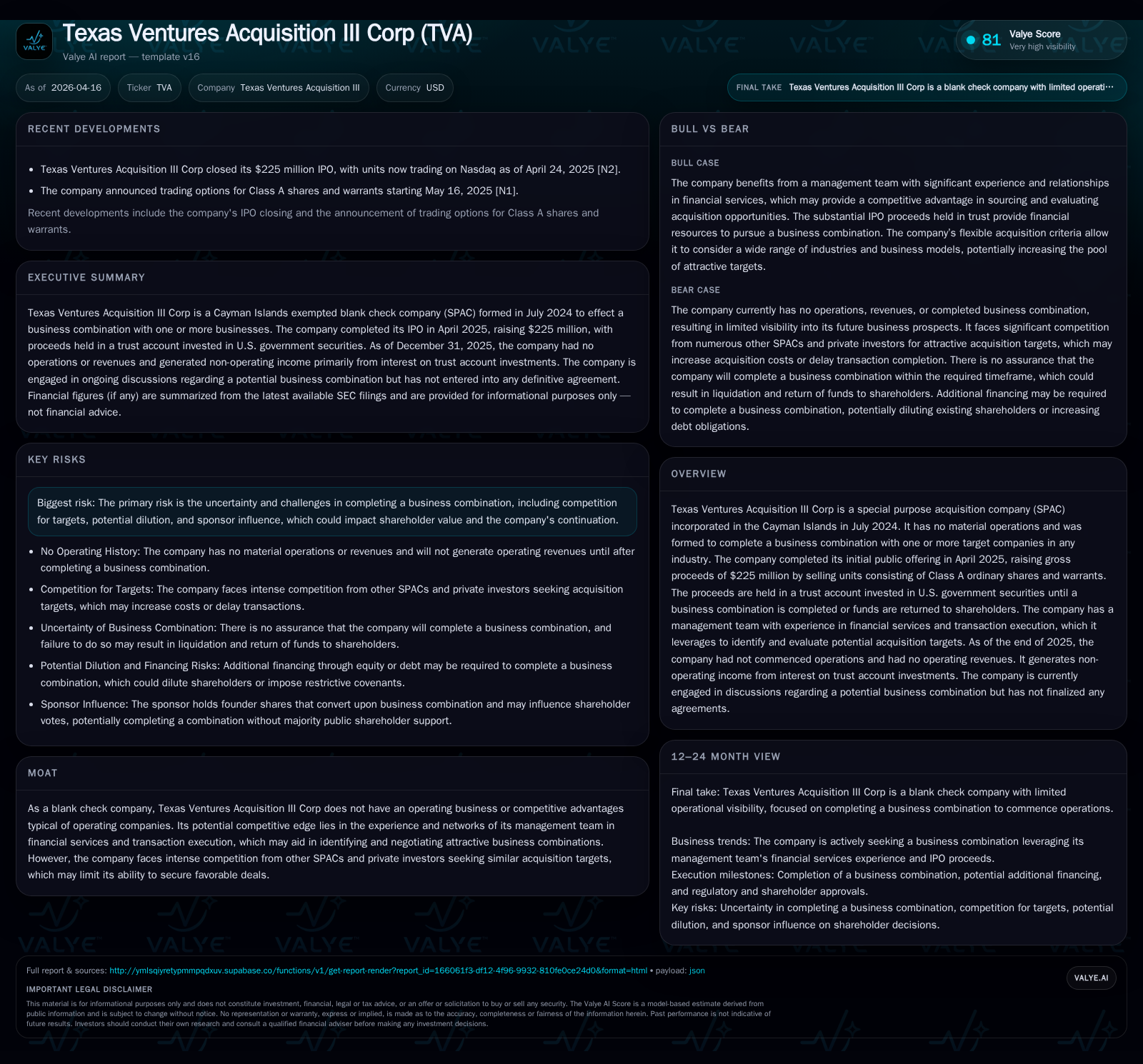
Texas Ventures Acquisition III Corp (TVA) is a Cayman Islands-based blank check company that raised $225 million in its April 2025 IPO, holding these proceeds in a secure trust account earning non-operating interest income. With no operating revenues yet, TVA’s financial profile centers on preserving capital for a future business combination anticipated within Nasdaq’s 36-month deadline. Management brings transaction execution expertise and pursues acquisitions across industries, navigating competitive pressures and shareholder redemption dynamics. Ongoing monitoring of capital allocation, sponsor arrangements, and regulatory compliance will be crucial to assessing TVA’s ability to realize value through its inaugural merger.
Historical Financial Position and Capital Preservation
Texas Ventures Acquisition III Corp (TVA) was incorporated on July 26, 2024, as a Cayman Islands exempted company formed solely as a blank check vehicle to effect one or more initial business combinations. The company completed its initial public offering (IPO) on April 24, 2025, raising gross proceeds of $225 million by selling 22.5 million units at $10 each. Each unit consists of one Class A ordinary share and one-half redeemable warrant [S1], [F1].
Following the IPO, the proceeds were placed into a U.S.-based trust account invested primarily in U.S. Treasury securities. As of December 31, 2025, investments held in the trust account stood at approximately $232.5 million with additional cash and prepaid expenses outside the trust totaling close to $0.96 million [S1], [S10], [F1]. This robust liquidity underpins the company’s financial foundation before completing a business combination.
Since inception through December 31, 2025, TVA has not commenced operations nor generated operating revenues. Its income derives exclusively from interest earned on trust account investments amounting to approximately $6.3 million during fiscal year 2025 [S1]. General and administrative expenses of roughly $0.7 million reflect costs related to organizational setup and IPO activities [S1]. The net loss predominantly stems from these pre-operational expenses.
The balance sheet shows current assets of approximately $958,631 against current liabilities near $233,852 resulting in a strong current ratio above 4:1 by year-end 2025 — indicating solid short-term financial flexibility prior to transaction execution [F1].
Historical performance (annual)
| FY |
|---|
| 2025 |
Source: SEC companyfacts cache [F1].
The table summarizes TVA's capital base secured by trust investments alongside operational cost structure prior to revenue generation.
Management Expertise and Strategic Focus
TVA’s leadership team brings experience in financial services and transaction execution with an unrestricted industry focus for target acquisitions [S1]. This broad mandate allows pursuit of diverse sectors in identifying attractive business combination candidates.
Management leverages sponsor networks for deal sourcing amid intense competition from other SPACs and private equity players targeting high-quality opportunities [S9]. The company may also utilize private investment in public equity (PIPE) transactions concurrent with business combination closings to augment available capital if required [S5], [S26]. Sponsor influence is significant given founder shares convertible post-merger and potential working capital loans extended pre-closing [S1], [S12].
Capital Structure and Liquidity Position
The IPO structure includes public Class A shares sold as units paired with redeemable warrants exercisable at $11.50 per share starting thirty days after business combination closing with five-year expiry [S1], [S3]. Founder shares totaling about 7.7 million Class B shares were issued pre-IPO at nominal cost; these convert one-for-one upon merger consummation subject to standard adjustments [S1].
All gross IPO proceeds are irrevocably held in a segregated Trust Account primarily invested in low-risk government securities earning modest yields until released for transaction purposes upon closing a business combination [S1], [S10]. Working capital outside this trust funds ongoing expenses.
Sponsor or affiliates may provide non-interest bearing working capital loans to cover transaction-related costs pre-merger; none were outstanding as of December 31, 2025 [S6], [S12]. Deferred underwriting commissions up to approximately $9 million will be payable from remaining Trust funds after shareholder redemptions upon deal completion [S8], [S10].
Currently, TVA has no long-term debt or restrictive covenants encumbering its balance sheet [S13].
Regulatory Timeline and Deal Completion Mandate
Nasdaq rules require SPACs like TVA to complete an initial business combination within thirty-six months following IPO or face trading suspension and delisting unless shareholders approve an extension via amendment procedures involving redemption rights exercises [S1].
TVA remains within this timeframe with an April 2028 deadline based on its April 2025 IPO date [S1]. Extensions require shareholder approval accompanied by redemption rights affecting available transaction capital.
Risks: Competition, Dilution, and Sponsor Governance Influence
Key risks include challenges acquiring suitable targets amid intense competition from other SPACs and private investors pursuing similar assets within constrained timelines [S9]. Valuation pressures may increase due to multiple bidders.
Dilution risks arise primarily from shareholder redemptions exercised upon vote approval combined with potential PIPE financings conducted concurrently with deal closings at prices potentially below market levels diluting existing interests [S5], [S26].
Sponsor influence through founder shares conversion plus voting control prior to deal completion poses governance considerations requiring transparent disclosure in proxy materials so minority holders’ interests are protected [S1], [S9].
Capital Allocation: Trust Fund Integrity and Absence of Distributions
All investor funds remain secured in the independent Trust Account earning federally backed interest until released for approved transactions or liquidations[S8], [F1]. This preserves principal alongside modest income generation.
No dividends or share repurchase programs exist given absence of operating cash flows; distributions occur only via permitted redemptions upon shareholder approvals related to business combinations[S15], [S19].
Redemption proceeds are paid pro rata from Trust funds less deferred underwriting fees; excess cash available post-redemption depends heavily on shareholder voting outcomes[S23],[S19]. Sponsor has waived redemption rights on founder shares aligning some incentives but PIPE-related dilution remains plausible.[S21]
Key Metrics for Monitoring Progress Toward Business Combination
Investors should track:
- Redemption Rates: Impact available transaction cash inflows directly affecting financing needs.
- Warrant Exercise Activity: Timing affects potential post-combination liquidity.
- Shareholder Voting Outcomes: Reflect market confidence toward proposed deals or extensions.
- Compliance with Nasdaq Listing Rules: Essential for maintaining trading status avoiding forced liquidation.
- Sponsor Actions: Changes in management or lending arrangements signal execution outlook.[S3],[S1],[S12]
These metrics provide insight into TVA’s trajectory transitioning from a blank check entity toward an operating company generating sustainable returns post-merger.
This analysis is based exclusively on publicly filed SEC documents without extrapolation beyond reported facts or speculative forecasts unrelated to explicitly stated company disclosures. Texas Ventures Acquisition III Corp exemplifies a financially secure SPAC focused on preserving investor capital ahead of completing its inaugural acquisition amid competitive industry dynamics.
Disclaimer: This is research-only, informational analysis and not investment advice. It may include AI-generated interpretation and general industry context. Always verify important details using primary sources.

Comments