
BRB Foods Faces Revenue Void as Key Unilever Licenses Expire, Challenging Operational Viability
BRB Foods has suspended commercial operations following expiration of major brand licenses, raising significant questions about its growth trajectory and financial stability.
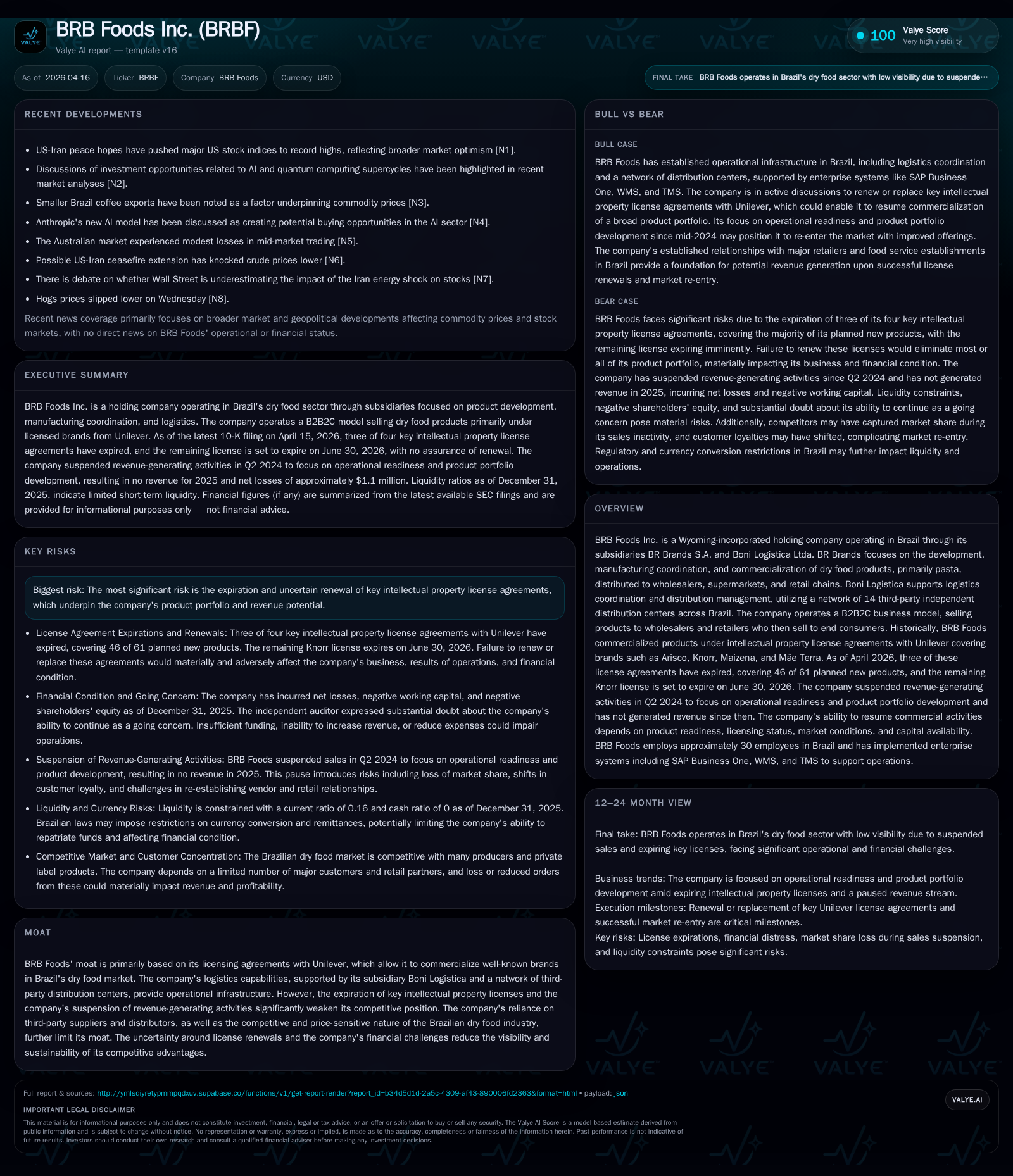
BRB Foods Inc., a holding company operating in Brazil through subsidiaries BR Brands and Boni Logistica, historically relied on licensing agreements with Unilever to market well-known dry food brands. As of early 2026, three of its four critical licensing agreements have expired, effectively halting the commercialization of the majority of its product portfolio. This led to a voluntary suspension of revenue-generating activities since mid-2024, resulting in zero revenue reported for 2025 alongside sustained operating losses and negative working capital. While discussions remain ongoing for license renewals, none are finalized, casting doubt on BRB Foods’ near-term ability to restore operations or revenues. The company’s substantial dependence on third-party suppliers, distributors, and a competitive Brazilian dry food market further constrains its strategic flexibility.
Company Overview
BRB Foods Inc. is a Wyoming-incorporated holding entity conducting business primarily in Brazil through its two key subsidiaries: BR Brands S.A., focused on the development and commercialization of dry food products such as pasta distributed mainly through wholesalers and retail chains; and Boni Logistica Ltda., which provides logistics coordination leveraging a network of fourteen third-party distribution centers across Brazil [S5][S24]. The company's business model follows a B2B2C approach whereby it sells products to intermediaries who then target end consumers.
Historically, BRB Foods commercialized its products under several licensing agreements with Unilever entities allowing use of brands including Arisco, Knorr, Maizena, and Mãe Terra—well-established names in Brazil's dry food segment [S5][S24]. These alliances formed the backbone of BRBF’s product portfolio and market presence.
Historical Performance and Operational Pause
From inception until early 2024, the company's operations involved launching new dry food products developed through these licenses. However, beginning Q2 2024, BRBF made a strategic decision to temporarily suspend all revenue-generating activities to prioritize operational readiness and expansion of its product portfolio [S1][S5][S14]. The suspension coincided with ongoing challenges related to renewing critical licensing agreements.
This impacted reported financial results markedly. The company generated minimal net revenues approximating $40,000 in 2024 but recorded nil revenue for the full year ending December 31, 2025. Operating losses persisted—$739,236 operating loss recorded in 2025—and net losses totaled $1.09 million during the same period [F1]. This reflects losses sustained amid inactivity in sales alongside ongoing overhead costs.
Historical performance (annual)
| FY |
|---|
| 2025 |
Source: SEC companyfacts cache [F1].
Operating income and net income figures indicate substantial operating deficits persisting during inactive revenue periods.
Licensing Agreements as Core Growth Constraint
The company’s ability to generate revenue depends heavily on intellectual property license agreements with Unilever Brasil Ltda., Unilever IP Holdings B.V., Mãe Terra Produtos Naturais Ltda., and Conopco d/b/a Unilever [S1][S5][S24]. These allow BRBF commercial rights over household brands critical for market penetration.
However by April 2026, three out of four principal licenses expired: Arisco (covering eleven products) expired December 1, 2025; Maizena (five products) expired February 28, 2026; Mãe Terra (27 products) expired March 1, 2026 [S1][S14]. Collectively these accounted for approximately 46 of the company's planned expanding portfolio of sixty-one new products anticipated for rollout in fiscal year 2026. Only the Knorr brand license remains active until June 30, 2026 covering fifteen specified products.
Despite ongoing negotiations with Unilever groups over renewal terms for all licenses including Knorr [S1], no agreements are finalized yet. Failure to renew any licenses would eliminate these branded offerings from its catalog and effectively preclude further product sales under those brand names leading to severe downsizing or discontinuance [S1][S14].
Supply Chain Infrastructure and Logistics
While commercial activity scaled down starting mid-2024 due to licensing uncertainties, BRB Foods maintained investment in logistics infrastructure through Boni Logistica Ltda., which coordinates distribution using a network of fourteen third-party independent distribution centers across Brazil [S5][S24].
Technical and commercial qualifications for third-party logistics partners were completed by end-2023 along with supplier integration initiatives. The company implemented enterprise-wide management systems such as SAP Business One plus warehouse/transport management tools (WMS/TMS), aiming to support efficient future supply chain execution [S5][S21]. These initiatives position it technically for prompt scale-up once licensing matters are resolved.
Competitive Environment and Market Risks
The Brazilian dry food industry comprises a competitive mix dominated by both large multinational manufacturers and regional players offering branded as well as private-label goods competing on price sensitivity typical within staple food categories like rice, beans, corn and pasta [S25]. The exit or inactivity by BRBF during this licensure gap creates opportunities for competitors to capture shelf space and consumer mindshare.
Moreover, BRB Foods relies heavily on third-party suppliers for raw materials under short-term contracts or spot purchases—rendering procurement susceptible to price fluctuations or supply disruptions that may affect margins [S26]. Dependence on major retail partners without formal binding purchase agreements increases vulnerability to ordering pattern shifts or partner consolidation effects that could tighten bargaining leverage against BRBF [S11].
The failure or delay to renew licenses not only reduces product offerings but also amplifies risks related to losing retail shelf access versus better-positioned rivals that maintain steady supply lines under proprietary branding [S25].
Financial Position and Capital Allocation
With no revenue generated since Q2-2024 but continued investments into operational readiness plus fixed logistical expenses incurred through subsidiaries like Boni Logistica Ltda., the firm's liquidity has deteriorated substantially.
As at December 31, 2025 BRBF reported negative working capital approximating $7.38 million ($1.402 million current assets vs $8.78 million current liabilities), highlighting significant short-term liquidity constraints capable of restricting operational flexibility absent external capital infusions or improved cash generation capability [F1][S17].
Independent auditors have highlighted substantial doubt about BRB Foods’ ability to continue as a going concern given cumulative losses ($8.2 million deficit) and negative shareholder equity ($6.8 million) as at end-2025 [F1][S17].
Cash flows from operations have been negative reflecting absence of revenues while core costs persist; no dividends or share buybacks have been declared preceding or during this inactive period [F1].
Outlook: What To Watch
The restoration of commercial operations hinges critically upon:
- Successfully renewing all vital Unilever licensing agreements including Knorr before expiration mid-2026;
- Maintaining supplier relationships ensuring timely ingredient procurement at acceptable cost;
- Rebuilding sales volumes via effective re-engagement with retail chains amid competitive pressures;
- Securing adequate capital either from equity or debt markets given current deficit liquidity status.
Absent license renewals or alternative branding arrangements aligned timely with market expectations, the prospect for meaningful revenue recovery remains doubtful given heavy dependence on licensed intellectual properties that underpin established brand equity.
Management’s efforts will likely continue focusing on cost containment, infrastructure readiness, and negotiating favorable license terms though uncertainty prevails regarding timeline viability based on public disclosures.
Legal Landscape and Risk Factors
Currently no material lawsuits threaten operational continuity though exposure exists concerning labor claims totaling under ~$16k USD as disclosed without comprehensive insurance coverage against product liability lawsuits that could adversely impact reputation if realized [S3][S13]. Legal complexities arising from labor laws prevailing within Brazil require continuing risk mitigation initiatives. Additionally regulatory scrutiny including competition law investigations or potential changes in taxation schemes could impose further operational strains [S16][S27].
Summary Assessment
BRB Foods Inc.’s reliance on licensed consumption brands provided by Unilever was strategically sound when active but now marks a double-edged sword exposing it to deep commercial disruption following failure so far to renew three major licenses expiring late-2025/early-2026 affecting most active products offered. Suspension of sales since mid-2024 precipitated near-zero revenues with ongoing operating losses raising fundamental concerns about short-term viability unless licensing resolutions materialize imminently. Significant investments have equipped it with modernized logistic capabilities potentially primed for relaunch. Nevertheless heightened competition from peers capturing abandoned shelf space alongside intrinsic risks from supply reliance, and constrained liquidity complicate an already precarious situation. Continued monitoring of licensing developments comprises an essential catalyst for any turnaround prospects. Absent which the firm's growth prospects appear highly constrained by structural dependencies within Brazil's intensely competitive dry foods industry.
This analysis synthesizes publicly available regulatory filings up to April 15th, 2026 including annual reports (10-K), quarterly updates (10-Q), but does not constitute investment advice.
Disclaimer: This is research-only, informational analysis and not investment advice. It may include AI-generated interpretation and general industry context. Always verify important details using primary sources.

Comments