
Abpro Holdings Revitalizes Biotech Pipeline With TetraBi Antibody Advances
Abpro leverages its proprietary antibody platforms to pursue novel therapies in oncology and ophthalmology amid capital and regulatory challenges.
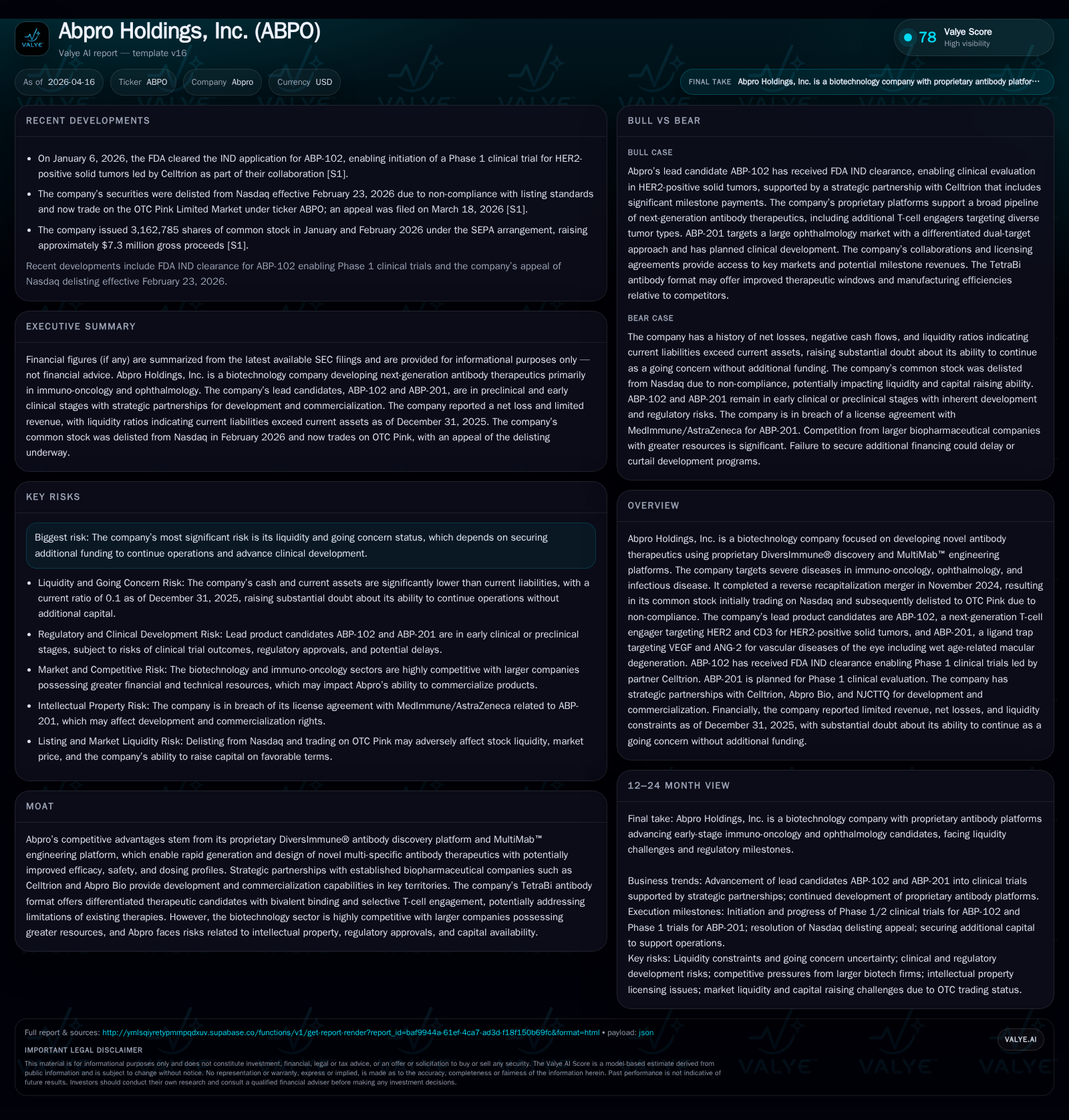
Abpro Holdings, Inc. employs its innovative DiversImmune® discovery and MultiMab™ engineering platforms to advance a novel tetravalent antibody format with lead candidates targeting HER2-positive solid tumors and vascular eye diseases. While the company has achieved pivotal clinical milestones such as FDA IND clearance for ABP-102’s Phase 1 trials and is progressing ABP-201 toward clinical evaluation, it faces severe liquidity constraints and recent delisting from Nasdaq. The reverse recapitalization merger in late 2024 raised initial capital but did not resolve funding challenges, resulting in sustained operating losses and a critically low current ratio of approximately 0.1. Future growth hinges on successful clinical development and capital raises, but external regulatory, competitive, and macroeconomic pressures contribute to a precarious near-term outlook.
Transforming Therapeutics: Abpro’s Proprietary Antibody Platforms
Abpro Holdings positions itself as a next-generation antibody therapeutics developer using its proprietary DiversImmune® antibody discovery platform coupled with the MultiMab™ engineering platform [S1]. These technologies underpin its TetraBi antibody format—a tetravalent configuration combining bi-specific targeting with bivalent binding sites arranged for enhanced selectivity and potency against disease-relevant antigens. This advanced format differentiates Abpro’s approach by enabling simultaneous engagement of two distinct targets with improved safety and dosing potential.
The company's lead molecules illustrate this platform's promise: ABP-102 is a T-cell engager dual-targeting HER2 (over-expressed in certain solid tumors) and CD3 (a critical T-cell receptor component), constituting an immuno-oncology asset designed to direct cytotoxic T-cells selectively to HER2-positive tumor cells. The recent FDA Investigational New Drug (IND) clearance enables Phase 1 clinical trial initiation led by strategic partner Celltrion, leveraging their established global development capabilities [S1].
In parallel, ABP-201 targets ophthalmologic vascular conditions through a ligand trap mechanism addressing both VEGF and ANG-2 pathways implicated in wet age-related macular degeneration (AMD) and similar conditions. This dual blockade strategy aligns with emerging therapeutic modalities seeking to reduce treatment burden by improving efficacy compared to anti-VEGF monotherapies currently standard of care.
Collectively, these efforts epitomize Abpro's bid to transcend traditional monospecific antibodies via tetravalent, multi-targeted therapeutics aimed at high unmet medical needs in immuno-oncology and ophthalmology.
Financial Performance and Operational Trends from 2022 to 2025
The company’s financial trajectory confirms the capital-intensive nature of biotech R&D focused on early-stage clinical development. A summary view of key financial results based on SEC filings and companyfacts data [F1] is provided below:
Historical performance (annual)
| FY | Net ($mm) | CFO ($mm) | OpInc ($mm) | Net YoY |
|---|---|---|---|---|
| 2025 | -6 | -8 | ||
| 2024 | -9 | -10 | ||
| 2023 | 3 | -4 | -2 | +218.1% |
| 2022 | 1 | -1 | -2 |
Source: SEC companyfacts cache [F1].
Capital returns and efficiency (annual)
| FY | ROE% |
|---|---|
| 2025 | |
| 2024 | |
| 2023 | -17.8 |
| 2022 | -7.9 |
Source: SEC companyfacts cache [F1].
Revenues remain limited (<$0.2 million in FY2024), reflecting the pre-commercial stage status typical of companies focused on pipeline advancement rather than sales. Operating losses expanded significantly after the reverse recapitalization merger reflecting increased G&A costs consistent with public company expenses plus ongoing R&D investment [S14]. Despite cost control efforts such as furloughs and termination of research personnel reducing R&D expense in late 2025 [S14], operating losses remain substantial.
Liquidity woes are highlighted by cash reserves collapsing below $100 thousand by end-2025 from ~$3 million one year earlier [F1], coupled with current liabilities surpassing $9 million against less than $0.9 million in current assets—yielding an alarming current ratio near 0.1 indicative of material going concern risks [F1][S5]. Equity deficits narrowed but persist deeply negative (-$8.83 million at FY2025) despite capital injections associated with the merger [F1].
Clinical Pipeline Progress and Strategic Collaborations
Clinical progression centers on ABP-102’s transition into Phase 1 human trials following IND clearance—the critical milestone validating preclinical safety enabling first-in-human dosing under FDA oversight [S1]. This Phase 1 study execution is led by Celltrion under collaboration terms that exploit their clinical development expertise especially across Asia-Pacific markets.
ABP-201 is positioned for imminent Phase 1 initiation targeting retinal vascular disorders utilizing Abpro’s TetraBi ligand trap architecture combining VEGF/ANG-2 inhibition—a strategy gaining traction as some AMD patients exhibit incomplete responses to conventional anti-VEGF alone [S1].
Partnerships such as the arrangement with Celltrion provide essential operational leverage needed for early clinical development resource efficiency while potentially serving as a foundation for regional or global commercialization avenues if clinical success ensues.
Regulatory Milestones and Market Listing Challenges
The November 13, 2024 reverse recapitalization merger consummated via Atlantic Coastal Acquisition Corp II transitioned the private entity into publicly traded status with Nasdaq Global Market listing commencing November 14, 2024 [S1]. This transaction included concurrent PIPE financing raising approximately $11.2 million gross proceeds intended to support operational expansion.
However, continuing non-compliance with Nasdaq listing standards led to delisting notifications effective February 23, 2026 [S3][S15]. The Company promptly appealed the Panel’s determination March 18, 2026 but currently trades on the OTC Pink Limited Market under ticker "ABPO" [S1][S15].
This regulatory setback impacts investor access liquidity adversely while complicating future capital raises necessitated by clinical program needs amidst fragile cash positions.
Capital Structure, Liquidity Crisis, and Funding Imperatives
Post-merger funding sources comprise issuance of convertible notes totaling several million dollars alongside related-party promissory notes accruing interest rates between five to seven percent annually [S5][S25]. These instruments coexist with legacy liabilities including accrued settlements for legal claims ($390K settlement pending payment) and licensing obligations exceeding $1 million still under negotiation [S22][S24].
Operating cash burn remains elevated at over $6 million p.a., although down from previous periods due mainly to scaling back R&D personnel post-Q3/2024 furloughs and terminations [S14]. Capital injections from equity sales through SEPA-approved Advance Notices provided intermittent relief yet cash balances dwindled resulting in perilous near-term solvency concerns requiring swift additional financing or collaborations [S10][S26].
The October 31, 2025 one-for-thirty reverse stock split was implemented partly as a remedial action to enhance per-share price metrics post-Nasdaq delisting risks but provides no direct cash infusion [S6][S20]. Management has articulated intentions to seek new capital via equity or debt issuances alongside collaboration agreements but acknowledges no certainty regarding timing or terms [S26].
Future Growth Catalysts and Potential Headwinds
Key growth drivers hinge fundamentally on proof-of-concept signals from ongoing Phase 1 trials of ABP-102 followed by forward momentum through registrational studies if warranted. Parallel progress on ABP-201 adds diversification into ophthalmology markets potentially accelerating commercial timelines contingent on safety/efficacy data [N/A][S1].
Strategic partnerships exploiting global biologics development infrastructure—e.g., Celltrion—are critical enablers for advancing pipeline assets beyond early stages amid limited internal resources.
Conversely risks include intensified competition within multi-specific antibody domains dominated by large pharma incumbents capable of rapid innovation cycles; stringent regulatory environments extending approval timelines globally; pricing pressures under evolving reimbursement frameworks; and macroeconomic uncertainties affecting cross-border operations given geopolitical tensions outlined by management including U.S.-China relations impact on supply chains [S4][S19].
Further headwinds stem from operational risks highlighted by precarious liquidity threatening program continuity absent successful fundraising; legal contingencies diverting attention; and constraints imposed by OTC Pink trading impairing investor confidence.
Investor Returns, Capital Allocation Policies, and Valuation Metrics
As an early-stage clinical biotech without product revenues generating losses consistently over multiple years including FY2025 operating loss near $8.45 million despite moderate improvement (~15% better than FY2024), Abpro’s current return metrics reflect negative equity returns (approximate ROE around -32%) linked primarily to sizable accumulated deficits compounded by dilutionary financings [F1].
No dividends or share repurchase programs are in place given pressing liquidity constraints accentuated post-merger delisting event [S6]. The reverse stock split adjusted share counts downward significantly aiming at restoring basic trading functionality though does not alter fundamental valuation parameters intrinsically tied to binary clinical outcomes.
Given prevailing OTC Pink status alongside highly constrained cash runway necessitating urgent capital raises or milestone monetizations within twelve months to ensure continued operations there remains considerable valuation uncertainty best reflected via cautious market perceptions rather than traditional earnings-based measures.
Disclaimer: This report is for informational purposes only. It does not constitute investment advice or recommendations regarding the purchase or sale of securities issued by Abpro Holdings or any other entity. The analysis presented relies solely on disclosed data without speculative projections beyond available evidence.
Disclaimer: This is research-only, informational analysis and not investment advice. It may include AI-generated interpretation and general industry context. Always verify important details using primary sources.

Comments