
RemSleep Holdings Faces Commercial Scaling and Liquidity Challenges After Founder’s Passing
The company is transitioning leadership and commercial strategy following its first FDA clearances amidst steep revenue declines and persistent losses.
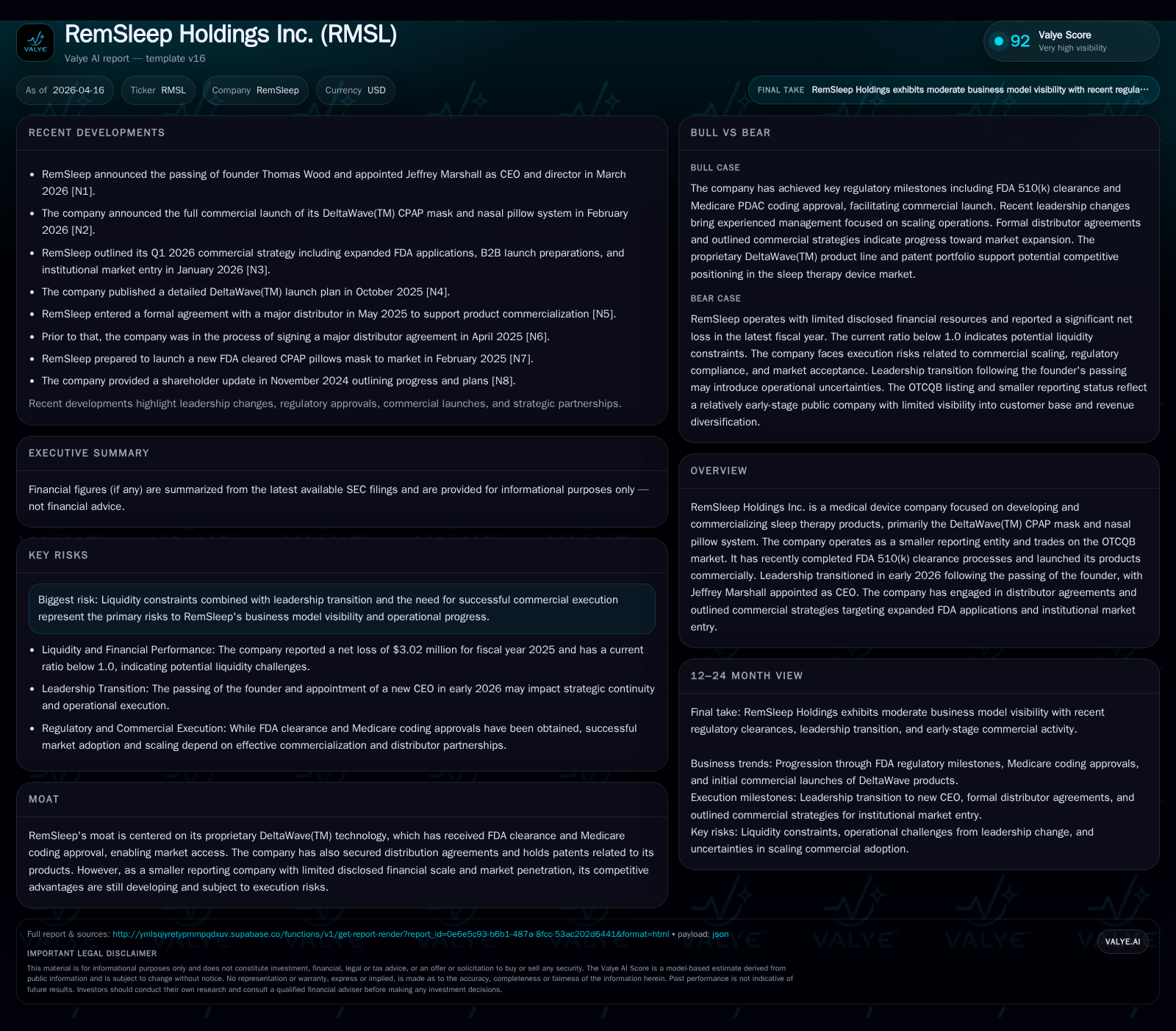
RemSleep Holdings Inc. develops the DeltaWave CPAP mask system, a niche device with FDA clearance that recently began commercial sales. Following founder Thomas Wood’s death in early 2026, new leadership has stepped in to guide the company through initial commercialization challenges. The company has seen a sharp decline in revenue over the last fiscal year despite earlier higher sales, while operating losses have widened substantially. Liquidity remains constrained with a sub-1 current ratio and ongoing negative cash flow from operations. Going forward, success hinges on expanding market reach through new FDA applications, distributor partnerships, and institutional accounts under the new CEO’s commercial strategy.
Company Overview
RemSleep Holdings Inc. operates as a smaller reporting company engaged in medical device development for sleep therapy. Its flagship product is the DeltaWave™ CPAP mask and nasal pillow system, which received FDA 510(k) clearance after an extended regulatory process led by founder Thomas Wood. The company subsequently launched its products commercially but remains at an early stage of revenue generation and market penetration [S1][N1].
Historical Performance
The company’s financial history reflects an early-stage commercial transition marked by significant recurring losses amid investment in product development, regulatory approval, and initial market entry. Revenue declined sharply from $320.7K in FY2022 to $16.7K in FY2025, an 85.7% decrease year-over-year [F1]. This contraction coincides with shifts from development contracts or initial shipments toward nascent commercial sales.
Operating income deteriorated notably to a negative $2.77 million in FY2025 from smaller losses previously, indicating increased fixed costs amid low sales volume [F1]. Net losses followed this trajectory, reaching just over $3 million most recently.
Operating cash flow remained negative but improved modestly by approximately 26% year-over-year to about -$503K, signaling ongoing cash burn albeit with some operational tightening [F1]. Capital expenditures have held steady near $125K annually as commercialization infrastructure stabilizes.
Historical performance (annual)
| FY | Rev ($) | Net ($mm) | CFO ($mm) | OpInc ($mm) | Rev YoY | Net YoY |
|---|---|---|---|---|---|---|
| 2025 | 16721 | -3 | -1 | -3 | -85.7% | -180.2% |
| 2024 | 117185 | -1 | -1 | -1 | -42.5% | +39.4% |
| 2023 | 203718 | -2 | -1 | -2 | -36.5% | -19.6% |
| 2022 | 320719 | -1 | -2 | -1 |
Source: SEC companyfacts cache [F1].
Capital returns and efficiency (annual)
| FY | FCF ($mm) | ROE% |
|---|---|---|
| 2025 | -1 | -9420.2 |
| 2024 | -1 | -320.2 |
| 2023 | -1 | -191.0 |
| 2022 | -2 | -54.9 |
Source: SEC companyfacts cache [F1].
RemSleep's revenue collapsed sharply during its transition to commercial sales post-FDA clearance while operating losses widened due to scaling fixed costs.
Leadership Transition
On February 26, 2026, founder Thomas Wood passed away shortly after the company's FDA clearance and product launch [N1][S3][S13]. Wood was instrumental in developing the DeltaWave technology and guiding it through regulatory approval.
Following this event, the Board was reconstituted: Anita Michaels became Chairman leveraging her healthcare background and majority inherited ownership; Jeffrey Marshall was appointed CEO bringing marketing and business development expertise; Alexander Johnson joined as Director providing capital markets advisory experience [S11][S12][S14]. This leadership team aims to maintain continuity while scaling the company amid challenging financial conditions.
Market Position
RemSleep's proprietary DeltaWave technology benefits from FDA clearance and Medicare coding approval supporting reimbursement pathways critical for institutional adoption . However, market penetration remains at an early stage with limited disclosed sales data. The competitive landscape includes established players offering diverse CPAP solutions bundled with hardware or services.
Financial Health and Capital Allocation
As of fiscal year-end 2025, RemSleep held $214K in cash against current liabilities of approximately $300K resulting in a current ratio of 0.89—indicating near-term liquidity pressure [F1]. Equity declined sharply to about $32K from prior highs exceeding $900K.
The company has not declared dividends or initiated share repurchases; capital allocation focuses on sustaining operations through commercialization efforts and regulatory milestones rather than returning capital to shareholders [S13]. Negative free cash flow—operating cash flow less capital expenditures—was approximately $628K last fiscal year reflecting ongoing investment alongside slow revenue ramp [F1].
Growth Outlook
Management highlights growth ambitions centered on broadening FDA-clearance-based product indications, leveraging Medicare coding for reimbursement expansion, establishing distributorship networks for broader channel access, and pursuing institutional markets such as hospitals or sleep clinics [N1]. Successful execution of these strategies under new leadership is critical given constrained financial resources.
Key Risks
Liquidity constraints pose fundamental risks given limited current assets relative to liabilities coupled with sustained negative operating cash flows [F1]. Execution risk arises from leadership changes following the founder’s passing which may affect commercial momentum or stakeholder confidence.
Limited historical market adoption adds uncertainty around future revenue scalability despite regulatory progress. No material litigation or contingent claims are currently reported [S4], mitigating certain legal risks.
What to Watch
In the absence of detailed management guidance beyond milestone-based equity incentives [S12], investors should monitor:
- Quarterly revenue trends reflecting actual DeltaWave product uptake.
- Operating expense trends relative to sales efficiency improvements.
- Progress on distributor agreements or institutional channel partnerships.
- Changes in liquidity including potential equity raises or debt financing needs.
- Regulatory filings expanding FDA indications enhancing addressable markets.
- Leadership communications clarifying strategic direction under new management.
Conclusion
RemSleep Holdings stands at a pivotal point transitioning from prolonged development toward early commercialization of its DeltaWave CPAP system amid significant internal shifts after its founder's death. While proprietary technology and Medicare coding provide structural advantages, successful scaling depends heavily on execution backed by sufficient financial resources.
Investors should weigh RemSleep’s historical financial volatility—marked by steep revenue declines post-initial sales—and acute liquidity challenges against the potential growth impetus offered by experienced new leadership focused on expanding regulatory approvals and distribution channels.
This analysis is intended solely for informational purposes without endorsing any investment action related to RemSleep Holdings Inc., recognizing inherent uncertainties typical of emerging medical device companies undergoing leadership transitions with constrained financial flexibility.
Disclaimer: This is research-only, informational analysis and not investment advice. It may include AI-generated interpretation and general industry context. Always verify important details using primary sources.

Comments