
Greenlit Ventures’ Dual Bet on Asian Consulting and Encryption Services Tests Viability Under Cash Constraints
Greenlit Ventures’ foray into encryption services compounds longstanding consulting growth challenges amidst tight liquidity and minimal staffing.
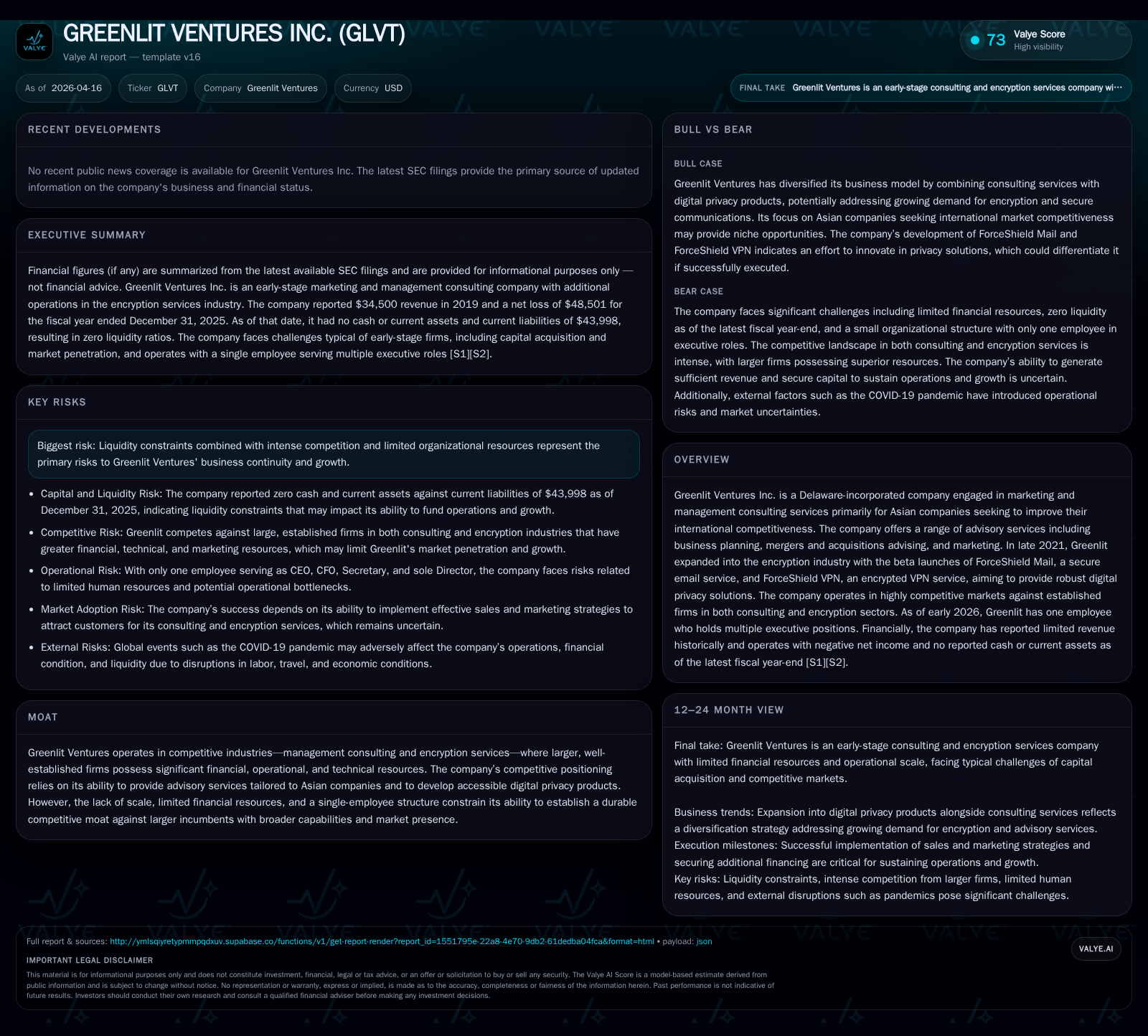
Greenlit Ventures Inc. has evolved from a marketing and management consulting firm focused on Asian clients to a company ambitiously entering the encryption market with ForceShield Mail and VPN. Despite its expansion attempts, the company struggles with persistent operating losses, no positive cash flow, and a single-employee leadership model that limits scaling. Established competitors in both sectors coupled with Greenlit’s constrained capital structure underline substantial risks to its growth trajectory and operational sustainability.
Evolution of Greenlit’s Business Model: From Consulting Roots to Encryption Expansion
Founded in Delaware in late 2016, Greenlit Ventures Inc. initially focused on delivering marketing and management consulting services tailored to companies based primarily in Asia seeking expanded competitiveness abroad [S1][S7]. Its advisory portfolio includes business planning, mergers and acquisitions advising, and marketing strategies calibrated to regional client needs. This specialization attempts to capture cross-border consulting demand driven by Asian enterprises aiming for global market adherence.
In November 2021, Greenlit pivoted by launching beta versions of ForceShield Mail—a secure email service employing modern end-to-end encryption—and ForceShield VPN, designed to provide encrypted virtual private network capabilities [S1][S7][S8]. These product introductions signify a strategic evolution toward digital privacy solutions amid rising consumer awareness about data security. The ForceShield offerings prioritize accessibility and integrated protection from cyber intrusions, reflecting the company's ambition to carve out a niche within the broader encryption service industry.
While this expansion diversifies its business model beyond professional advisory services into technology products requiring software development acumen, it also introduces new operational complexities uncommon to pure consulting firms.
Historical Financial Performance: Revenue Gains Amid Persistent Operating Losses
Financially, Greenlit’s progression reflects modest top-line improvements overshadowed by continuous deficits at the operating and net income levels. Revenue increased sharply by approximately 117% year-over-year from $15,915 in 2018 to $34,500 in 2019 [F1]. However, subsequent annual results indicate ongoing losses:
- Operating loss narrowed from -$105,426 in 2020 to -$57,272 in 2023 [F1]
- Net loss remained substantive at -$48,501 by end-2025 [F1]
Despite some progress in reducing operating losses post-2020 peak, negative net outcomes reflect persistent high burn rate relative to revenue scale. Operating cash flow has consistently reported as zero recently [F1], underscoring challenges converting losses into positive liquidity generation.
Historical performance (annual)
| FY | Net ($) | CFO | OpInc ($) | Net YoY |
|---|---|---|---|---|
| 2025 | -48501 | 0 | +78.7% | |
| 2024 | -227487 | 0 | -257.7% | |
| 2023 | -63589 | 0 | -57272 | -14.7% |
| 2022 | -55452 | 0 | -54044 |
Source: SEC companyfacts cache [F1].
Capital returns and efficiency (annual)
| FY | ROE% |
|---|---|
| 2025 | 20.4 |
| 2024 | 120.4 |
| 2023 | 41.3 |
| 2022 | 61.3 |
Source: SEC companyfacts cache [F1].
Revenue figures after 2019 are unavailable or not material enough for reporting; however, losses continue unabated signaling limited operational leverage achieved so far [F1]. Negative equity deepened substantially over recent years due to accumulated losses.
Competitive Dynamics in Consulting and Encryption Markets
Greenlit's consulting operations contend with dominant multinational advisory firms like Morgan Stanley and Bank of America Corporation that command expansive financial resources, extensive industry expertise, comprehensive service portfolios, and global footprints [S4][S5]. These incumbents excel due to scale advantages including deep client networks and robust technical teams enabling competitive pricing and quality differentiation.
Similarly challenging is the encryption market segment where ForceShield products compete directly against established providers such as Trend Micro, Cisco, Sophos, Zoho Mail, and BAE Systems [S5]. These players benefit from long-standing reputations for reliability and technological innovation backed by broad R&D investments. Customer expectations for dependable service uptime combined with rapid threat adaptation require significant technical sophistication beyond what a nascent entity with limited staff can achieve swiftly.
Industry competition focuses on factors including:
- Technical expertise level
- Price competitiveness balanced against service quality
- Geographic presence enabling local customer support
- Brand trust cultivated over time through consistent delivery.
Given these dynamics, Greenlit operates at a considerable disadvantage relative to entrenched providers possessing superior capital resources and operational scale.
Assessing Growth Drivers and Constraints Across Core Segments
Growth drivers within Greenlit’s consulting domain rest on sustained demand from Asian businesses pursuing internationalization coupled with heightened emphasis on compliance with global market standards [S7]. Such trends potentially expand opportunities for specialized advisory tailored to cultural and regulatory nuances unique to Asia-origin firms.
Conversely in encryption services growth is fueled by escalating digital privacy concerns globally that increase demand for secure communication tools [S8]. Launching ForceShield Mail and VPN positions Greenlit to exploit this secular trend provided it can convert beta innovations into commercial-grade offerings attractive enough for adoption.
Contrastingly significant constraints impede scale-up prospects:
- The company’s single-employee structure constrains human capital availability required for sales force expansion or technical development acceleration [S5]
- Limited financial resources create barriers for aggressive marketing initiatives critical to penetrating crowded markets
- Ongoing lack of profitability restricts reinvestment capacity slowing product evolution pace necessary for maintaining competitive relevance.
These factors collectively cap near-term growth potential absent successful external capital infusion or partnership formation.
Capital Structure and Liquidity Challenges Amid Operational Losses
Greenlit’s balance sheet reveals acute liquidity pressures that jeopardize operational continuity if unaddressed. As of December 31, 2025:
- Current assets stand at zero against liabilities approximating $43,998 [F1]
- Equity position is deeply negative (-$237,446), signaling accumulated deficit exceeding shareholder contributions or available capital buffers [F1]
- No cash or equivalents reported since Q1 2023 further highlighting cash scarcity [F1]
- Operating cash flow remains at zero consistently during recent years indicating no internal funds generation from core activities [F1]
This precarious capital structure limits the firm’s ability to sustain pivotal areas such as ongoing software development efforts for ForceShield products or scaling consulting teams necessary for bolstering revenue streams. Moreover absence of positive cash flow heightens dependency on external financing which may be difficult given risk profile [S8].
Forward-Looking Considerations: Milestones and Monitoring Metrics
The company has not issued explicit forward-looking revenue or profit forecasts publicly. Key milestones investors should monitor include:
- Progression of ForceShield Mail and VPN beyond beta stages including user base growth metrics,
- Success rate of converting advisory engagements into recurring revenue contracts,
- Any announcements regarding fundraising rounds or capital injections,
- Quarterly financial disclosures noting trends in operating expenses relative to revenues signaling path toward break-even.
Achieving measurable uptake in encrypted service adoption alongside stable consulting client acquisition is critical for reversing historical losses. These indicators will serve as barometers validating whether dual business lines can generate sustainable cash flows.
Governance and Operational Capacity Risks Due to Single-Person Leadership Structure
CEO Fu Yong Nan runs all key executive functions — CEO, CFO, Secretary — making Greenlit essentially a one-person operation at the helm of both strategic direction and day-to-day operations [S5][S7].
This governance model may confer agility benefits such as faster decision-making cycles but raises concerns over capacity bottlenecks when juggling product development oversight together with financial control responsibilities. Furthermore reliance on one individual heightens operational risk related to continuity planning or skillset breadth required across distinct business domains (consulting vs tech product development).
Such extreme lean staffing complicates scalability prospects barring recruitment or structural reorganization allowing delegation.
Summary of Risks: Competition Intensity, Funding Needs & Market Barriers
Key risks identified include:
- Intense competition from larger established firms possessing superior financial firepower threatening market share both in consulting and encryption sectors [S3][S4][S5]
- Severe liquidity constraints necessitating additional capital raises without guaranteed investor interest given lack of profitable track record [S6][S8][S9]
- Operational limitations due to tiny workforce restricting sales execution capabilities undermining growth plans [S8][S10]
- Adoption risks as newly introduced ForceShield products may fail to gain necessary traction amidst sophisticated cybersecurity landscape demanding continual product enhancements [S8]
- Macroeconomic uncertainty impacting client budgets notably due to travel restrictions amid ongoing pandemic effects constraining consulting engagements [S4][S8]
No current litigation or regulatory proceedings exist providing legal stability but structural vulnerabilities remain material threats risking sustainability absent corrective measures [S3].
This analysis synthesizes information filed through April 2026 without extrapolation beyond documented figures. Readers should consider inherent uncertainties presented by nascent business transitions within highly competitive markets accompanied by financial fragility characteristic of early-stage ventures.
Disclaimer: This is research-only, informational analysis and not investment advice. It may include AI-generated interpretation and general industry context. Always verify important details using primary sources.

Comments