
Superstar Platforms Inc. Charts Course in Pawnshop Digitalization Under Capital Constraints
Superstar Platforms targets pawn industry transformation via its PawnTrust marketplace despite liquidity and developmental hurdles.
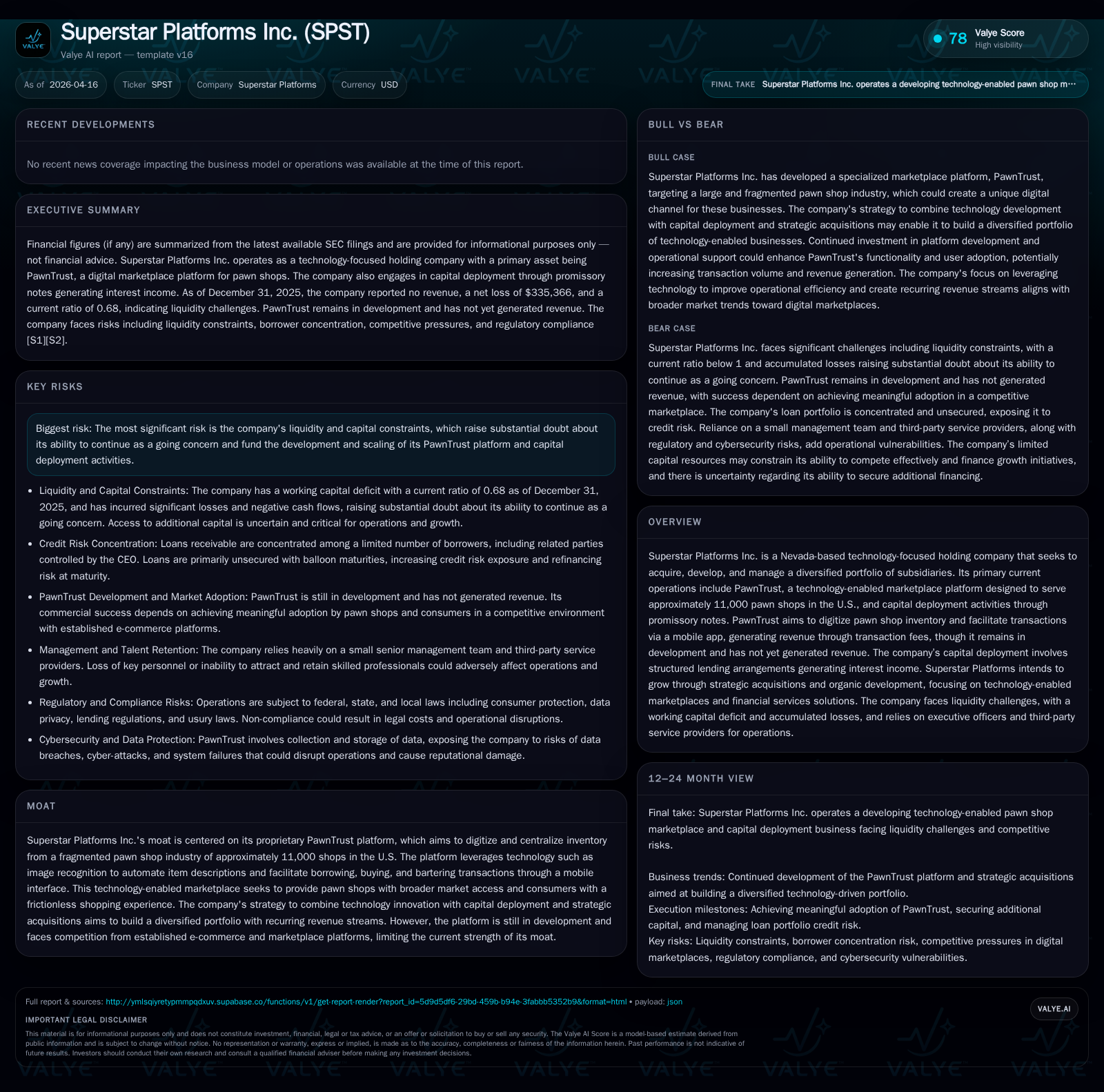
Superstar Platforms Inc. operates as a technology-focused holding company with its flagship PawnTrust platform aimed at digitizing the fragmented U.S. pawnshop market of roughly 11,000 locations. PawnTrust remains in development, contributing to nil revenue and ongoing operating losses. The company supplements its business model with capital deployment via structured lending arrangements generating interest income, facing significant liquidity pressures that cast doubt on funding its platform’s scaling. Sustained growth depends on successful platform adoption, strategic acquisitions, and overcoming operational and regulatory risks.
Historical Trajectory: Growth Drivers and Financial Trends
Superstar Platforms Inc., incorporated originally in Nevada in 2002 under previous names Simplagene USA Inc. and later Dinewise Inc., rebranded to its current identity in March 2025 as it shifted strategic focus towards technology-enabled marketplace solutions. The company currently centers on PawnTrust, a digital platform designed specifically to address the pawnshop industry's historically fragmented nature.
Financially, Superstar Platforms reflects the early-stage nature of its operations. The company reported zero revenue for fiscal year 2025 [F1], consistent with PawnTrust still being under development rather than commercially launched. Operating expenses primarily relate to ongoing platform development, management overhead, and capital deployment activities through structured lending.
Operating losses stood at $541,211 for the period ending December 31, 2025 [F1], while net losses totaled $335,366. Current asset levels at approximately $2.79 million (quarter-end September 2025) contrasted with current liabilities near $4.11 million (end-December 2025), resulting in a suboptimal liquidity position reflected by a current ratio of 0.68 [F1]. This snapshot underscores working capital constraints likely intensified by continued R&D outlays and limited operational cash flow.
Historical performance (annual)
| FY |
|---|
| 2025 |
Source: SEC companyfacts cache [F1].
The firm’s historical trajectory signals a strategic pivot toward building a unique technology-enabled business model leveraging digital marketplaces within a niche sector traditionally underserved by online innovation.
PawnTrust Platform: Technology-Driven Industry Transformation
PawnTrust represents Superstar Platforms' flagship initiative to overhaul an estimated universe of some 11,000 pawnshops across the U.S.—a highly fragmented network often lacking scalable marketing or e-commerce capabilities [S1]. The platform uses advanced image recognition algorithms to automate detailed item descriptions of each shop’s inventory while enabling consumers to borrow against items, purchase merchandise directly, or engage in bartering—all through an intuitively designed mobile interface.
This technology-enabled marketplace aims to create network effects by aggregating otherwise isolated pawn shops onto one digital stage, thereby extending their reach beyond local foot traffic and enabling consumers nationwide to browse inventories without physical store visits [S7]. For consumers purchasing outside their locality, shipping logistics are integrated into the platform experience.
Despite its innovative positioning offering a frictionless shopping experience aligned with contemporary consumer expectations for convenience and immediacy, PawnTrust faces material competitive pressure. Established e-commerce platforms and specialized classified listing services dominate online retail ecosystems with greater resources and brand recognition [S4]. The landscape demands rapid execution on technology enhancements alongside compelling value propositions for both pawn operators accustomed to legacy processes and end users seeking trustworthiness and usability.
The early development stage limits current moat defensibility since network effects remain preliminary without wide-scale adoption; therefore execution risk persists heavily influencing near-term success probabilities.
Capital Deployment Strategy and Structured Lending Activities
Complementing platform development, Superstar Platforms also engages in capital deployment primarily via promissory note arrangements with both related parties and external entities [S7]. These structured lending activities generate steady streams of interest income reflected as "other income" but carry inherent credit risks due to unsecured loan structures coupled with balloon maturities all concentrated on December 31, 2026 [S14], intensifying refinancing risk should borrowers fail repayment or refinancing capabilities.
Typical loan interest rates hover around elevated levels (~24% per annum), reflecting risk premiums tied to borrower creditworthiness challenges amid limited collateralized exposure [S14]. Notably, significant portions of loans reside with entities controlled by the company's CEO, introducing potential conflicts of interest along with heightened scrutiny demands from regulatory eyes as well as investors [S14].
These structured lending arrangements operate within tight regulatory frameworks where compliance with state usury laws is critical [S8]. Failure to align within these guidelines could materially impact profitability or trigger sanctions.
As such, capital allocation toward these financing activities seeks disciplined deployment targeting recurring revenue streams that may partially offset operational burn from ongoing technology investments while awaiting platform commercial scale.
Liquidity Headwinds and Balance Sheet Analysis
Liquidity emerges as one of Superstar Platforms’ most pressing challenges. The September-end current assets stood at $2.79 million but were overshadowed by December-end current liabilities of $4.11 million, yielding a concerning current ratio of roughly 0.68 [F1]. This shortfall reflects acute working capital constraints potentially undermining smooth operational funding.
Historical context includes prior receivership proceedings resolved between January 2018 and early 2020 during which judicial custodianship was exercised over company control before resumption under new board governance [S7]. While the receivership concluded successfully with restored control, the history conveys institutional cautionary context around financial stability.
Management openly acknowledges substantial doubt about continuing as a going concern without securing additional financing or pursuing strategic divestitures [S7]. Operational prudence is necessary given constrained cash runway impacting further developments within PawnTrust as well as capital deployment capabilities.
These liquidity pressures compound refinancing risks associated with debt maturities clustered at year-end 2026 across outstanding notes payable approximating $2.67 million as disclosed [S10], emphasizing dependency on borrower performance alongside capital market receptivity for fund replenishment.
Outlook: Growth Prospects, Scaling Challenges, and Market Risks
Looking ahead, Superstar Platforms envisions growth from two core levers: organic expansion of PawnTrust adoption among pawnshops across the U.S. and disciplined bolt-on acquisitions targeting complementary technology-enabled marketplaces or financial service businesses suitable for portfolio integration [S12].
However, explicit forecasting guidance remains absent from filings reflecting developmental uncertainty; hence investors are advised to monitor ramp-up metrics such as active pawnshop participants onboarded onto PawnTrust, transaction volumes via the app interface signaling marketplace traction, and progress on incremental financing deals enhancing liquidity buffers—none of which are yet publically disclosed but constitute critical near-term milestones from an industry perspective.
Scaling concerns revolve around acquiring sufficient critical mass within highly localized pawnbroker networks resistant historically to rapid technological shifts plus overcoming incumbent competition from entrenched e-commerce giants familiar with broader retail verticals [S4]. Moreover cybersecurity threats pose notable operational risk given PawnTrust's reliance on collecting sensitive consumer data along with inventory information requiring robust IT system defenses against breaches or malicious attacks consequentially threatening reputation or legal standing [S10], [S17].
Regulatory uncertainties encompass enforcement trends relating to non-bank lending activities underpinning parts of Superstar’s business model subject to dynamic usury statutes varying by jurisdiction—and potential tax compliance ramifications given extended delays in historical federal tax filings raising audit exposure concerns [S22].
Overall industry-specific insight suggests marketplace models targeting traditional brick-and-mortar segments demand lengthy customer education cycles coupled with iterative product refinements before meaningful monetization achieved—context applicable here accentuating structural patience requirements for Superstar Platforms' ambitions.
Capital Allocation, Returns, and Shareholder Considerations
Capital stewardship currently favors preservation over distributions given no declared dividends or share buybacks reported historically per filings [S16]. This aligns logically considering persistent net losses restraining free cash flows available for returns policies.
Notwithstanding negative absolute earnings figures, derived return on equity stands near approximately 26% reflecting relatively modest equity base against net income deficit scale—indicating leverage effects but not portraying economic profitability broadly speaking given immature revenue generation profile [F1].
Shareholder dynamics reflect typical microcap traits including sparse daily trading volumes leading to thinly traded stock status susceptible to volatility driven by relatively few transactions; compounded by disclosure that CEO maintains substantial equity concentration giving him outsized influence on corporate governance matters potentially limiting minority control inputs [S11], [S16].
The absence of active secondary market interest may deter institutional engagement while exposing holders to elevated liquidity risk—general features consistent with small publicly reporting companies transitioning from early development phases toward commercial viability in emerging sectors.
Management highlights retention of specialized personnel as integral success factor given complex interplay blending proprietary technology development with regulated financial services requiring multidisciplinary skillsets—a point underscored repeatedly across risk disclosures emphasizing operational sensitivity regarding executive continuity amidst competitive labor market pressures [S1].
Disclaimer: This is research-only, informational analysis and not investment advice. It may include AI-generated interpretation and general industry context. Always verify important details using primary sources.

Comments