
Eagle Nuclear Energy Corp.’s Integrated Launch of Uranium Mining and SMR Tech Under Early-Stage Constraints
A newly public firm merges uranium exploration with small modular reactor design, wrestling with infancy-stage technology and capital intensity.
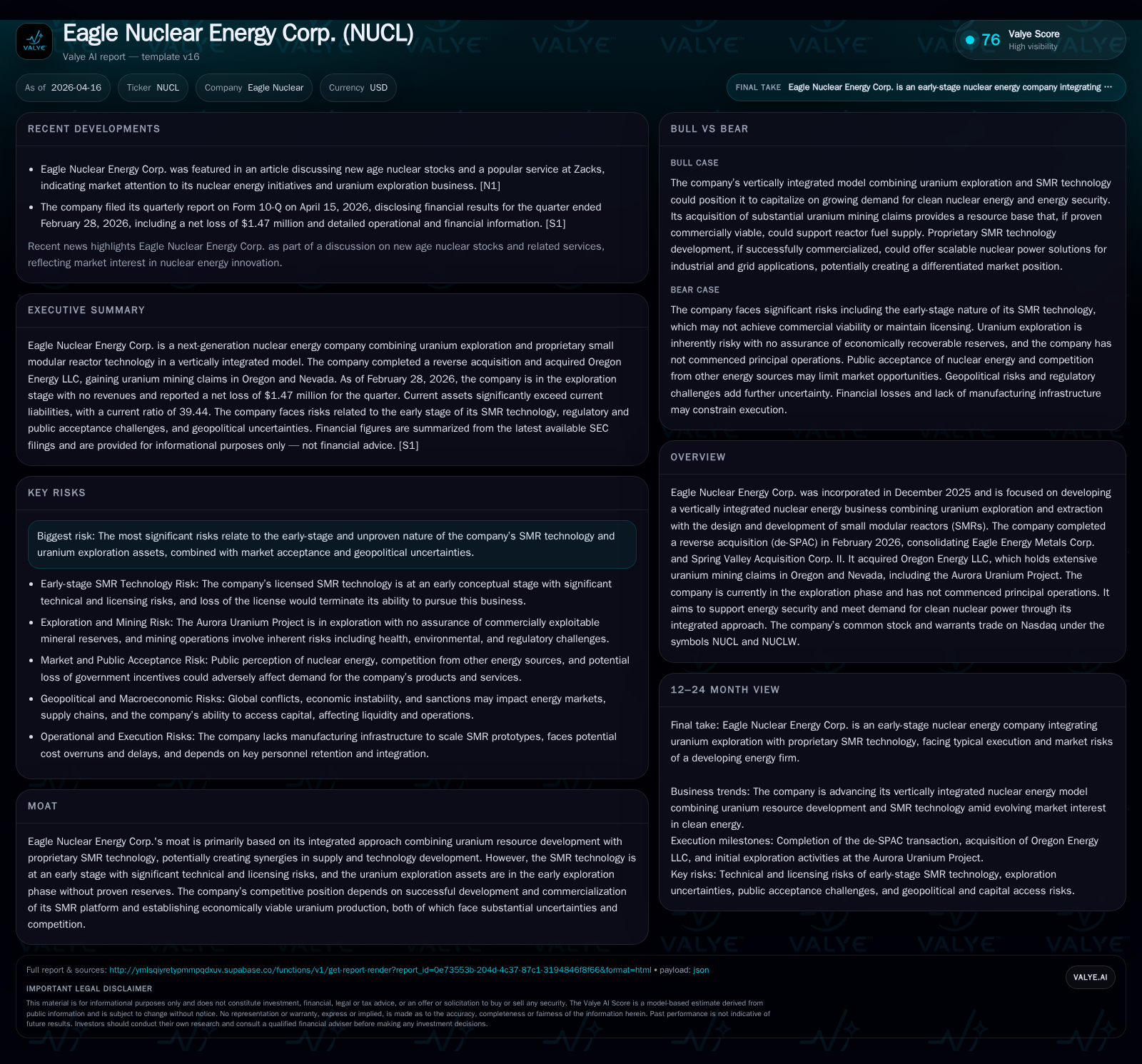
Eagle Nuclear Energy Corp., formed through a reverse merger in early 2026, aims to vertically integrate uranium resource development via its Aurora Uranium Project with concurrent innovation in small modular reactors (SMRs). As a nascent entity without operating revenues and amid significant technical and regulatory hurdles, the company is building its foundation with recent asset acquisitions and substantial financing. Its future growth depends heavily on successful SMR commercialization and proving economic viability in uranium mining, with early financials reflecting ongoing losses and negative cash flow but a strong liquidity buffer post-de-SPAC.
Company Background and Historical Performance
Eagle Nuclear Energy Corp., incorporated in December 2025, rapidly established presence through a reverse acquisition transaction completed in February 2026 that merged Eagle Energy Metals Corp. and Spring Valley Acquisition Corp. II ([S2],[S3]). This transaction served as the foundational event transitioning the entity into a publicly traded company under Nasdaq ticker NUCL.[S22]
The company simultaneously acquired Oregon Energy LLC, securing more than 360 unpatented lode and placer mining claims concentrated in Malheur County, Oregon, and neighboring Nevada — notably the Aurora Uranium Project covering roughly 43 square kilometers ([S9],[S22]). These assets remain exploratory without proven reserves; revenue generation is therefore hypothetical pending feasibility studies which the company expects to advance over coming periods.
Financially, Eagle Nuclear is at an embryo stage with no revenue generation history or principal operations commenced as of fiscal Q1 FY2026. Reflecting nascent operational status coupled with initial costs of acquisitions and corporate buildup, the company reported a net loss of approximately $1.47 million for the first quarter ended February 28, 2026 ([F1]). Operating cash flow was negative $1.57 million over same period, consistent with exploration phase cash burn ([F1],[S26]). Equity expanded markedly from roughly $1.69 million at November 30, 2025 (pre-de-SPAC close) to $14.43 million by February-end attributable to new equity issuances tied to the de-SPAC process and PIPE financing ([F1],[S21]).
Summarized Financial Snapshot
Historical performance (annual)
| FY | Net ($mm) | CFO ($mm) | Net YoY |
|---|---|---|---|
| 2026 | -1 | -2 | +72.0% |
| 2025 | -5 | -5 | -415.7% |
| 2024 | -1 | 0 | |
| 2023 |
Source: SEC companyfacts cache [F1].
Capital returns and efficiency (annual)
| FY | ROE% |
|---|---|
| 2026 | -10.2 |
| 2025 | -311.4 |
| 2024 | 163.6 |
| 2023 |
Source: SEC companyfacts cache [F1].
The step-change in equity signifies primary capital infusion supporting its operational build-out including property rights acquisition and preliminary R&D efforts on SMR projects ([S7],[S13]). No dividend payments or buybacks have been initiated.
Business Model and Growth Prospects
Eagle Nuclear's strategic premise is vertical integration: it combines upstream uranium resource exploration/extraction through Oregon Energy’s assets with midstream/downstream advanced nuclear technology development — specifically focusing on small modular reactors (SMRs), which represent a potentially transformative future-generation nuclear platform (,[S23]).
This dual-pronged model aims to mitigate supply chain uncertainties common in uranium procurement while leveraging innovative reactor technology development internally.
However, current SMR efforts are conceptual with associated technical risks such as achieving design certification and licensing approval still pending ([S23]). The uranium assets remain exploratory; mineral reserves have not been positively delineated as economically viable deposits are not yet confirmed ([S23],[S9]). Both segments operate within politically sensitive environments influenced by regulatory regimes, environmental considerations, public perception towards nuclear energy post-Chernobyl/Fukushima memory lanes, geopolitical tensions impacting energy security narratives (e.g., Russia/Ukraine conflict implications), and competition from renewables/scaling fossil fuels ([N1],[S23]).
Growth catalysts hinge on:
- Advancing demonstration projects for SMRs including obtaining safety licenses from regulators.
- Successful exploration milestones confirming commercial-grade uranium deposits at Aurora Project leading towards pre-feasibility studies.
- Leveraging government incentives/support amid transition goals favoring clean energy sources including nuclear power.
- Securing manufacturing capacity to scale SMR units economically avoiding cost overruns common in nuclear construction.
Conversely, prospective growth constraints involve:
- Delays or denial of regulatory approvals for SMR tech deployment.
- Failure to discover sufficient grade/high volume uranium resources impacting raw material availability.
- Market resistance due to high cost or unattractive economics relative to competing energy forms.
- Geopolitical disruption affecting global supply-demand balance especially given strategic importance of nuclear fuel cycles.
Forecasts, Milestones & Other Expectations
Explicit management guidance remains scarce given company's infancy stage ([N1],[S2]). However investors should track:
- Progression milestones on Aurora Uranium Project exploration delineations producing measured and indicated mineral resources.
- Licensing updates for proprietary SMR technology platform including NRC safety reviews or equivalent agencies.
- Announcements regarding manufacturing partnerships or pilot reactor fabrication agreements indicating progress towards commercialization.
- PIPE-related capital raise completions or further equity offerings underpinning long-term funding requirements.
Given current operating cash burn trends (~$1.57 million per quarter) funded by existing liquidity buffers exceeding $31 million,[F1][S7] the company has runway extending into near term but will likely require successive financings aligned with project scale-up phases.
Returns & Capital Allocation Strategy
The company currently operates at a loss with no indication of profitability prospects within near term: Q1 FY2026 net income was negative $1.47 million representing an approximate ROE of negative ~10% annualized based on trailing equity ([F1]).
Capital allocation focuses predominantly on investment back into mineral rights acquisition ($12.75 million recognized), intangible assets related to patent licenses linked to planned SMR technology developments ($75K), property plant equipment ($283K), plus operating costs accrued during exploration and development stages ([S8],[S10]).
No dividends or share repurchases have occurred; indeed capital structure growth reflects issuance of common stock proceeds netting roughly $31.64 million including PIPE participation coincident with reverse recapitalization activities ([S7],[S13],[S21]).
Importantly, preferred shares issued (Series A Cumulative Convertible Preferred Stock) accounted for significant mezzanine equity (~$25.53 million) marked as redeemable preferred stock subject to redemption provisions starting post-February 2031 indicating hybrid capital arrangement terms designed to optimize financial flexibility without immediate cash outflows ([S19]).
Industry Context & Competitive Position (Analysis)
Small modular reactors are emerging as a pivotal innovation within nuclear energy aiming to resolve traditional generation IV challenges: high upfront capex, construction complexity, lengthy timelines plagued by cost overruns. The ability to fabricate smaller scalable units promises lowered capital commitment per plant unit enabling flexibility across grids especially where large-scale reactors are impractical.
Simultaneously securing upstream uranium supplies domestically via assets like the Aurora Uranium Project could shield Eagle Nuclear from global commodity price volatility which notoriously complicates nuclear fuel supply chains.
That said competition intensifies from established mining firms developing larger ore bodies alongside nascent SMR developers backed by major utilities or government consortia possessing deeper engineering experience or broader licensing track records.
Public acceptance remains volatile as fossil fuel alternatives compete aggressively driven by subsidies; moreover nuclear energy continues facing challenges linked to waste disposal policies and past accident stigmas introducing degree of market resistance absent clear cost parity advances.
Risks Summary Based on Filings
Key risks highlighted include:
- Early-stage nature of both uranium exploration assets lacking proven reserves impairing near-term revenue realization potential.
- Technical uncertainty surrounding proprietary SMR development possibly never achieving commercial viability or license retention failures jeopardizing reactor business line ([S23]).
- No manufacturing infrastructure presently slowing prototype scaling risking cost escalation/delays.
- Geopolitical instability affecting material supply chains and investor sentiment towards nuclear especially considering global conflicts like Russia’s Ukraine invasion impacting energy markets globally ([N1],[S23]).
- Potential market acceptance barriers from adverse public perception or policy reversals diminishing nuclear power incentives crucial for sustained demand growth.
- Dependence on key personnel whose departure could delay strategic objectives given narrow early team composition ([S23]).
Conclusion & What To Watch
Eagle Nuclear Energy Corp represents an ambitious vertically integrated entrant into the evolving nuclear ecosystem combining domestic uranium exploration with small modular reactor innovation—both domains still embryonic in their commercial applicability but central to clean energy transition plans worldwide.
While recent financing success provides liquidity breathing room, absence of revenues alongside steep technical/regulatory obstacles emphasize very early-stage operational risk profile requiring patient capital engagement.
Investors should monitor forthcoming geological results from the Aurora Uranium Project for resource clarity; regulatory progress milestones related to SMR licensing; partnership announcements signaling manufacturing advancements; ongoing liquidity changes reflecting financing needs; alongside macro conditions influencing nuclear power adoption dynamics globally.
This analysis reflects information available as of April 16, 2026 and does not constitute investment advice.
Disclaimer: This is research-only, informational analysis and not investment advice. It may include AI-generated interpretation and general industry context. Always verify important details using primary sources.

Comments