
Vipshop Holdings: Shifting Currents in Off-Price Retail Profitability and Growth
Vipshop’s revenue momentum slows against steady net income, underscoring challenges in merchandising amidst China’s dynamic off-price retail sector.
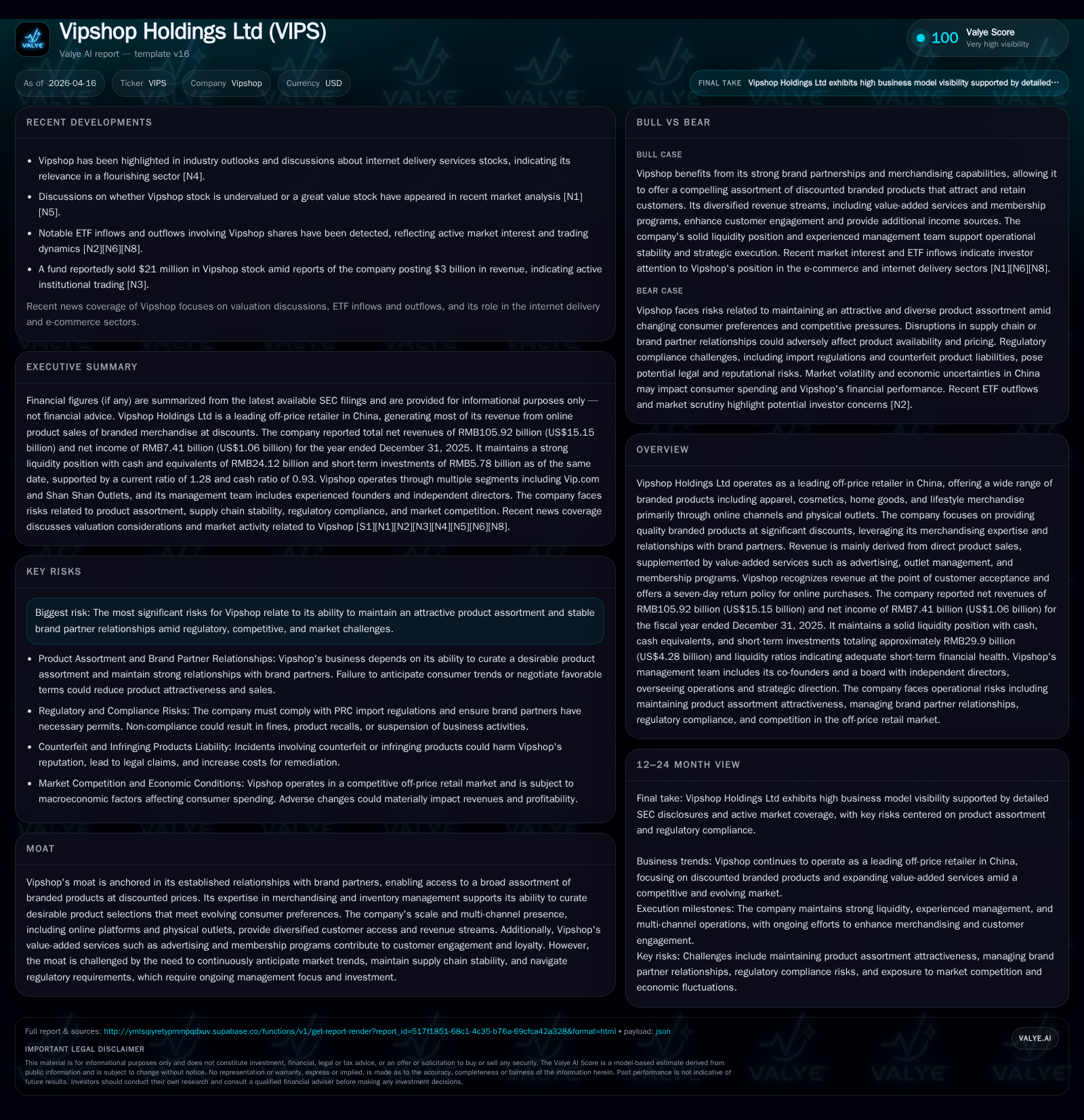
Vipshop Holdings, a leading off-price retailer in China, has experienced slowing revenue growth over recent years while maintaining relatively stable net income supported by disciplined cost management. The company’s business model, centered on branded discount product sales and value-added services, faces intensified challenges in product assortment curation, competitive pressures, and regulatory complexities. Vipshop continues to allocate capital prudently through substantial share repurchases and maintains a strong liquidity position, although future growth prospects hinge critically on evolving multi-channel strategies and merchant relationship management within an uncertain macroeconomic environment.
Historical Revenue Expansion and Profitability Trends
Vipshop Holdings Ltd has shown impressive top-line growth since its revenue was around $3.77 billion in FY2014, scaling sharply to more than $11.2 billion by FY2017 as it solidified its position as China's premier off-price online retail platform [F1]. However, that growth trajectory began moderating noticeably over the past three years. Revenues reported for FY2023 to FY2025 illustrate a declining trend from RMB112.86 billion (US$16 billion) in 2023 to RMB105.92 billion (US$15.15 billion) in 2025 [S1]. Despite this revenue contraction of about 6%, the company maintained a relatively steady net income profile with RMB7.41 billion (US$1.06 billion) posted in 2025 compared to RMB8.20 billion in 2023 [S1], supported by operational cost discipline.
The revenue composition confirms Vipshop's primary reliance on direct product sales which accounted for roughly 92% of total revenues in 2025 [S1] — down slightly from prior years but still dominant. The remaining revenue arises from value-added services—advertising across online platforms, outlet rental/management, and SVIP membership—which contribute about 8%, reflecting a diversified multi-channel strategy.
This transition toward quality over volume was deliberate; for example, the slight falloff in net revenue contrasts with an increase in active SVIP customers by over 11% year-over-year to nearly 9.8 million members in 2025 [S8]. Margins remain healthy given a stable gross margin around 23.1% to 23.5% despite the revenue dip [S8].
Historical performance (annual)
| FY | CFO ($bn) | OpInc ($mm) | Capex ($mm) |
|---|---|---|---|
| 2025 | 1.1 | 1163 | 284 |
| 2024 | 1.3 | 1257 | 373 |
| 2023 | 2.0 | 1282 | 305 |
| 2022 | 1.5 | 899 | 352 |
Source: SEC companyfacts cache [F1].
Capital returns and efficiency (annual)
| FY | Buybacks ($mm) | FCF ($mm) |
|---|---|---|
| 2025 | 707 | 782 |
| 2024 | 530 | 878 |
| 2023 | 719 | 1725 |
| 2022 | 907 | 1173 |
Source: SEC companyfacts cache [F1].
Note: Figures approximated from RMB converted at noted exchange rates; "~" denotes approximation from available data [F1],[S1],[S8].
Evolving Drivers Behind Growth Deceleration
Vipshop attributes the slowing top-line momentum primarily to complexities inherent in assortment curation amid evolving consumer preferences and intensifying competition both online and offline [S12]. The company highlights merchant/vendor partner engagement as a critical risk factor — failures here can lead to inventory imbalances causing lost sales or excess write-downs [S12]. Analysts reflect that competition from established platforms with stronger brand recognition or pricing power further pressures Vipshop's customer acquisition and retention efforts [N1], [N5].
Moreover, regulatory uncertainties affecting internet business models in China have complicated planning cycles and constrained investments into new technology or marketing [S12]. These factors collectively temper growth prospects despite incremental gains in loyal customer tiers like SVIP members.
Strategic Outlook: Expansion Prospects and Market Constraints
Looking forward, Vipshop plans to leverage its entrenched multi-channel distribution strategy — combining digital platforms with physical outlet expansion — aiming to deepen customer engagement while improving fulfillment efficiency [N3], [S1]. Investments into technology infrastructure aim to refine personalized marketing algorithms and optimize inventory deployment based on advanced data analytics [S24]. Enhancement of loyalty programs is expected to underpin stable wallet share gains.
However, these initiatives occur against a backdrop of macroeconomic uncertainty—including discretionary spending patterns influenced by broader economic policy—and ongoing regulatory scrutiny around data privacy and financial controls within the PRC e-commerce sector [S12], [N3], [S24]. This environment suggests tempered growth ceilings requiring agile operational execution.
Examining Key Financial Milestones and Forecast Indicators
No explicit forward guidance was found within filings or recent news communications; however, key operational metrics provide insight into near-term performance expectations [N1], [N5], [S2]. Revenue recognition intricacies related to goods-in-transit estimates impacted RMB456 million (~US$65 million) of recognized revenues for FY2025 alone [S20], highlighting sensitivity to logistical delivery cycles.
Strategic partnerships remain crucial for sustaining healthy gross margins despite revenue shrinkage; continued vendor cooperation will be vital for navigating assortment variability without eroding profitability substantially.
From an external monitor perspective, movement in active SVIP member counts and fulfillment expense ratios will be critical bellwethers for tracking customer retention quality versus growth intensity.
Capital Allocation Priorities: Share Repurchases, Cash Reserves, and Returns
Vipshop exercises disciplined capital allocation marked by consistent share repurchase programs: approximately US$706 million worth of ADSs/Class A shares were repurchased during FY2025 under an authorized buyback program extending through early 2027 [S4], [F1]. Notably, no dividends were distributed during recent periods signaling prioritization of reinvestment flexibility alongside shareholder return via buybacks rather than cash dividends.
The company holds robust liquidity with combined cash & equivalents plus short-term investments of approximately US$4.28 billion as of end-2025—providing operational cushioning for extended market uncertainty or investment cadence shifts [S7], [F1]. Reported operating cash flow was strong though down from prior high watermark levels at about US$1.07 billion; when adjusted for capital expenditures near US$284 million yields free cash flow north of US$780 million—a positive metric for sustaining buybacks or opportunistic deployment without debt reliance [F1].
Return on equity stands solid at an estimated ~17.7% for FY2025 confirming efficient equity utilization amidst top-line pressures while balancing necessary operating investments [F1].
Merchant Relations and Merchandise Precision as Cornerstones
The fundamental moat protecting Vipshop's competitive position derives largely from its cultivated relationships with brand partners that facilitate access to desirable branded products at discounted prices—a core requisite for off-price retail success within China's fragmented market landscape [S10], [S12], [S1]. Effective supply chain agility enables responsive adjustments to category mix refinements aligned with shifting consumer demand signals.
Failure to anticipate these trends or negotiate favorable purchase agreements can negatively impact inventory turnover ratios and margin profiles—a risk flagged prominently within SEC disclosures underscoring the high execution complexity involved in assortment curation precision at scale [S12]. The company’s added services also act as stickiness enhancers between brands and customers bolstering loyalty beyond mere price competition.
Liquidity Strength Amid Regulatory Complexities in China
Vipshop operates predominantly through Chinese subsidiaries subject to PRC regulatory constraints including restrictions on currency conversion affecting dividend flows upstream to holding entities—the effect being that cash generated locally may not immediately translate into parent liquidity without governmental approvals or clearances [S7], [S9]. Nevertheless, Vipshop currently maintains a buffer sufficient “to successfully navigate an extended period of uncertainty” per management commentary citing both cash reserves exceeding US$3 billion plus committed short-term bank investment products totaling hundreds of millions more ensuring operational resilience despite geopolitical/regulatory fluxes.
Operational cash generation exceeding one billion dollars annually underpins working capital adequacy even as macro-environmental shifts demand cautious capex posture emphasizing targeted facility expansions over broad asset-heavy commitments seen historically [S3], reflecting an adaptive strategy suited for volatile market conditions.
This report synthesizes publicly available disclosures from Vipshop Holdings Ltd's latest filings and recent news commentary without providing any investment advice or forecast certainty beyond factual reporting.
Disclaimer: This is research-only, informational analysis and not investment advice. It may include AI-generated interpretation and general industry context. Always verify important details using primary sources.

Comments