
ENERGY CO OF PARANA Balances Expanding Capex with Regulated Tariff Constraints
COPEL's financial performance reflects stable regulated revenues intertwined with rising capital expenditures and financing needs.
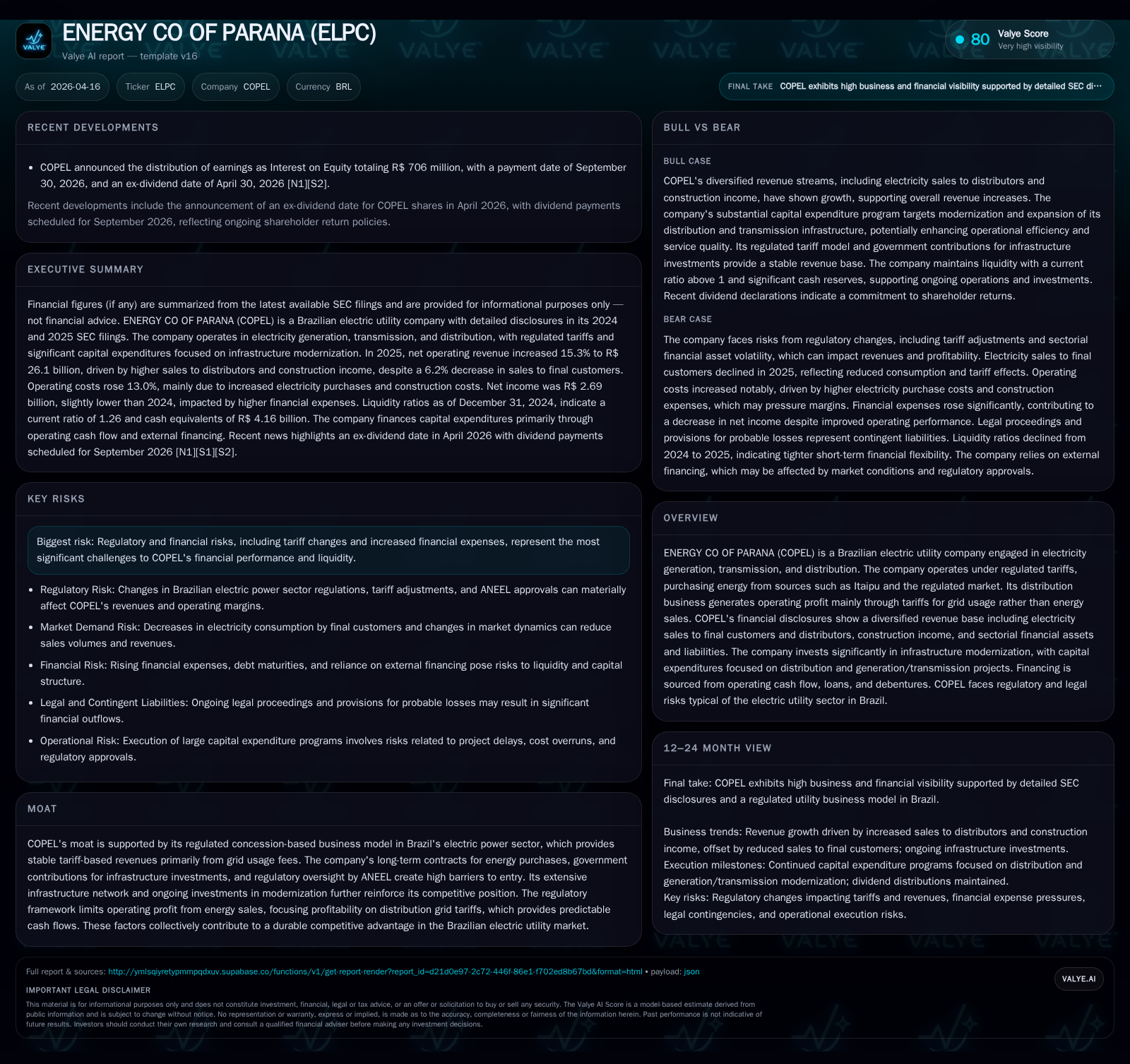
ENERGY CO OF PARANA (COPEL) operates as a Brazilian utility focusing on electricity generation, transmission, and distribution under a regulated tariff model. Its growth historically has been supported by tariff-based revenues, with operating profit concentrated in grid usage fees rather than energy sales. While revenue increased modestly with a 5.5% rise to R$22.65 billion in 2024, net income improved by over 20%, reaching R$2.8 billion, driven by operational stability despite increased financial expenses. COPEL plans significant capital investments exceeding R$3 billion in 2026, primarily in distribution infrastructure, financed through operating cash flow and long-term debt. The company faces regulatory and liquidity risks from tariff adjustments and growing financial charges but maintains robust working capital management and a structured debt maturity profile supporting ongoing expansion.
Company Overview
ENERGY CO OF PARANA (COPEL) is a major Brazilian electric utility engaged across the electricity value chain — generation, transmission, and distribution — predominantly within the regulated tariff framework mandated by national authorities such as ANEEL. The company’s business model revolves around acquiring electricity from sources like Itaipu hydroelectric power and the regulated market to supply its distribution network.
Unlike merchant-focused utilities where profitability is tied directly to energy sales volumes or spot prices, COPEL’s operating profit derives principally from tariffs charged for the use of its distribution grid rather than outright electricity sales. These tariffs provide relatively predictable cash flows but restrict margin expansion opportunities on energy pricing itself [S17].
Historical Growth and Performance
The company has demonstrated consistent top-line growth over recent years with revenues increasing from approximately R$18.63 billion in FY2021 to R$21.48 billion in FY2023 and further reaching R$22.65 billion in FY2024 — representing a compounded annual growth rate near mid-single digits since 2021 [F1]. This trend reflects gradual volume recovery and inflation-linked tariff adjustments.
Net income showed volatility with a dip following FY2021's recording of an exceptional gain (R$5.05 billion), normalizing to R$1.15 billion in FY2022 before rebounding markedly by over 20% to nearly R$2.8 billion in FY2024 [F1]. The improvement was supported by operational efficiencies and stable regulated earnings despite headwinds.
Historical performance (annual)
| FY | Rev ($bn) | Net ($bn) | Rev YoY | Net YoY |
|---|---|---|---|---|
| 2024 | 22.7 | 2.8 | +5.5% | +20.3% |
| 2023 | 21.5 | 2.3 | +102.5% | |
| 2022 | 1.1 | -77.2% | ||
| 2021 | 18.6 | 5.0 | 0.0% |
Source: SEC companyfacts cache [F1].
Capital returns and efficiency (annual)
| FY | ROE% |
|---|---|
| 2024 | 10.9 |
| 2023 | 9.6 |
| 2022 | 5.4 |
| 2021 | 22.8 |
Source: SEC companyfacts cache [F1].
Operating profit remained resilient around R$3.25 billion despite rising costs such as depreciation and third-party services [S6]. Electricity sales volumes faced pressure; sales to final customers declined about 6% year-over-year recently due to market factors but were partially offset by increasing sales to distributors at higher tariffs [S6].
Financial Position and Capital Allocation
As of December 31, 2024, COPEL reported solid balance sheet metrics including current assets of roughly R$13 billion against current liabilities near R$10.34 billion (current ratio ~1.26), indicating stable liquidity fundamentals [F1]. Cash and equivalents totaled over R$4 billion at that date.
Operating cash flows have been robust yet showed decline trends more recently: net cash provided from operations slipped below R$3 billion in FY2025 compared with prior years due mainly to greater working capital use amidst revenue expansion [S7, S19]. Financing cash flows were negative in 2025 reflecting scheduled debt repayments and funding for capex.
The company's growth is heavily reliant on capital expenditure programs directed chiefly toward modernizing and expanding the distribution grid infrastructure and power generation/transmission assets—critical given Brazil's evolving demand dynamics and regulatory expectations [S27]. Capital expenditures grew from about R$2.3 billion in FY2023 to over R$3.6 billion in FY2025 driven primarily by distribution projects that alone accounted for nearly R$3 billion of investment last year [S7]. The budget for CAPEX remains elevated into FY2026 at around R$3 billion spread between generation/transmission (R$972 million), distribution (R$1.94 billion), and others (~R$107 million) [S7, S11].
Long-term borrowings stood at approximately R$20 billion domestically denominated as of end-2025 with no U.S.-dollar-denominated debt reported—helping mitigate direct FX exposure but exposing financing costs to domestic interest rate fluctuations indexed largely by Brazil's CDI benchmark rate [S5, S8]. Debt maturities are well laddered across the next decade into the early post-2030s reducing refinancing risks.
Financial expenses increased sharply by approximately one-third year-over-year in FY2025 reflecting rising interest rates on floating-rate liabilities plus effects from consolidation of newly acquired assets [S18]. These growing financial charges partially offset gains elsewhere.
Capital returns include dividend distributions reflecting adherence to a formal policy targeting minimum payouts of roughly three-quarters of net adjusted income while managing leverage targets near Net Debt/EBITDA of approximately 2.8x within a tolerance range allowing flexibility depending on business conditions [S21]. Recent declared Interest on Equity payments signal management's commitment to returning value amid investment cycles [N1][S9][S10].
Future Growth Prospects and Risks
Looking ahead, COPEL's growth will remain tightly linked to execution of mandated infrastructure investments under concession contracts alongside regulatory developments influencing tariff structures—notably limitations on profit derivation from direct energy sales versus grid tariffs which temper margin expansion possibilities.
Key risk factors include:
- Regulatory uncertainties including potential tariff revisions that could tighten revenue streams.
- Increased financial expenses stemming from macroeconomic volatility impacting borrowing costs.
- Legal contingencies involving tax claims and environmental litigation amounting collectively to significant provisions but closely monitored by management [S12][S16].
- Currency conversion limitations affecting ADS investors' ability to repatriate dividends or sale proceeds abroad under Brazilian foreign investment rules [S1].
Management continuously monitors liquidity via stress-tested scenarios encompassing leverage ratios and minimum cash buffers while maintaining readiness to adjust investment timing or pursue additional financing as needed [S4][S19]. The extensive network infrastructure base combined with government-backed special obligations help underpin long-term concession positions that constitute structural competitive advantages within Brazil’s utility market landscape.
What to Watch (Analysis)
Absent explicit forward guidance beyond announced CAPEX budgets and dividend declarations, validation points over the next quarters will include:
- Trajectory of operating cash flows relative to capex spending pace,
- Evolution of financial expense profiles amid Brazil’s interest rate environment,
- Regulatory updates impacting concession terms or tariff formulas,
- Outcomes of legal proceedings affecting contingent liabilities,
- Dividend sustainability amid leverage fluctuations. Monitoring these indicators will be vital for assessing the balance between growth funding needs and shareholder return potential.
This analysis synthesizes publicly available financial data, regulatory filings, and recent corporate disclosures without offering investment advice or recommendations regarding ENERGY CO OF PARANA stocks or securities.
Disclaimer: This is research-only, informational analysis and not investment advice. It may include AI-generated interpretation and general industry context. Always verify important details using primary sources.

Comments