
Marsh & McLennan’s Strategic Evolution and Financial Performance in 2026
Marsh & McLennan is balancing a comprehensive restructuring plan, acquisitions, and macroeconomic pressures to shape its near-term financial landscape.
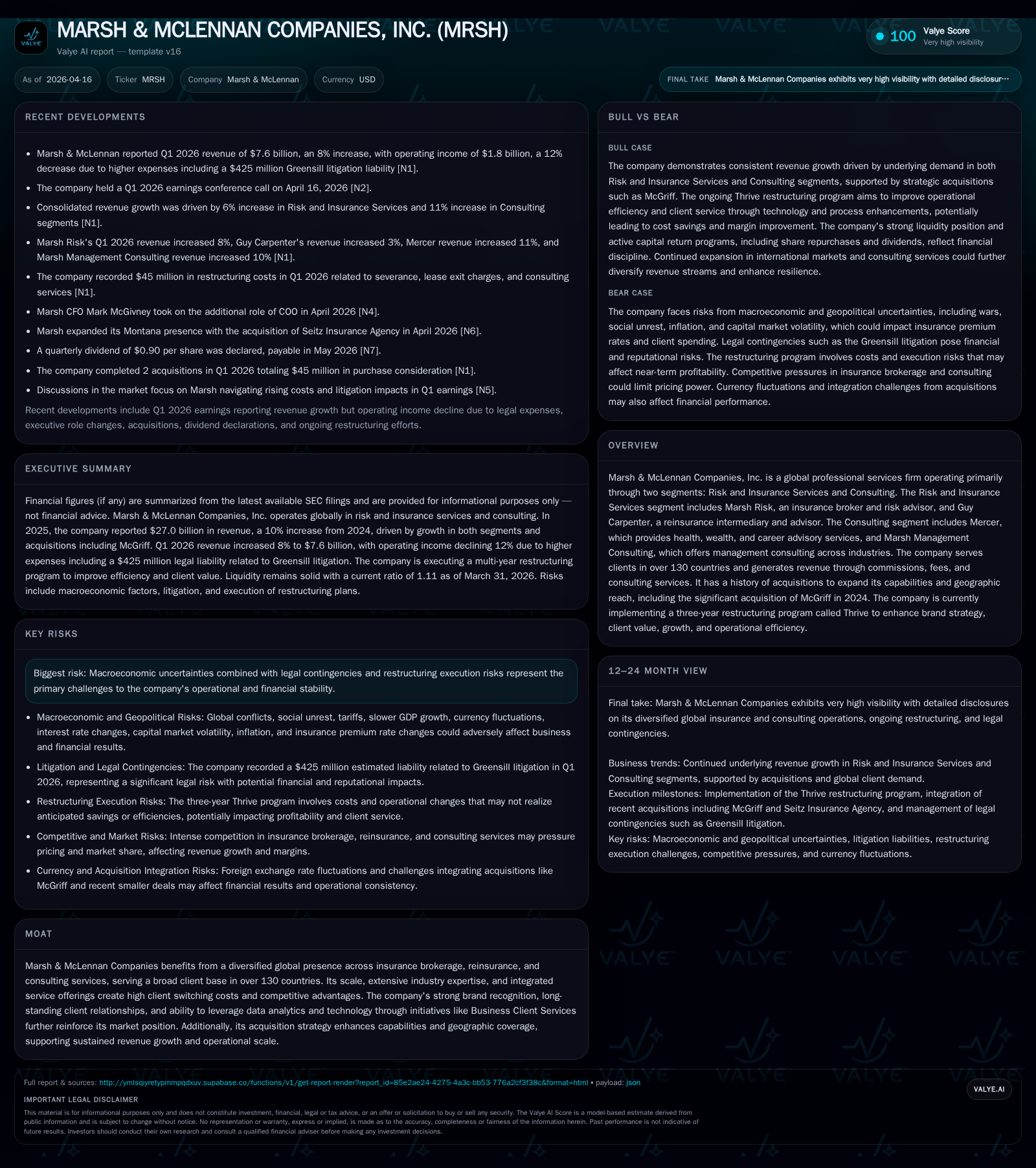
In 2025 and early 2026, Marsh & McLennan Companies, Inc. has demonstrated steady underlying revenue growth supported by strategic acquisitions including the pivotal McGriff transaction. However, these growth drivers coexist with notable headwinds from heightened legal contingencies and restructuring costs linked to its three-year Thrive program, which aims at driving operational efficiency and client value enhancement. The company's capital allocation reflects disciplined dividends and aggressive share repurchases alongside debt refinancings amid ongoing geopolitical uncertainties. Monitoring operating income trajectory and restructuring execution will be key to assessing the scalability of Marsh & McLennan’s evolving business model.
A Track Record of Steady Growth Amid Expansion
Over the four-year period ending December 31, 2025, Marsh & McLennan Companies (MMC) recorded consistent top-line growth fueled by organic expansion and an active acquisition strategy. Consolidated revenue advanced from $22.7 billion in 2023 to nearly $27.0 billion in 2025, representing a compound nominal increase of roughly 10%. On an underlying basis—which strips out foreign currency effects and acquisition impacts—revenues grew around 4% annually [F1][S1]. This steady pace of underlying revenue growth reflects successful cross-segment positioning amid diverse client needs.
Operating income rose notably from $4.3 billion in 2022 to $6.2 billion by end-2025 (+7% YoY), benefiting from scale economies particularly following the integration of McGriff acquired late-2024 for $7.75 billion cash consideration [S1]. This transaction significantly bolstered Marsh Risk’s footprint in the U.S., lifting its reported revenue by about 15% year-over-year in 2025 inclusive of the acquisition impact [S1]. Meanwhile, operating expenses also increased due to restructuring charges totaling $222 million in that year related to severance costs and lease exit fees as MMC pursued operational efficiency goals under the Thrive restructuring program.
Operating cash flows outpaced net income trends with a notable increase of over 20% between 2024 and 2025, reaching approximately $5.3 billion. Capital expenditures showed a moderated decline reflecting optimized investments into technology platforms supporting centralized operations [F1].
Historical performance (annual)
| FY | Net ($bn) | CFO ($bn) | OpInc ($bn) | Capex ($mm) | Net YoY |
|---|---|---|---|---|---|
| 2025 | 4.2 | 5.3 | 6.2 | 291 | +2.5% |
| 2024 | 4.1 | 4.3 | 5.8 | 316 | +8.1% |
| 2023 | 3.8 | 4.3 | 5.3 | 416 | +23.1% |
| 2022 | 3.0 | 3.5 | 4.3 | 470 |
Source: SEC companyfacts cache [F1].
Capital returns and efficiency (annual)
| FY | Div ($mm) | Buybacks ($bn) | FCF ($bn) |
|---|---|---|---|
| 2025 | 1699 | 2.0 | 5.0 |
| 2024 | 1513 | 0.9 | 4.0 |
| 2023 | 1298 | 1.1 | 3.8 |
| 2022 | 1138 | 1.9 | 3.0 |
Source: SEC companyfacts cache [F1].
*Net income attributable to company [F1]
This historical snapshot underscores MMC's ability to drive underlying revenue growth in both its core Risk & Insurance Services as well as Consulting segments while managing reinvestments prudently.
Dissecting Revenue Drivers Across Insurance and Consulting Segments
MMC’s two primary operating segments reflect complementary but distinct economic models: the commission-driven brokerage/reinsurance business within Risk & Insurance Services versus fee-based consulting advisory services.
In Q1 2026, consolidated revenue increased by approximately 8% to $7.6 billion compared with the same period last year, translating into about +4% on an underlying basis after adjusting for currency translation and recent acquisitions including continued integration of McGriff [S2][N1][F1].
Within Risk & Insurance Services ($5.1 billion Q1 revenue), Marsh Risk accounted for roughly $3.7 billion (+8% YoY; +4% underlying), supported mainly by new business gains in U.S./Canada (+3%) and international markets like EMEA (+6%), Asia Pacific (+5%), along with modest contribution from recent acquisitions [S8][S13]. Guy Carpenter’s reinsurance intermediary services posted a smaller but steady gain (+3% reported; +2% underlying). The segment confronted pressure from declining insurance premium rates but offset these via volume expansions—a classic dynamic for commission-driven brokerage lines—as well as innovation through analytical modeling capabilities.
Consulting ($2.6 billion Q1 revenue) demonstrated stronger momentum growing +11% reported (+5% underlying). Mercer led this advancement with health and wealth advisory businesses expanding double digits internationally thanks to favorable market conditions including positive net flows in wealth management [S9][S26]. Conversely, career consulting experienced a slight contraction due to reduced project-based engagements in North America which partially tempered overall segmental growth rates.
Like-for-like, fee-based consulting offers higher margin profiles but faces demand cyclicality tied closely to corporate confidence cycles across health benefits optimization or workforce transformation agendas.
Navigating Headwinds: Legal Issues and Cost Pressures
Despite positive top-line developments early in FY26, MMC's profitability faced significant challenges largely attributable to exceptional charges associated with ongoing litigation risks and restructuring expenses.
Most notably, during Q1 the Company accrued an estimated liability of $425 million as provision for litigation expenses linked to the Greensill lawsuit—a material non-recurring charge impacting operating margins adversely [S2][N10]. In parallel, MMC recorded around $45 million in restructuring costs primarily related to employee severance packages, facility consolidations, lease exit fees, and external consultant engagements underpinning the Thrive program rollout.
These one-off charges contributed to a reported operating income decline of roughly -12% despite an underlying increase in revenues [S2]. Operating leverage suffered accordingly as expense growth outpaced top-line gains during this transitional phase; however management emphasized that these investments are critical precursors toward longer-term margin enhancement.
Future Horizons: Growth Outlook Grounded in Strategy
MMC management has signaled continued optimism regarding medium-term organic growth opportunities driven by digital transformation initiatives within Business Client Services alongside bolstering cross-segment product suites [N2][N5][S9]. Geographic expansion remains another pillar with selective acquisitions augmenting presence especially across high-growth international markets post-McGriff integration.
Specifically within consulting practice areas such as Mercer’s wealth management advisory or Marsh Management Consulting’s diversified industry verticals, anticipated secular tailwinds include demographic shifts necessitating retirement solutions plus evolving risk paradigms requiring advanced advisory services.
However, recurrent macro uncertainties—ranging from global conflicts exacerbating inflation risk premia to persistent supply chain disruptions—represent potential constraints on discretionary client spend or insurance premium rate trajectories [S1][S25]. Thus MMC appears cautiously adaptive while emphasizing brand deepening efforts for enhanced client engagement.
Structural Reshaping via Thrive: Operational Efficiency as Catalyst
The introduced three-year Thrive program epitomizes MMC’s strategic intent to recalibrate its cost structure while enriching client propositions through streamlined brand strategy alignment [N4][S9]. The framework integrates centralized operational units under Business Client Services designed to leverage data analytics technologies including AI-enhanced risk modeling aiming for superior advisory precision.
As disclosed through March 31, 2026, incurred restructuring costs totaled approximately $187 million—primarily severance—aligned evenly distributing expenses alongside expected annualized savings estimated at around $400 million when fully realized over the Program duration [S9]. These efforts should yield measurable operating leverage improvements ultimately boosting margin profiles once transient disruptions abate.
Capital Allocation Practices: Dividends, Buybacks, and Debt Management
MMC maintains a disciplined capital return philosophy grounded on strong free cash flow generation enabling balanced distributions combined with strategic debt refinement.
In FY25 alone MMC returned nearly $1.7 billion in dividends accompanied by share repurchases totaling just over $2 billion—the latter nearly doubling prior year volumes reflecting confidence in cash flow robustness [F1][S10][S17][S25]. During Q1 2026 alone it repurchased roughly 4.2 million shares totaling about $750 million while sustaining dividend payments at approximately $440 million per quarter [S14].
Concurrently the Company managed debt maturity profiles prudently through issuances of new senior notes aggregating $600 million at a higher coupon rate (~4.95%) paired with repayments replacing maturing obligations worth around $600 million ensuring stable long-duration liabilities amid a rising interest rate environment [S7][S25].
Despite elevated leverage levels partly owed to large acquisitions such as McGriff—and reflected by a compressed return on equity metric arising from expanded equity base relative to net income—the company’s ample liquidity buffer evidenced by current ratio above one supports ongoing shareholder distributions without compromising balance sheet resilience [F1][S4].
Key Earnings Milestones to Monitor Ahead
Key near-term performance indicators will revolve around monitoring operating income progression relative to saved cost realization stemming from Thrive restructurings alongside integration milestones on recent acquisitions completed during early ’26 totaling roughly $45 million purchase consideration [N2][N5][S2]. Investor focus will also target litigation resolution timelines regarding Greensill exposures given their outsized influence on quarterly earnings volatility.
Additionally quarterly releases will shed light on whether incremental client value enhancements translate into sustainable upticks in consulting bookings or insurance renewals under tightening economic conditions.
Marsh & McLennan’s Position Within Competitive Dynamics
MMC enjoys entrenched competitive moats derived from its globally diversified service portfolio blending commission-driven insurance brokerage with fee-based high-value consulting offerings augmented through data analytics capabilities embedded across its platforms [N8]. The conglomeration facilitates complex cross-selling synergies rarely replicable by standalone peers who tend toward siloed expertise.
Its durable brand franchises coupled with longstanding client relationships create substantial switching costs while continuous upgrading of proprietary actuarial models through Guy Carpenter further reinforces differentiation within reinsurance intermediaries—a market segment increasingly reliant on precision risk insights rather than purely transactional volume.
Comparable peer AJG also pursues aggressive acquisition-led growth supporting geographic breadth akin to MMC but lacks equivalent scale vertically integrated across similar adjacent segments serving multifaceted client demands concurrently [N8].
This analysis incorporates information available up to April 16th, 2026 from SEC filings (Form 10-K/10-Q/8-K), recent earnings releases, conference calls, and relevant market news without speculative estimates beyond documented figures or stated management commentary. It does not constitute investment advice but aims at providing detailed insight into Marsh & McLennan Companies’ evolving financial profile and strategic posture within its sector context.
Disclaimer: This is research-only, informational analysis and not investment advice. It may include AI-generated interpretation and general industry context. Always verify important details using primary sources.

Comments