
NEXTNRG’s Scaling and Capital Challenges Shape 2025 Performance and Growth Outlook
NEXTNRG advances its AI-driven renewable energy microgrids and mobile fuel delivery amid steep losses and liquidity pressures.
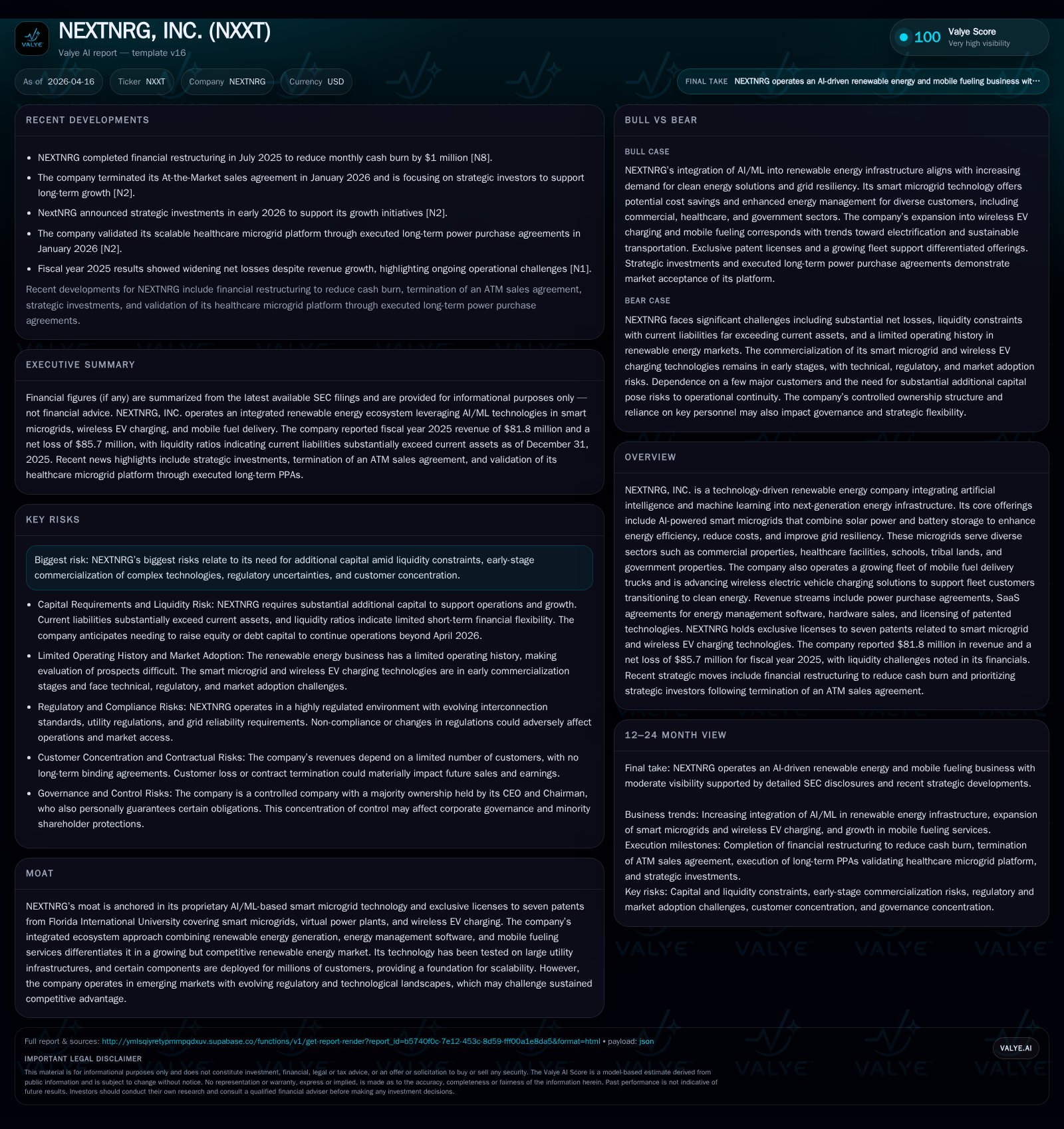
NEXTNRG, Inc. reported a near tripling in revenue to over $81.8 million in 2025, driven by traction in its mobile fueling and renewable energy platforms. However, operating losses widened substantially to over $70 million, reflecting elevated costs from early commercialization and expansion efforts. The company faces significant liquidity constraints requiring capital raises beyond April 2026, with a precarious balance between sustaining innovation initiatives (smart microgrids, wireless EV charging) and managing mounting financial obligations. NEXTNRG’s exclusive technology patents underpin differentiation but market adoption risks remain amid regulatory uncertainty and competitive pressures.
Company Overview and Strategic Positioning
NEXTNRG, Inc. operates at the intersection of renewable energy infrastructure and advanced digital technologies, embedding AI and machine learning into its core offerings. The company's primary value proposition is a proprietary smart microgrid platform that integrates solar power generation, battery storage systems, and intelligent load management designed for commercial real estate, healthcare facilities, schools, tribal lands, recreational sectors, and government properties.
Beyond static infrastructure, NEXTNRG expands into mobile fuel delivery services using a digital platform that facilitates on-demand fueling for individual consumers, commercial fleets, marine vessels, and specialty vehicles — markets characterized by high fuel consumption intensity where convenience drives demand. The company is also developing pioneering wireless electric vehicle (EV) charging technologies aimed at streamlining the transition for fleet operators towards clean energy mobility.
Its moat rests on exclusive licenses to seven patents stemming from Florida International University research encompassing smart microgrids architecture, virtual power plants coordination, and wireless EV charge transfer innovations — providing product differentiation within a competitive renewable ecosystem .
Historical Financial Performance
NEXTNRG’s revenue trajectory evidences rapid top-line expansion amid nascent commercialization phases:
Historical performance (annual)
| FY | Rev ($mm) | Net ($mm) | CFO ($mm) | OpInc ($mm) | Rev YoY | Net YoY |
|---|---|---|---|---|---|---|
| 2025 | 82 | -86 | -14 | -70 | +194.7% | -429.6% |
| 2024 | 28 | -16 | -5 | -7 | +19.6% | -54.6% |
| 2023 | 23 | -10 | -7 | -9 | +54.3% | +40.2% |
| 2022 | 15 | -18 | -12 | -17 |
Source: SEC companyfacts cache [F1].
Capital returns and efficiency (annual)
| FY | ROE% |
|---|---|
| 2025 | 435.7 |
| 2024 | -751.0 |
| 2023 | 549.4 |
| 2022 | -302.6 |
Source: SEC companyfacts cache [F1].
The nearly tripling of revenues (+194.7%) between 2024 and 2025 indicates successful market penetration efforts particularly in mobile fueling services that leverage an app-based customer interface alongside scaled fleet operations [F1][S12,S26]. Despite this advance in sales volumes, the cost base ballooned dramatically — operating income declined approximately ninefold reflecting scaling expenses related to R&D for evolving products like wireless EV charging hardware, administrative overhead increases due to geographic expansion plans across U.S metropolitan statistical areas (MSAs), plus infrastructure investments executed through equipment leases.
Net losses widened more than fourfold as interest on growing debt loads coupled with one-off charges compounded cash burn [F1][S5,S6,S9]. Correspondingly, cash flow from operations remained negative around $14.5 million in fiscal 2025 highlighting persistent working capital absorption associated with deployment cadence.
Liquidity Profile and Capital Structure
The company's liquidity situation is sharply constrained: as of December 31st 2025 Current Assets totaled roughly $3.2 million versus Current Liabilities exceeding $28.3 million — an extremely low current ratio near 0.11 signals potential solvency pressures absent new capital inflows [F1].
NEXTNRG has tapped multiple financings including:
- Senior secured convertible notes aggregating up to $11.8 million issued under a September 2025 purchase agreement involving warrants exercisable into common stock.
- Term loan facilities such as a $750 thousand Cashera Business Loan bearing an effective annualized rate exceeding 170%, indicating strained credit conditions.
- Various promissory notes extended by insiders inclusive of restrictive equity conversion provisions designed as partial debt-for-equity exchanges.
Despite aggressive capital raises through convertible instruments offering investors equity kicker instruments like warrants — dilution risks loom given caps per Nasdaq regulations restricting share issuance without shareholder consent to under 20% ownership percentages [S15][S21].
Business Segments and Market Focus
Operating segments bifurcate primarily into:
- Mobile Fuel Delivery: This service caters to individual consumers for home or workplace refueling via scheduled deliveries optimized by GPS-enabled logistics software. Commercial verticals encompass fleet management for delivery companies, livery operations,and heavy machinery sectors benefiting from reduced downtime through concurrent multi-vehicle refueling during off-hours. Specialty verticals target niche markets such as marina boating vessels prevalent in south Florida with premium-priced fuel needs.
- Renewable Energy Microgrids & Energy Management Software: Utilization of AI/ML enables predictive energy management optimizing consumption patterns while integrating solar PV output with battery storage notably addressing grid resilience needs amid extreme weather events or utility outages.
- Wireless Electric Vehicle Charging Solutions: Innovative hardware yet at commercial pilot stages aiming to complement fleet electrification initiatives with seamless inductive charging technology.
Strategically NEXTNRG prioritizes urban MSAs where vehicular dependency remains high but there exists substantial tailwinds from evolving sustainability mandates at municipal or state levels incentivizing clean energy adoption [S12][S26].
Growth Prospects and Constraints
Future growth avenues lie in expanding deployments of smart microgrid systems coupled with rollout of wireless EV chargers relevant for large-scale fleet electrification programs anticipated across multiple states deploying Infrastructure Investment funds. Cross-selling mobile fuel services alongside these energy products may drive incremental revenue while boosting operational synergies. Nevertheless several constraints temper optimism:
- Regulatory environments governing grid interconnections remain fluid; compliance failures could materially delay project execution timelines or incur fines affecting economics.
- Technology commercialization risk prevails given the sophistication inherent in system integration spanning hardware-software supply chain coordination.
- Customer concentration risk persists as contractual relationships remain cancellable without long-term guarantees raising volatility in recurrent revenues.[S14][S18]
- Geopolitical tensions influencing tariffs on imported components could escalate hardware acquisition costs undermining planned pricing models.[S23]
- Litigation involving the controversial Ingle Florida solar/battery storage project poses potential financial liabilities upwards of $4.1 million impacting near-term cash flows.[S19]
Financial Milestones and Forecast Signals
NEXTNRG has embedded specific operational milestones within equity compensation frameworks:
- Vesting of restricted shares upon commercial deployment thresholds of the third generation solar/wireless EV charging/microgrid system or upon surpassing annual revenues exceeding $100 million or cumulative project deployment costs over $100M.[S25]
Absent official forward guidance disclosures post-10-K filing efforts should focus on tracking quarterly progress towards these deployment goals alongside any announcements regarding enlarged financing rounds critical to sustain working capital requirements past April end-of-runway.[N1][S29]
Capital Allocation and Returns Analysis
With consistent net losses accelerating annually culminating in approximately $85.7 million negative net income in FY2025, and persistent operating cash flow deficits near $14.5 million against modest capex spend estimated circa $3–4M range, the company’s free cash flow stood negative around $17.8 million jeopardizing self-sustaining operations absent external capital injection [F1].
Equity levels swung from positive $2.2M in prior year to negative nearly $19.7M indicating balance sheet erosion primarily linked to accumulated deficits overshadowing shareholder equity base reductions. No dividends or share repurchase activities have been recorded or declared during this period consistent with growth-stage firms prioritizing reinvestment over returns.[F1][S29]
This financial posture reinforces that returns on equity metrics are currently unrepresentative due to negative equity cushions though approximations yield anomalous inflated ROE figures when using purely accounting net income over shareholder equity ratios. Investor focus remains on potential de-risking paths involving revenue scale-up coupled with margin improvement stemming from technology maturation.
Competitive Landscape Insight
NEXTNRG functions within highly fragmented renewable energy markets experiencing escalating competition both from legacy utilities entering AI-managed renewables integration space, and well-funded start-ups leveraging novel virtual power plant architectures. The barriers to entry remain moderate given component commoditization though proprietary AI models combined with exclusive patent licenses create technological differentiation enhancing defensibility. Additionally mobile fueling competitors see low barriers limiting pricing power but NEXTNRG's integrated software platform targeting optimized delivery schedules sets it apart locally.[S12,S14] Wireless EV charging is emergent with uncertain market acceptance complicating forecasts relative positioning vis-à-vis established plug-in infrastructure providers.
Risk Overview Summary
Primary risks include:
- Acute liquidity needs requiring timely successful equity/debt raises which if unmet could force operational cutbacks or restructuring
- Legal disputes especially litigation related to material contracts affecting development rights imposing uncertain financial exposures
- Regulatory volatility particularly federal policy shifts curtailing clean vehicle tax credits dampening market incentives[S7]
- Customer concentration exposure risking revenue volatility[S13]
- Supply chain disruptions via tariffs potentially elevating component costs reducing competitiveness[S23]
- Execution risks inhering in early-stage technologies delaying commercialization amplifying losses[S14]
Conclusion: Watchpoints Ahead
NEXTNRG stands at a critical inflection point balancing aggressive growth ambitions inherent in pioneering next-gen renewable energy infrastructures intertwined with mounting financial strain embodied by widening losses and looming liquidity deadlines extending only until late April 2026 absent securing fresh capital.[F1][S1] Investors and partners should monitor quarterly reports closely for indications of revenue quality progression especially recurring SaaS/services contracts tied into AI-operated microgrids complemented by tangible advancement milestones around third-generation solar-EV wireless deployments unlocking restricted shares incentives.[S25,N1] Equally important will be pathways the company pursues around resolving key litigations related to acquisition claims while deftly managing high-cost debt maturities outstanding across multiple notes stabilized through warrant-induced equity financing flexibility.[S19,S21] Ultimately NEXTNRG’s frontier positioning enabling integrated AI-powered energy ecosystems offers significant potential disruption upside subject to navigating execution risks endemic in capital-intensive emerging technology plays within regulated clean energy sectors.
This document is an independent analysis prepared by Valye News solely for informational purposes; it does not constitute investment advice or a recommendation regarding any securities.
Disclaimer: This is research-only, informational analysis and not investment advice. It may include AI-generated interpretation and general industry context. Always verify important details using primary sources.

Comments