
AppYea's Strategic Pivot to Blockchain Lottery: Early Financial Setbacks Amid Market Entry
AppYea transitioned from digital health AI products to blockchain-based lottery gaming, facing commercial infancy and liquidity challenges.
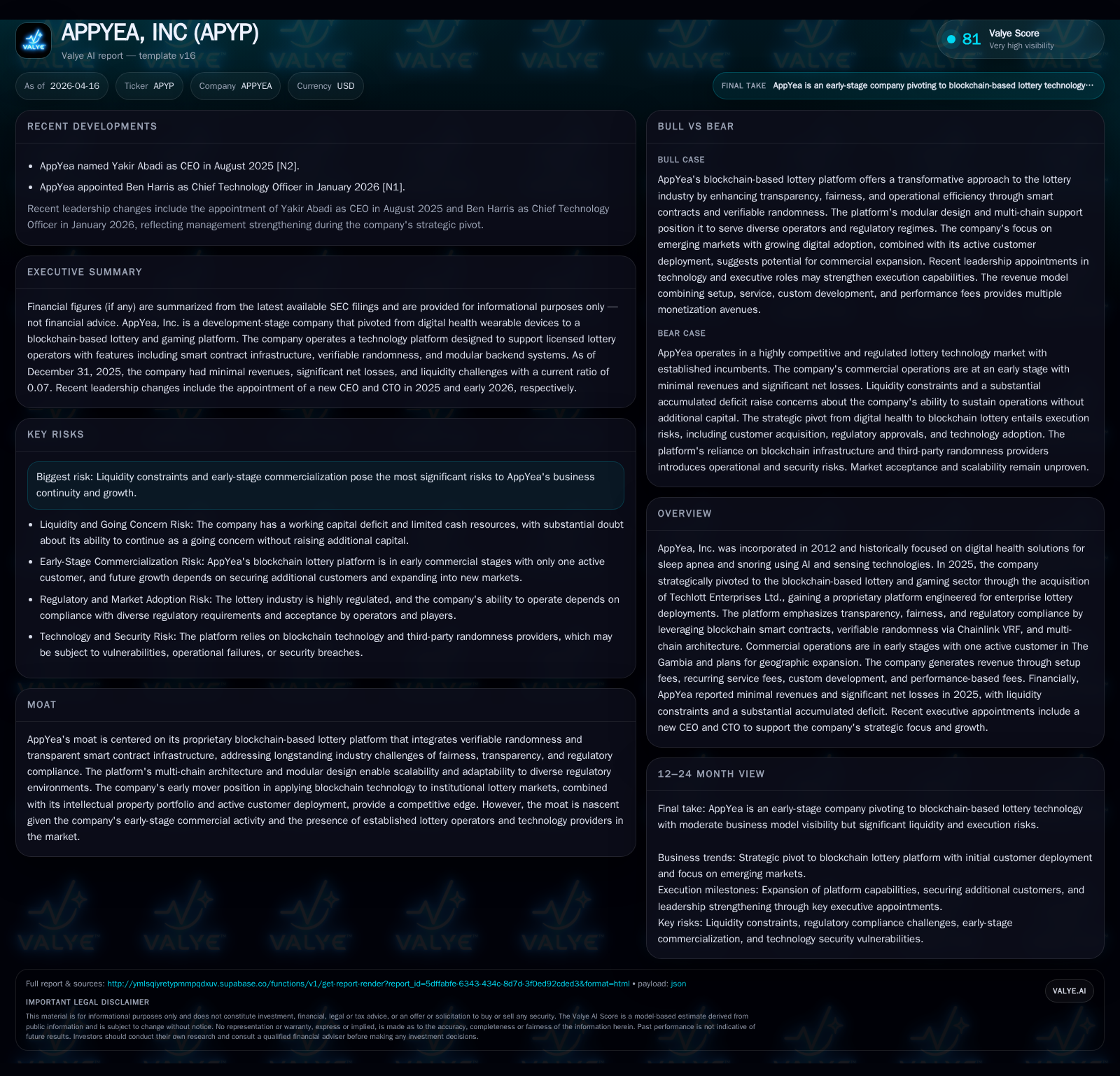
AppYea, Inc. undertook a significant strategic pivot in 2025, moving away from its prior focus on AI-driven sleep apnea solutions to embrace blockchain technology for lottery and gaming platforms. Despite owning a proprietary, multi-chain blockchain platform designed to enhance transparency and regulatory compliance in lottery markets, the company remains in early-stage commercialization with only one active customer. Financially, AppYea reported minimal revenue and widened operating losses in 2025, spotlighting substantial liquidity constraints and capital needs as it strives for market expansion. The company's competitive moat is nascent but rooted in its technology advantages, while execution discipline and funding will be critical to its future trajectory.
Historical Performance Trends and Shifting Revenue Drivers
AppYea’s financial history underscores a pronounced transformation as the company moved from developing AI-enabled digital health devices aimed at diagnosing and treating sleep apnea towards engaging with blockchain lottery platforms post-2025 acquisition of Techlott Enterprises Ltd. Prior to the pivot, revenues were minimal but stable within the healthcare domain; for instance, reported revenue stood at $29K in 2024. Following the strategic reorientation in 2025, revenues plummeted by about 94% year-over-year to roughly $7.6K [F1]. This collapse reflects the cessation of prior product sales combined with nascent commercial activity within the new blockchain gaming vertical.
Concurrently, operating losses escalated dramatically, increasing from approximately $1.8 million (2024) to a steep $17 million loss in 2025 [F1]. This deterioration stems from substantial operational spending related to platform integration costs, fair value adjustments on contingent liabilities linked to share issuances tied to controlling shareholders, and ongoing R&D efforts to transition the product offering [S13]. Operating cash flow remained negative but improved slightly from -$785K in 2024 to -$606K in 2025 [F1], indicating constrained cash burn behavior despite widened losses.
Historical performance (annual)
| FY | Net ($mm) | CFO ($) | OpInc ($mm) | Net YoY |
|---|---|---|---|---|
| 2025 | -15 | -606000 | -17 | -274.4% |
| 2024 | -4 | -785000 | -2 | -121.9% |
| 2023 | -2 | -597000 | -2 | -39.3% |
| 2022 | -1 | -595000 | -2 |
Source: SEC companyfacts cache [F1].
Capital returns and efficiency (annual)
| FY | ROE% |
|---|---|
| 2025 | -116.6 |
| 2024 | 97.7 |
| 2023 | 71.6 |
| 2022 | 51.2 |
Source: SEC companyfacts cache [F1].
The table highlights recognition of significant revenue contraction coinciding with increased investment related to the pivot.
Blockchain-Based Lottery Platform: Technology Edge and Industry Implications
Central to AppYea’s repositioning is ownership of a proprietary blockchain-based lottery platform acquired through Techlott Enterprises Ltd. The platform integrates verifiable randomness employing Chainlink VRF protocols—an industry-standard oracle solution providing cryptographically secure random number generation critical for fairness assurance. Furthermore, its architecture supports smart contract infrastructure enabling transparent contract execution without intermediaries.
This technology suite addresses two historically thorny issues plaguing institutional lottery markets: opacity around randomness generation leading to fairness concerns and opaque compliance with various regulatory mandates across jurisdictions [S6]. The multi-chain architecture enhances scalability and allows adaptation across different regulatory regimes—a crucial capability for international deployments where laws vary drastically.
Such institutional-grade software contrasts with legacy lottery systems that typically lack integrated blockchain components or live auditability of game outcomes. Although early mover advantage exists by embedding blockchain into lottery infrastructure at enterprise scale, entrenched incumbents pose competitive headwinds requiring AppYea’s platform differentiation through seamless operator onboarding and compliance facilitation.
Current Commercial Footprint and Customer Diversification Efforts
Commercially, AppYea’s operations remain embryonic. It currently supports one active customer based in The Gambia—a market characterized by emerging regulatory frameworks where technological modernization efforts aim at improving trustworthiness and regulatory supervision through digital infrastructure [S6]. The revenue model leverages multiple streams: upfront setup fees for deployment and configuration tailored per client; recurring service charges covering maintenance and technical support; bespoke development services adapting the platform to local payment integrations or compliance nuances; plus performance-based fees linked proportionally to transactional volumes processed.
Strategically, AppYea targets licensed operators rather than assuming direct risk as a licensed gambling entity itself—a noteworthy approach reducing regulatory burden but placing emphasis on partner selection and effective collaboration [S6]. Geographic expansion remains planned but early-stage with no disclosed timelines or volumetric revenue targets.
Financial Health and Liquidity Constraints: Balancing Early-Stage Investment with Capital Needs
Liquidity represents perhaps the most acute vulnerability confronting AppYea today. As of December 31, 2025 cash equivalents hovered at $408K juxtaposed sharply against current liabilities totaling about $7.9 million—yielding an extremely tight current ratio approximating only 0.07 [F1], [S4], [S7]. This mismatch generates substantial short-term solvency pressure.
The balance sheet portrays elevated liabilities including derivative financial instruments tied to anti-dilution rights and convertible loans reported at fair value reflecting volatile instrument valuations connected to equity-linked debt features [S14], [S15]. To address imminent cash needs management enacted maturity extensions on promissory notes due through February 2028 but stressed need for additional capital raising remains paramount [S5], [S12]. Recent financing activities included private stock issuances totaling sub-million dollar scales accompanied by warrants—actions evidencing incremental bridging rather than comprehensive recapitalization [S3].
Management cautions that available funds are forecasted sufficient only through December 2026 under current burn assumptions [S5]. This introduces significant going concern disclosures underscoring existential risk absent successful funding or revenue scale gains by then [S12]. Moreover, reliance on equity or debt issuance subjects the company to dilution risk or onerous covenants potentially constraining operational flexibility.
Capital Allocation Strategy and Investor Returns Outlook
AppYea presently does not distribute dividends nor conduct share buybacks given its developmental stage coupled with acute capital demands [S18]. Return metrics reflect severe shareholder value pressures: an approximate return on equity calculated at -116.6% based on last fiscal net loss against equity balance signals pronounced erosion rather than value creation for common shareholders [F1]. Such negative returns correspond logically with intensified operating losses resulting from heightened fair value adjustments of contingent shares issued alongside R&D investments focused primarily on advancing software offerings rather than physical assets or income-generating projects.
Capital expenditures pertain principally to software development including internal-use software costs now subject to amortization following project maturation criteria reassessment during the year [S10], [S13]. The sustained R&D expense focus signals prioritization of platform refinement over immediate monetization while also maximizing IP capture for future licensing or service fees.
In this phase capital preservation remains critical but realization of positive returns hinges entirely on successfully scaling commercial adoption which remains uncertain.
Regulatory Environment Impact and Litigation Risks
Operating within the highly regulated global gambling industry imposes multifaceted challenges for AppYea’s technological offerings owing to heterogeneous regulatory demands extant across jurisdictions served or targetable markets [S22]. While the platform’s design emphasizes compliance facilitation including localized adaptations for payment systems and reporting tools it does not insulate fully against persistent legal risks inherent in regulated gaming spheres globally.
Compounding external risks are internal governance matters highlighted by pending litigation filed in Israeli courts involving key executives including the Chairman related to historical partnership disputes predating the current business framework [S22]. This legal proceeding could impact investor confidence as it raises questions about corporate governance stability amidst ongoing restructuring.
Such factors necessitate continuing cautious monitoring concerning regulatory approvals required per geography as well as resolution progress regarding litigation contingencies affecting management bandwidth.
Key Milestones to Monitor in Market Expansion and Platform Adoption
Absent explicit forward guidance or milestone commitments there remain several operational benchmarks worthy of attention:
- Expansion beyond single active customer status toward multiple licensed operators signifying broader market acceptance,
- Geographic deployment into additional regulated or emerging markets reflecting scalable multi-chain architecture effectiveness,
- Revenue ramp quarters marked by increases in recurring service fees or performance-based income as transactional volumes grow,
- Successes in subsequent equity or debt financings extending runway well beyond December 2026,
- Progression towards technology iterations enhancing operational tools or user engagement modules supporting retention.
Monitoring these commercial execution KPIs can provide tangible early indicators of whether AppYea moves beyond developmental phase toward sustainable growth amid strong incumbent competition within institutional lottery distribution ecosystems.
Conclusion: Strategic Outlook Amid Execution and Funding Challenges
AppYea’s revamped strategy embodies an ambitious attempt to leverage advanced blockchain solutions addressing well-recognized transparency shortcomings within regulated lottery sectors worldwide. Its proprietary platform equipped with verifiable randomness via Chainlink VRF affords credible scientific moat potential if commercial traction materializes robustly across multiple geographies.
However this promise is presently tempered by stark realities reflected in severe financial distress manifested through deepened losses exacerbated by stark liquidity shortages threatening continuity absent successful capital raises shortly thereafter. Early commercialization limited primarily to one client constrains scale economies while persistent governance litigation injects incremental uncertainty hindering sentiment improvement.
Investors should focus closely on operational scalability evidence coupled with prudent liquidity management actions undertaken soon. Achieving broader operator partnerships while navigating complex jurisdictional regulations will ultimately determine if AppYea transitions successfully from technology pioneer status toward a mature lottery technology solutions provider capable of generating stable returns amid stiff incumbent competition.
Disclaimer: This analysis is for informational purposes only based on publicly available filings as of April 16, 2026. It does not constitute investment advice nor endorsement.
Disclaimer: This is research-only, informational analysis and not investment advice. It may include AI-generated interpretation and general industry context. Always verify important details using primary sources.

Comments