
Fastenal Co.’s 2025 Growth Momentum Strengthened by Digital and Site-Centric Strategy
Fastenal's expansion and innovation in integrated inventory solutions and site-centric customer engagement drove robust growth and profitability in 2025.
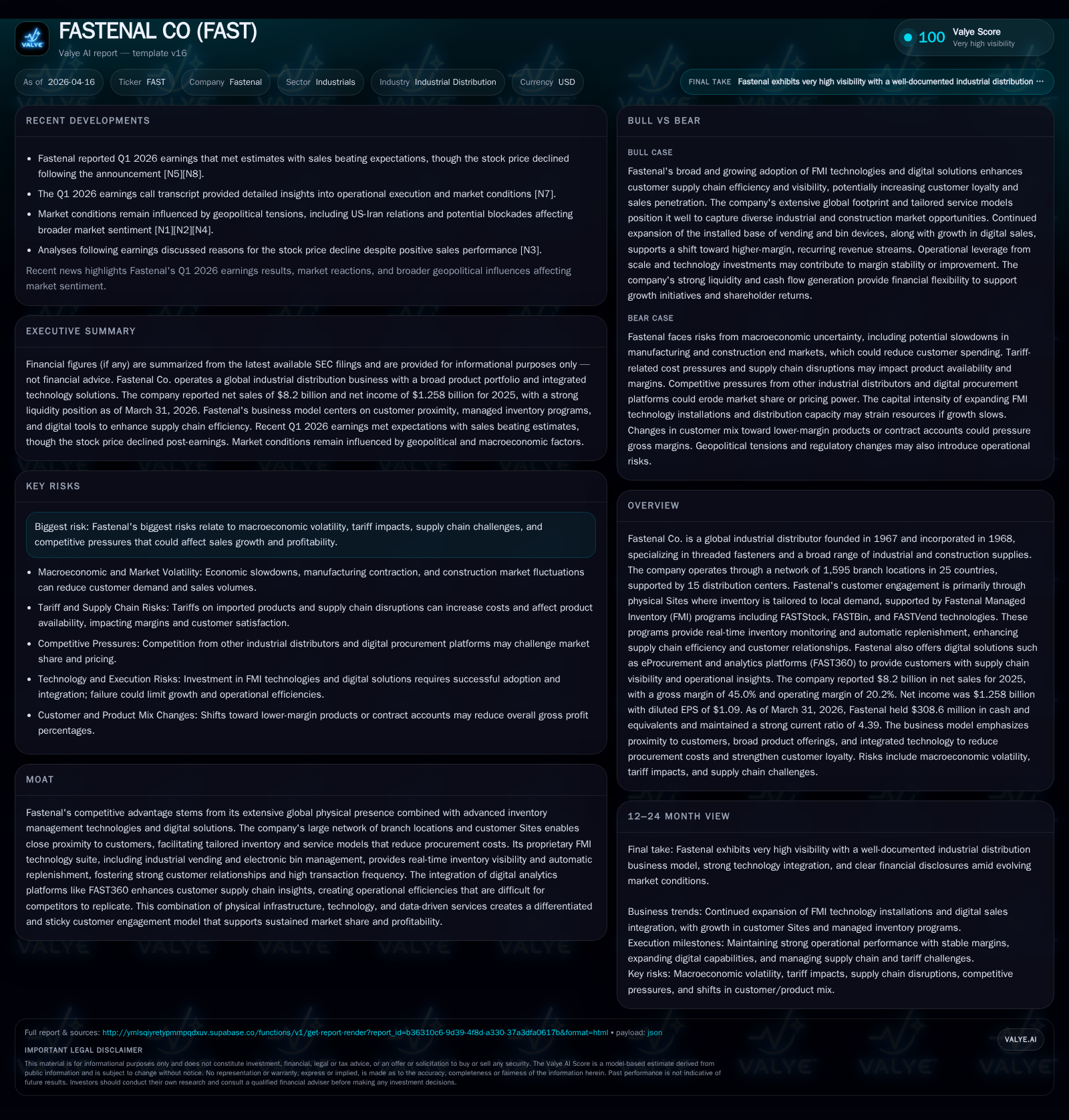
Fastenal Co. leveraged its deep branch network evolving into a customer site-based model complemented by proprietary Fastenal Managed Inventory technologies to achieve an 8.7% revenue growth in 2025. The firm's digital footprint grew to over 60% of sales, enhancing supply chain visibility via FAST360 analytics, reinforcing sticky customer relationships and operational efficiencies. Capital discipline with a strong cash flow profile supported steady dividends and strategic investments in distribution automation, positioning Fastenal for sustained profitability amid macroeconomic uncertainties.
From Branch Network to Global Site-Centric Model: Historical Growth Drivers
Fastenal Co., founded over half a century ago in modest Winona, Minnesota, has transformed steadily from a local fastener supplier into a global industrial distribution powerhouse. Historically anchored by incremental branch openings across varied U.S. markets, its growth story pivoted notably around 2025 toward optimizing customer engagement through a site-centric model [S1], [S5]. Rather than expanding branch counts indiscriminately—which plateaued near 1,595 locations—the focus shifted toward serving distinct customer "Sites," often individual facilities or campuses possessing tailored inventory demands.
In 2025, Fastenal reported net sales of $8.2 billion—an 8.7% increase versus the prior year—and showcased robust revenue growth driven primarily by strategic penetration into high-value manufacturing end markets [F1], [S1]. Manufacturing customers dominate Fastenal’s client base with frequent direct materials purchases integrated into production processes alongside indirect materials supporting operational continuity. This nuanced segmentation enabled Fastenal to tailor inventory assortments precisely to site-specific consumption patterns.
These Sites operate across varied geographies—with a concentration still centered in North America but growing internationally—supported by an extensive physical network supplemented by regional distribution centers [S5]. This evolution from branch footprint expansion to concentrated Site engagement optimizes labor allocation and inventory deployment efficiency.
Historical performance (annual)
| FY | Net ($mm) | CFO ($mm) | OpInc ($mm) | Capex ($mm) | Net YoY |
|---|---|---|---|---|---|
| 2025 | 1258 | 1296 | 1656 | 245 | +9.4% |
| 2024 | 1151 | 1173 | 1510 | 227 | -0.4% |
| 2023 | 1155 | 1433 | 1529 | 173 | +6.3% |
| 2022 | 1087 | 941 | 1454 | 174 |
Source: SEC companyfacts cache [F1].
Capital returns and efficiency (annual)
| FY | Div ($mm) | Buybacks ($mm) | FCF ($mm) |
|---|---|---|---|
| 2025 | 1004 | 1051 | |
| 2024 | 893 | 0 | 947 |
| 2023 | 1017 | 0 | 1260 |
| 2022 | 711 | 238 | 767 |
Source: SEC companyfacts cache [F1].
Table: Historical Financial Performance Summary (2016-2025), revenue rounding to nearest millions [F1]
Physical Proximity Meets Advanced Inventory Technology: Foundations of Fastenal’s Competitive Moat
Fastenal's moat intertwines its unrivaled proximity to customers through branches with its advanced Fastenal Managed Inventory (FMI) programs: FASTStock (bin stocking), FASTBin (electronic bin sensor technology), and FASTVend (industrial vending machines) [S4],[S18]. These offerings elevate traditional distribution into a just-in-time replenishment system where real-time consumption monitoring triggers automatic restocking.
Key to this is the combination of hardware—such as IR sensors lining bins for precise inventory level detection—and software integration that aggregates data signals into centralized logistics planning [S28]. For customers operating lean manufacturing or facility operations management models, this translates into reduced stockouts, diminished labor for inventory counts or orders, and overall procurement friction reduction—a critical advantage given the typically low unit cost but high aggregate volume nature of many fasteners and supplies.
By the end of 2025, Fastenal had installed approximately 124,000 FASTVend devices globally with an estimated addressable market exceeding 1.7 million units giving substantial runway for device installations [S18]. This embedded physical asset base fosters high-frequency transactions with customers – often daily – driving volume consistency alongside operational stickiness unmatched by competitors merely offering digital portals without physical presence.
Sector-wise, these efforts resonate within lean manufacturing workflows where supplier proximity combined with visibility enables agile response to rapid demand shifts ‘at the point-of-use’—a push factor for maintaining high service levels while minimizing working capital tied up in safety stock.
Digital Evolution — Leveraging FMI Suite and FAST360 to Enhance Customer Supply Chains
The digitization of Fastenal’s traditional distribution activities has redefined value capture beyond purely product sales into advanced supply chain insight provision. The company's digital sales footprint—including both hardware-supported FMI programs plus eProcurement platforms like FAST360—accounted for over 61% of total sales in 2025 [S4], signifying deep integration of technology with physical operations.
FAST360 serves as an analytics engine delivering supply chain visibility tools enabling customers to visualize spend categories, monitor inventory turnover rates in real time, track contract compliance, and proactively manage risk exposures from potential stockouts or overstock scenarios [S6]. Such end-to-end transparency facilitates data-driven decision-making protocols that align purchasing patterns tightly with operational needs.
Integration of Microsoft Power BI analytics within FAST360 allows tailored reporting templates which empower both frontline managers at customer sites and executive procurement teams alike—a combination fostering buy-in across hierarchical levels reliant on actionable data insights [S6].
Importantly, these digital capabilities complement rather than supplant Fastenal’s physical channels: electronic orders often route seamlessly into the replenishment cycles governed by nearby branch networks or automated vending units demonstrating a symbiotic hybrid fulfillment model difficult for purely digital or purely brick-and-mortar rivals to replicate.
Customer Segmentation Shift: Targeting High-Value Sites with Tailored Supply Models
Since late 2024/early 2025 disclosure changes reflect strategic emphasis on prioritizing customer Sites delineated by their monthly spend characteristics—with particular focus on those exceeding $50,000 monthly purchases [S8]. Manufacturing $50k+ Sites grew from approximately 1,994 in 2024 to over 2,215 in 2025 exhibiting accelerated penetration among high-value operational nodes.
This refined segmentation enables resource allocation concentrating on locations where operational leverage can be maximized—high-volume sites justify investment in dedicated FMI devices or bespoke contract arrangements that promote both volumetric efficiency gains and margin enhancement via lower transactional costs per dollar sold.
Conversely, less-active small spend sites (<$5k/monthly) declined by over eleven percent year-over-year reflecting an intentional pruning aligning service intensity with economic potential rather than uniform coverage regardless of return-on-investment considerations [S8]. This measured approach supports scalable profitability through selectively intensified digital-physical engagement rather than indiscriminate footprint expansion.
Emerging Risks in Macroeconomy and Technology Integration
While Fastenal maintains substantial resilience due to diversified end-markets—including manufacturing, construction, transportation sectors—the macro environment remains layered with risks:
- Geopolitical & Tariffs: New tariffs introduced across various product lines inflate input costs forcing dynamic price/cost neutrality adjustments that may pressure gross margins if unpassed [S9], [S1].
- Supply Chain Volatility: Extended lead times due to overseas sourcing coupled with transportation network disruptions pose risks for inventory availability alignment especially amid rapid demand shifts [S15].
- Technology Adoption: Integrating emerging AI-driven analytics or next-gen vending capabilities carries execution risks including cybersecurity vulnerability exposures crucial given the mission-critical nature of industrial supply chains [S17]. Failure here could impair operational continuity or erode competitive edge.
- Operational Liability: Increased exposure entering higher-risk industrial sectors could heighten insurance claims or reputational damages linked to product liability or catastrophic events at customer sites [S17].
The interplay of such risks requires nimble mitigation strategies balancing cost containment with necessary technology investments while safeguarding supply reliability for customers operating just-in-time manufacturing regimes.
Capital Allocation Excellence: Cash Flow Generation, Dividends, and Strategic Capex
Financially, Fastenal demonstrated robust capital discipline in fiscal year 2025:
- Generated operating cash flow approximating $1.3 billion (+10% YoY), supporting near $245 million capex devoted primarily to FMI hardware expansions, distribution center automation upgrades, and IT infrastructure improvements [F1], [S13].
- Free cash flow after capital expenditures exceeded $1 billion underpinning sustainable dividend policy increases totaling $1 billion paid out during the year—a reflection of consistent shareholder returns even amid expansion investments [F1], [S26].
- No share buybacks were executed in recent years conserving liquidity for organic growth initiatives aligned with long-term site network optimization plans [F1], [S26].
- Reported return on equity approached a healthy ~32%, signaling efficient use of equity capital catalyzing shareholder wealth creation given controlled debt burdens ($125 million outstanding under Master Note Agreement) and strong current assets coverage (current ratio >4x) [F1], [S7].
This balanced approach highlights management’s pragmatic stance favoring reinvestment into growth-enhancing technologies while rewarding shareholders consistently without jeopardizing financial flexibility.
Operating Performance Milestones and What to Watch Next
The company reported a solid top-line surge of nearly 15% YoY in its latest full year results ending December 31st, 2025 driven by both organic share gains across segments and further penetration of managed inventory offerings converting transactional spend into sticky contractual relationships [F1]. First-quarter results released April ’26 indicated earnings meeting guidance expectations though shares experienced slight price pullback partially due to short-term sentiment factors unrelated directly to fundamentals but worth observing for any volatility signals post-release [N2], [N4], [N1].
Going forward key metrics warrant close attention including:
- Continued growth trajectory within digital footprint penetration toward the stated goal exceeding two-thirds total sales,
- Expansion rate among >$50k monthly spend Sites which underpins scalable margin improvements,
- Adoption curve momentum of new FMI devices relative to forecasted market capacity (~1.7 million units),
- Potential impact from evolving tariff environments affecting gross margins,
- Progress integrating AI-enhanced forecasting tools within FAST360 analytics complementing existing predictive replenishment algorithms,
- Any indications of supply chain strain impacting customer service levels particularly in overseas sourced fastener segments.
Overall Fastenal appears well positioned yet remains sensitive to external macroeconomic shocks necessitating adaptive strategies.
Disclaimer: This analysis is based purely on publicly available financial statements and news reports provided herein as of April 2026; it does not constitute investment advice or recommendation. Market conditions can change rapidly affecting company prospects differently than historical trends suggest.
Disclaimer: This is research-only, informational analysis and not investment advice. It may include AI-generated interpretation and general industry context. Always verify important details using primary sources.

Comments