
China Foods Holdings: Financial Trends and Regulatory Dynamics Shaping Its Health Sector Role
Analyzing how China Foods Holdings’ financial losses and supply chain strategies intersect with regulatory risks to influence its future in China’s expanding health market.
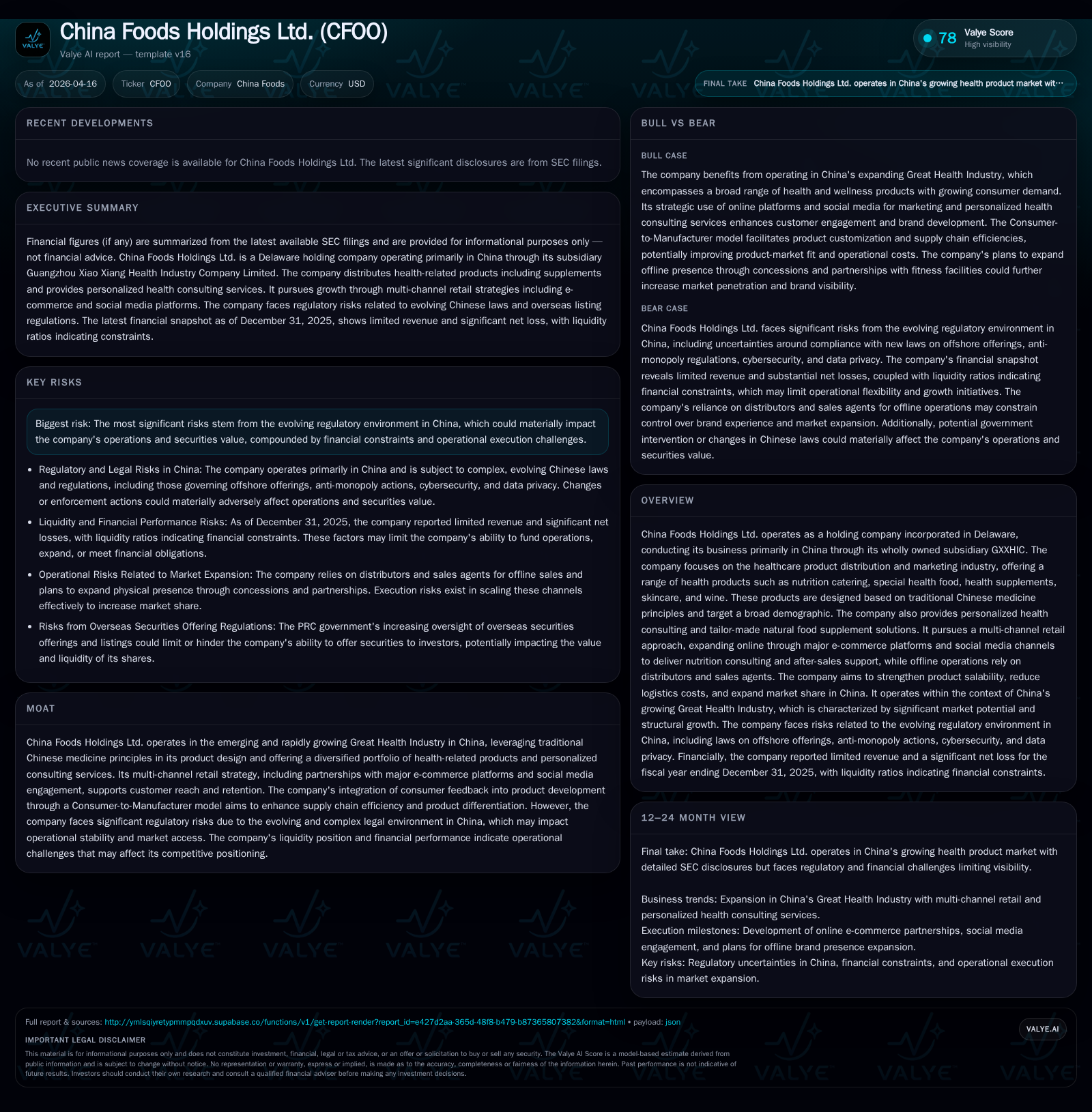
China Foods Holdings Ltd., operating primarily through its Chinese subsidiary GXXHIC, focuses on traditional Chinese medicine–based health products and personalized consulting via a multi-channel retail model. Despite the rapidly growing Great Health Industry in China, the company has experienced persistent operating losses from 2022 through 2025, alongside liquidity constraints evidenced by a very low current ratio and negative equity. Regulatory complexities in China, particularly around data security and monopoly oversight, add uncertainty to operational stability. Growth initiatives leveraging consumer-driven manufacturing (C2M) and expanding online and offline sales channels offer potential avenues for improvement, but careful monitoring of regulatory adaptation and financial health remains paramount.
Historical Financial Performance Reflecting Early-Stage Operational Challenges
China Foods Holdings Ltd. has recorded persistent operating deficits across recent fiscal years. According to available SEC XBRL company facts [F1], the company reported operating income losses of approximately -$392,733 USD in 2022 escalating slightly to -$455,637 USD in 2024 before marginally improving to -$398,923 USD in 2025. Net income followed a similar trajectory with a loss of -$354,078 USD in 2022 worsening through 2024 before a modest recovery to -$398,672 USD last year. This pattern highlights early operational challenges typical in scaling health product distribution amid competitive market dynamics.
Revenue data prior to the merger-related transition is not reported [F1], reflecting that Trafalgar Resources Inc., the pre-merger entity acquired in early 2019, had not commenced substantive operations previously. The lack of historical sales figures limits comprehensive trend analysis but suggests initial developmental stages for CFOO’s Chinese subsidiary GXXHIC within the Great Health Industry.
Operating cash flow (CFO) mirrored these losses with an outflow deepening from -$171,598 USD in 2022 to approximately -$389,251 USD by 2025 [F1]. Capital expenditures (capex) have remained relatively low but steady at circa $23,454 USD per annum over the last two years — indicating measured investment activity likely focused on foundational infrastructure rather than aggressive expansion.
Historical performance (annual)
| FY | Net ($) | CFO ($) | OpInc ($) | Capex ($) | Net YoY |
|---|---|---|---|---|---|
| 2025 | -398672 | -389251 | -398923 | 23454 | +12.5% |
| 2024 | -455571 | -353812 | -455637 | 23454 | -12.8% |
| 2023 | -403700 | -297169 | -404637 | 746 | -14.0% |
| 2022 | -354078 | -171598 | -392733 | 27358 |
Source: SEC companyfacts cache [F1].
Capital returns and efficiency (annual)
| FY | FCF ($) | ROE% |
|---|---|---|
| 2025 | -412705 | 31.2 |
| 2024 | -377266 | 53.5 |
| 2023 | -297915 | 103.3 |
| 2022 | -198956 | -2031.5 |
Source: SEC companyfacts cache [F1].
Reported figures per fiscal year end from SEC filings [F1].
The company’s current ratio currently stands near a precarious 0.11 driven by current assets of $162,943 USD against obligations exceeding $1.48 million USD [F1]. Equity has turned deeply negative at approximately -$1.28 million USD as of December 31, 2025 [F1], signaling constrained financial flexibility going forward.
Business Model and Product Diversification Rooted in Traditional Healthcare
Through its wholly owned subsidiary Guangzhou Xiao Xiang Health Industry Company Limited (GXXHIC), China Foods Holdings operates within China focussing on health products designed according to traditional Chinese medicine principles [S7][S9]. The product portfolio spans nutrition catering services, special health foods tailored for specific wellness needs, health supplements formulated on TCM theories of complementary medicine combinations, skincare lines emphasizing holistic health enhancement, and wine products aimed at wellness-oriented demographics.
This framework targets all age groups with variations catering to different life stages and health concerns [S9]. Complementing physical products is a suite of personalized health consulting services offering tailor-made nutritional plans and natural food supplement solutions aligned with consumer conditions.
Crucially, the firm employs a multi-channel retail approach combining digital engagement via dominant e-commerce platforms such as Tmall and Jingdong mall alongside emerging social media ecosystems on WeChat, TikTok, and Xiaohongshu for direct healthcare knowledge dissemination and consultation delivery [S7]. Offline channels depend heavily on expanding distributor networks and agent-based salesforce model supported by strategic plans for physical concessions or nutrition clubs linked to fitness centers aiming to enhance brand presence on-ground [S7].
Significantly, CFOO leverages a Consumer-to-Manufacturer (C2M) model integrating realtime customer feedback loops into its supply chain design facilitating improved demand forecasting and product differentiation [S7]. This aligns manufacturing more closely with actual consumer needs reducing inventory cost burdens while promoting stronger alliance formation internally along upstream partners including manufacturers and distributors.
Navigating Regulatory Complexities Amid Data Security and Monopolistic Oversight
Operating predominantly within Mainland China’s regulatory regime exposes CFOO to numerous evolving legal risks common among companies straddling cross-border public listings [S4][S8][S10]. Important recent developments include implementation of the PRC Data Security Law alongside Personal Information Protection Law enacted in 2021 which pose heightened cybersecurity and data privacy compliance demands [S4][S19].
While management reports no known breaches nor violations presently [S6], ongoing adaptation efforts remain critical as new Cybersecurity Review Measures issued by the Cyberspace Administration of China may impose additional mandatory clearances affecting overseas-listed entities like CFOO [S19].
Further complication arises under intensified anti-monopoly regulations tightening enforcement scope around competition practices impacting supply chain partners’ conduct plus distribution exclusivity issues [S8]. Although currently no formal inquiries against CFOO or GXXHIC exist regarding monopolistic concerns or breach of anti-competition rules [S17], latent penalties including fines or business suspensions represent material contingencies arising from inadvertent noncompliance.
Moreover prevalent uncertainties persist related to offshore securities regulation requiring filings or approvals from Chinese authorities for overseas listings or offerings affecting continued access to foreign capital markets – a recognized threat that could hinder equity financing or asset value realization [S4][S8][S17]. Historical licensing confirms possession of business license under State Administration for Market Regulation yet ambiguity exists whether future licenses might become prerequisites for expanded service offerings or market reach beyond current scope [S8][S17].
These layers collectively underscore China’s complex jurisdictional landscape where rapid legal evolutions combined with opaque enforcement discretion conspire against operational predictability making regulatory monitoring indispensable for sustainable market positioning.
Strategic Growth Initiatives Leveraging C2M Model and Multi-Channel Sales Expansion
China Foods Holdings’ growth strategy hinges on expanding both digital reach through established e-commerce giants alongside intensifying physical presence via distributors and agent networks [S7]. The nutrition consulting service launched via social media since late 2020 exemplifies a pioneering effort aimed at enhancing client interaction with pre-sale guidance plus robust after-sales support fostering customer loyalty.
Offline enhancements contemplate dedicated branded point-of-sale concessions within high-traffic retail environments as well as collaborative partnerships with premium fitness centers establishing nutrition clubs focusing on lifestyle integration including weight-loss programs regimented alongside healthcare assessments [S7].
Underpinning these tactics is the advanced C2M supply chain integration model continuously assimilating consumer experience data fed back into manufacturing specifications permitting tailored formulation innovation promoting better product-market fit plus cost optimization across inventory holdings.
Longer-term ambitions also involve strategic acquisitions or partnerships intending diversification beyond existing product segments potentially accelerating top-line growth while broadening competitive moats vis-à-vis emerging wellness industry players within China’s burgeoning Great Health ecosystem projected at RMB11.4 trillion by end-2026 comprising functional foods valued near RMB483 billion segment alone [S9].
Liquidity Constraints and Capital Allocation: Cash Flows, Debt, and Equity Trends
Liquidity remains tightly constrained given CFOO’s small cash reserves (~$9k USD at FY-end 2025), minimal current assets relative to substantially larger liabilities totaling nearly $1.48 million USD yielding an acutely stressed current ratio approximated at just 0.11 per latest filing data [F1]. This imbalance indicates difficulty meeting short-term obligations absent external capital infusion or drastic operational cash flow improvements.
Compounding financial pressure stems from sustained negative equity now reaching roughly -$1.28 million USD further evidencing capital erosion undermining balance sheet resilience [F1]. Operating cash flows continue negative without meaningful improvement slipping further from around -$171k USD in early years into excess of -$389k USD last fiscal year reflecting widening working capital needs plus ongoing unprofitable core operations amidst scaled activities [F1].
Capital expenditure outlays remain modest but steady hovering near $23k USD per annum recently thus far seemingly insufficient to materially lift growth capacity though potentially preserving essential asset maintenance functionality rather than growth capex investment [F1][S16].
Management indicates no dividend payments or share repurchase programs currently given operational losses compounded by liquidity stress with intent expressed to retain all earnings (if any arise) towards funding working capital demands plus business development initiatives foreseeable near term [S16][F1].
Absent clear turnaround signals these financial realities accentuate vulnerability necessitating close attention by stakeholders evaluating incremental funding needs alongside capacity for debt servicing or equity issuance if pursued.
Key Milestones To Watch: Market Penetration, Regulatory Adaptation, and Profitability Turning Points
Looking ahead without explicit management guidance disclosed publicly, several critical inflection points warrant observation:
- Successful navigation of increasingly stringent data privacy laws plus anti-monopoly enforcement avoiding penalties that could disrupt core operations or erode investor confidence;
- Expansion velocity across e-commerce platforms alongside offline reach gauged via distributor growth rates augmented by emerging concessions/nutrition club ventures influencing brand visibility;
- Improvement trends towards positive operating income supported by scalable C2M efficiencies generating incremental gross margin lift translating into narrower net losses;
- Measurable enhancements in operating cash flow profile signaling improved working capital management reinforcing sustainability prospects;
- Any strategic partnership announcements or accretive acquisitions expanding product breadth solidifying competitive positioning within China’s Great Health Industry domain.
Continuous monitoring across quarterly filings coupled with developments in PRC regulatory frameworks impacting overseas-listed companies will consequently be pivotal for assessing trajectory shifts potentially unlocking latent value embedded amid current challenging circumstances.
This analysis utilizes audited financial statements filed as of April 16th, 2026 alongside descriptive disclosures within official SEC filings including the Form10-K dated April16th2026 among others ([F1],[S1]-[S28]). It aims solely at providing an informed evaluation without issuing investment recommendations.
Disclaimer: This is research-only, informational analysis and not investment advice. It may include AI-generated interpretation and general industry context. Always verify important details using primary sources.

Comments