
Insteel Industries' Earnings Slip: What Q2 2026 Reveals About Supply Chain Strains and Future Growth
Q2 2026 results spotlight revenue growth shadowed by tightening margins amid geopolitical supply pressures.
Insteel Industries Inc.’s Q2 2026 earnings showed revenue momentum but margin pressure due to rising raw material and logistics costs amid geopolitical tensions. The company sustained shareholder returns through steady dividends and modest buybacks despite lower cash flow. Historical performance reveals cyclicality with recent revenue recovery and volatile cash flows. Market technicals hint at improving investor sentiment, yet supply chain challenges remain key risks.
Q2 2026 Performance Recap: Revenue Gains Tempered by Margin Pressure
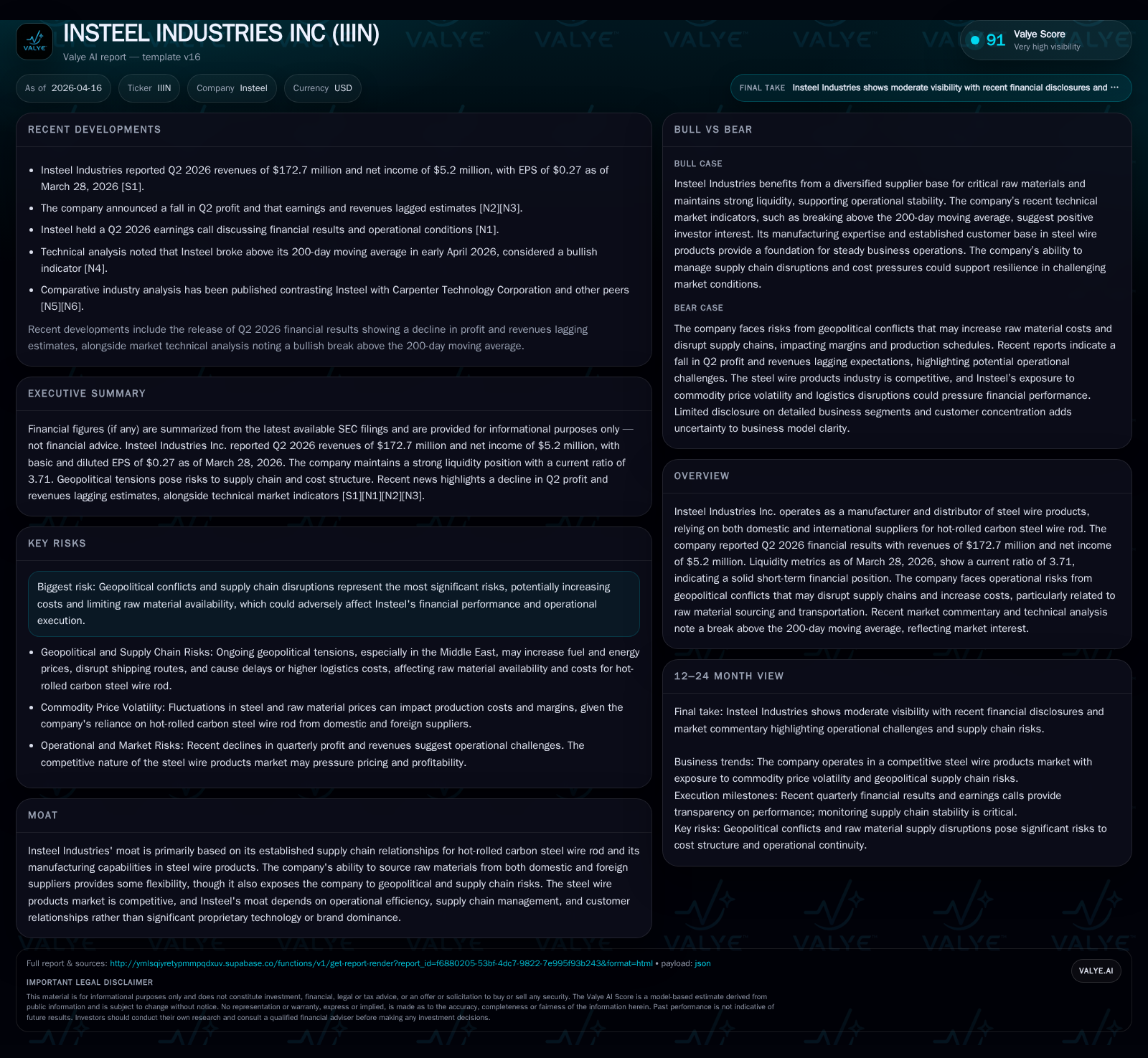
Insteel Industries reported second quarter revenues of $172.7 million for the period ending March 28, 2026 [N1]. This reflects ongoing sales activity amid challenging market conditions; however, net income declined to approximately $5.2 million, below analyst expectations and prior periods [N2][N3]. The decrease stems largely from rising costs of hot-rolled carbon steel wire rod—its primary raw material—and increased logistics expenses connected to geopolitical disruptions [S2][S4]. Liquidity remained solid with a current ratio of about 3.71 at quarter-end, indicating strong short-term asset coverage relative to liabilities [F1]. Despite top-line growth, margin compression highlights operational pressures related to external supply chain factors.
Historical Growth Trends and Drivers: Cyclicality and Cash Flow Variability
Reviewing fiscal years 2022 through 2025 reveals significant cyclicality in Insteel’s financials. Revenues fell from $826.8 million in FY2022 to $647.7 million in FY2025, after recovering from a dip in FY2024 [F1]. FY2025 saw a revenue increase of roughly 22.4% compared to FY2024’s $529.2 million, signaling partial rebound amid fluctuating industrial demand.
Net income similarly oscillated, rising over 112% year-over-year to about $41 million in FY2025 from a softer FY2024 base [F1]. Operating cash flow exhibited notable volatility, falling more than half (-53.3%) in FY2025 versus the previous year’s $58.2 million [F1], reflecting typical working capital fluctuations inherent in the steel wire manufacturing sector.
Capital expenditures declined significantly from their FY2023 peak ($30.7 million) down to approximately $8.2 million in FY2025, illustrating cautious investment amid uncertain market conditions [F1]. These trends collectively depict an industry balancing cyclical demand swings alongside raw material sourcing complexities.
Historical performance (annual)
| FY | Rev ($mm) | Net ($mm) | CFO ($mm) | Capex ($mm) | Rev YoY | Net YoY |
|---|---|---|---|---|---|---|
| 2025 | 648 | 41 | 27 | 8 | +22.4% | +112.5% |
| 2024 | 529 | 19 | 58 | 19 | -18.5% | -40.4% |
| 2023 | 649 | 32 | 142 | 31 | -21.5% | -74.1% |
| 2022 | 827 | 125 | 6 | 16 |
Source: SEC companyfacts cache [F1].
Capital returns and efficiency (annual)
| FY | Div ($mm) | Buybacks ($mm) | FCF ($mm) |
|---|---|---|---|
| 2025 | 22 | 2 | 19 |
| 2024 | 51 | 2 | 39 |
| 2023 | 41 | 2 | 111 |
| 2022 | 41 | 1 | -10 |
Source: SEC companyfacts cache [F1].
Note: YoY % changes reflect sequential fiscal year comparisons.
Supply Chain Fragility and Geopolitical Risks Impacting Raw Material Costs
Insteel depends heavily on hot-rolled carbon steel wire rod sourced domestically and internationally—a diversified approach that nonetheless exposes it to geopolitical risks [S2][S4]. Conflicts in the Middle East involving Iran threaten critical oil-producing and shipping corridors essential for global freight and energy markets.
The company identifies rising fuel prices as increasing transportation and manufacturing energy costs; port congestion causing delays; higher insurance premiums; and rerouted freight adding transit time—all factors driving up landed raw material costs [S2]. These supply chain disruptions challenge Insteel's ability to consistently meet customer demand while maintaining margins given competitive pressures limiting full cost pass-through [S4].
Capital Deployment Strategy: Dividends, Buybacks, and Cash Flow Assessment
Despite operating cash flow declining from over $58 million in FY2024 to just above $27 million in FY2025 [F1], Insteel continued returning capital with dividends totaling about $21.8 million during the latest fiscal year [F1][S14][S15]. Share repurchases were modest but consistent at approximately $2.3 million for FY2025 [F1], indicating measured capital recycling aimed at supporting shareholder value.
Capital expenditures were reduced by nearly 60% year-over-year, aligning investments with operational priorities rather than expansion amid market uncertainty [F1]. Return on equity stands near an estimated 11% based on net income of $41 million relative to shareholders’ equity of roughly $371.5 million as of FY2025 end, reflecting respectable profitability under sector headwinds.
Profitability Metrics and Return on Equity Context
While margin pressures from input cost inflation have impacted gross profits, net income growth highlights operational leverage where incremental sales still contribute positively [F1]. This sustains an ROE near double digits—a meaningful measure of capital efficiency despite external cost challenges.
Market Sentiment Shift: Technical Indicators and Investor Reaction
Prior to Q2 earnings release, Insteel's stock price surpassed its long-term (200-day) moving average—a technical signal often interpreted as improving investor confidence or momentum despite fundamental headwinds [N4]. For buy-side investors, such signals may indicate shifting risk appetite following volatility phases; however, sustaining momentum depends on easing raw material cost pressures.
Outlook and Key Milestones Ahead
Though explicit guidance remains limited, management highlighted focus areas including stabilization of raw material prices as geopolitical tensions potentially ease or alternate sourcing develops [N1]. Future quarters will be closely watched for margin recovery signs alongside improvements in logistics such as easing port congestion or reduced freight rerouting costs.
Working capital management remains critical given prior cash flow volatility; enhancements here could unlock liquidity for strategic investments or increased shareholder returns.
In summary, navigating persistent external risks will shape Insteel’s near-term trajectory with milestones centered on operational continuity and margin normalization tied closely to global supply chain developments.
This analysis is based exclusively on publicly available information as of April 16, 2026 including SEC filings and verified news sources cited herein; it does not constitute investment advice or recommendation.
Disclaimer: This is research-only, informational analysis and not investment advice. It may include AI-generated interpretation and general industry context. Always verify important details using primary sources.

Comments