
DOMO's Modest Revenue Growth Challenges Profitability and Operating Efficiency in FY2026
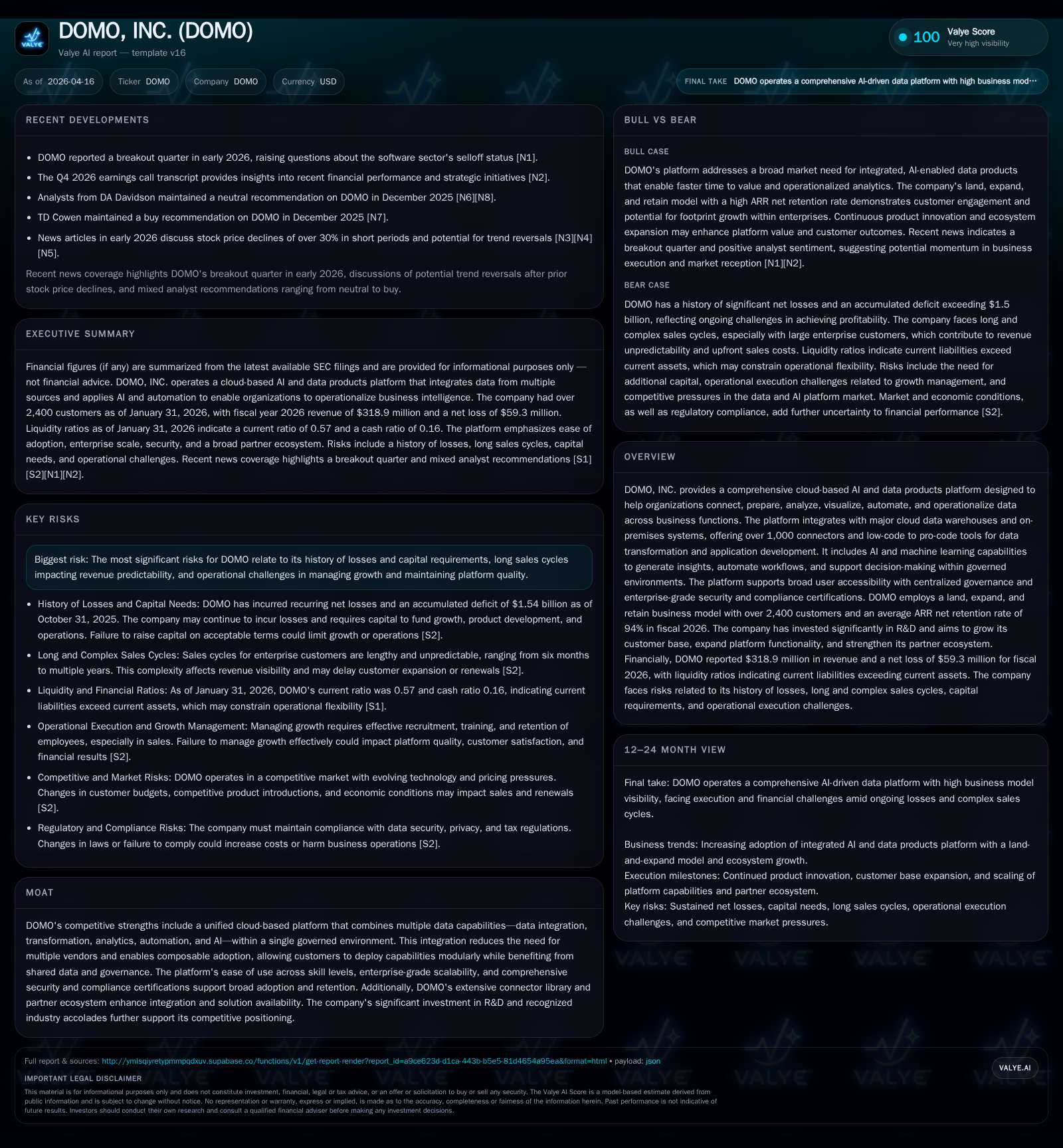
DOMO, INC. sustains its cloud-based AI-driven data platform growth with over 2,400 customers, yet ongoing losses and operational investments constrain profitability.
DOMO, INC. reported nearly flat revenue growth around $319 million in FY2026 with improved net losses compared to prior years but still significant negative operating income. The company operates a unified cloud platform integrating data integration, transformation, analytics, automation, and AI within a governed environment serving a broad customer base predominantly in the U.S. Despite strong ARR retention hovering around 94%, DOMO faces long sales cycles, capital-intensive investments especially in R&D and international expansion, and competitive pressures from large software vendors. Cash flow modestly improved but free cash flow remains negative due to sustained capex. Future growth prospects hinge on expanding international presence, deepening enterprise adoption through a land-and-expand strategy, and continuous AI integration. Success depends on effective scaling of sales productivity and improving gross margins amid fierce competition and regulatory complexities.
Historical Financial Performance
DOMO's recent fiscal years show relatively stable revenues near $319 million with modest fluctuations: a slight 1% decline in FY2025 followed by a recovery to near prior levels in FY2026 as per SEC filings [F1][S8]. This stability reflects a broad customer base exceeding 2,400 entities worldwide, primarily U.S.-based.
Despite stable top-line figures, DOMO continues to report significant operating losses that have improved from -$88.9 million in FY2023 to -$39.1 million in FY2026, alongside net losses narrowing from -$105.5 million to -$59.3 million over the same period [F1]. Operating cash flow turned positive at $7.9 million in FY2026 after prior negative results; however capital expenditures near $10 million annually keep free cash flow slightly negative [-$2.0 million] indicating ongoing investment needs [F1].
Historical performance (annual)
| FY | Net ($mm) | CFO ($mm) | OpInc ($mm) | Capex ($mm) | Net YoY |
|---|---|---|---|---|---|
| 2026 | -59 | 8 | -39 | 10 | +27.6% |
| 2025 | -82 | -9 | -59 | 9 | -8.4% |
| 2024 | -76 | 3 | -55 | 12 | +28.4% |
| 2023 | -106 | -11 | -89 | 8 |
Source: SEC companyfacts cache [F1].
Capital returns and efficiency (annual)
| FY | FCF ($mm) | ROE% |
|---|---|---|
| 2026 | -2 | 31.9 |
| 2025 | -18 | 46.2 |
| 2024 | -9 | 49.2 |
| 2023 | -19 | 72.1 |
Source: SEC companyfacts cache [F1].
Note: Dividends and share repurchases have not been reported recently reflecting reinvestment focus.
Business Model and Platform Overview
Domo offers an integrated cloud-native AI and data products platform comprising five core pillars: data integration, transformation, business intelligence & analytics, applications & embedded experiences, and automation & AI workflows—all governed centrally for enterprise readiness [S4][S5][S16].
The platform connects seamlessly with leading cloud data warehouses such as Snowflake, Amazon Redshift, Google BigQuery among others enabling customers to leverage existing infrastructure investments rather than replacing them outright [S5][S14]. It supports over a thousand connectors facilitating diverse data ingestion including on-premises sources.
Advanced AI capabilities are embedded throughout the platform including model management and access to third-party AI models enabling customers to build "Agent Catalyst" AI agents that operate across workflows with human oversight—highlighting responsible AI governance emphasis [S11][S19].
The composable architecture allows customers modular adoption—starting with foundational capabilities like data integration or BI then expanding into applications or automation without re-architecting data pipelines or fragmenting governance—supporting incremental investment aligned to business priorities [S6][S14].
Customer Base and Sales Dynamics
Domo serves over 2,400 customers globally with approximately 80% of revenue from U.S.-based clients across industries and company sizes; no single customer accounts for more than 10% of revenues reducing concentration risk [S8][S22][S24]. Customers are defined broadly including subsidiaries or divisions counted separately when invoiced distinctly.
Sales follow a land-and-expand approach where initial deployments typically occur within specific divisions or use cases before broader enterprise adoption driven by demonstrated value and engagement metrics [S8][S16]. Multi-year contracts represent about 76% of dollar-weighted recurring GAAP revenue as of January 31, 2026—up from prior years—and ARR net retention averaged approximately 94%, evidencing strong renewals and upsell success [S8].
Direct sales dominate complemented by growing channel partnerships including system integrators and resellers aimed at expanding international reach amidst localization efforts [S4][S24]. Marketing activities target senior functional leaders supported by annual user conferences like Domopalooza fostering community engagement.
Growth Prospects and Constraints
Domo targets broad market opportunity driven by enterprises’ increasing demand for integrated AI-enabled data platforms that enable rapid insight-to-action workflows under secure governance—applicable across departments such as marketing, HR, finance, IT among others especially amid accelerated digital transformation trends post-pandemic [S12].
Growth drivers include expanding domestic customer base as well as international markets where penetration remains lower but requires upfront investment for localization compliance (privacy laws), latency improvements and channel development typical for SaaS scaling abroad [S24]. Such expansion demands capital with uncertain near-term returns.
Deepening existing client penetration through modular adoption of analytic capabilities first then layering automation apps and AI agents enhances platform stickiness via ecosystem effects [S6][S8]. Product development invests heavily in ease-of-use (low-code), scalability targeting enterprise requirements alongside continuous AI innovation maintaining competitiveness against rivals who bundle offerings aggressively potentially pressuring pricing power [S7][S13].[N1]
Competitive pressures arise from large technology companies (Microsoft Azure Power BI; AWS Quicksight; Google Looker), specialized analytics firms (Tableau/Salesforce; Qlik; ThoughtSpot), cloud-native integrators (FiveTran; Databricks) whose greater scale challenges Domo’s ability to maintain market share amid consolidation trends [S13][S18].[N2]
Capital Allocation and Returns Analysis
Despite progress narrowing net losses showing better operational performance DOMO remains unprofitable signaling prioritization of growth-oriented investments such as R&D which has exceeded $1 billion cumulatively underpinning broad platform development though delaying near-term profitability realization consistent with SaaS industry norms for complex B2B scale-up phases [F1][S7].
Positive operating cash flow of about $7.9 million in FY2026 reflects improving cash conversion aided by multi-year contracts enhancing revenue visibility though sustained capex near $10 million annually keeps free cash flow negative around -$2 million due to infrastructure scaling including critical cybersecurity investments supporting compliance certifications like SOC2 type II,HITRUST,HIPAA valued by regulated sectors such as healthcare or finance [F1][S20].[N1]
Liquidity metrics show challenges with current ratio below unity (~0.57) indicating working capital pressures typical among growth-stage SaaS companies balancing receivables collections against spending on growth initiatives; equity remains deeply negative reflecting accumulated losses over years rather than immediate solvency concerns given positive operating cash flows but warrants monitoring if macroeconomic headwinds intensify [F1].
No dividends or share repurchases have been reported recently consistent with reinvestment strategy during this phase [F1]. Return on Equity is not meaningful due to negative equity though improving net loss margins indicate directional operational progress.
Risks Summary
Key risks include continued history of losses raising concerns about sustainable profitability despite improvements; elongated sales cycles typical of enterprise software complicating revenue predictability; intense competition from entrenched big-tech vendors offering bundled solutions potentially eroding market share; evolving regulatory compliance obligations spanning privacy (GDPR,PIPL), security certifications increasing costs alongside international trade uncertainties complicating geographic expansion execution; talent acquisition/retention pressures amid competitive tech labor markets remain salient as Domo scales globally; cybersecurity breaches could severely damage customer trust given sensitive data handled highlighting critical risk management needs .[N1]
Monitoring Points Ahead (Analysis)
Without explicit guidance beyond latest filings ([N1],[N2]), stakeholders should monitor:
- Trends in subscription revenue mix between consumption-based vs fixed tiers indicating monetization effectiveness.
- Expansion rates within existing customers via usage growth supporting ARR uplift potential.
- Progress on international market penetration including marquee accounts outside the U.S.
- Operating margin improvements reflecting scaling efficiencies offsetting increased sales & marketing spend.
- Product innovation cadence notably uptake of AI agent orchestration offering differentiation vs competitors.
- Responses to competitor bundling/pricing tactics pressuring gross margins.
- Stability of multi-year contract percentages providing subscription revenue visibility.
- Disclosures on macroeconomic or geopolitical headwinds impacting bookings or churn.
Conclusion
DOMO remains a SaaS player anchored by an integrated cloud-native platform fusing multiple high-value data capabilities encompassing connectivity through advanced AI-enabled workflows structurally designed for extensible enterprise adoption scenarios adhering to rigorous governance standards demanded by regulated industries.
Modest top-line growth combined with improving yet still negative profitability reflects typical maturation challenges amplified by resource-intensive R&D alongside strategic bets on international expansion tempered by macro uncertainties.[N2] Sustained customer retention combined with incremental cross-sell via composable platform adoption underpin resilient positioning despite headwinds from larger rivals offering bundled solutions within broader portfolio ecosystems.[S13]
Operational cash generation turning positive marks execution progress but liquidity constraints visible via low current ratios necessitate vigilant working capital management amid ongoing scalability demands.[F1] The outlook hinges critically on translating technological advantages into faster time-to-value outcomes justifying premium positioning within highly competitive enterprise cloud analytics markets evolving rapidly due to AI proliferation.[N1]
Stakeholders should watch upcoming quarterly execution results especially international traction plus native AI feature commercialization impact alongside evolving regulatory cost implications across diverse geographies.
This analysis is based solely on available financials filed April 16th, 2026 ([F1],[S#]) plus relevant market news ([N#]) without offering any investment recommendations.
Disclaimer: This is research-only, informational analysis and not investment advice. It may include AI-generated interpretation and general industry context. Always verify important details using primary sources.

Comments