
Family Office of America Pursues CPA Practice Consolidation Amid Continued Operating Losses and Liquidity Challenges
FOFA targets acquisition and integration of CPA firms to address industry succession gaps while managing early-stage financial pressures.
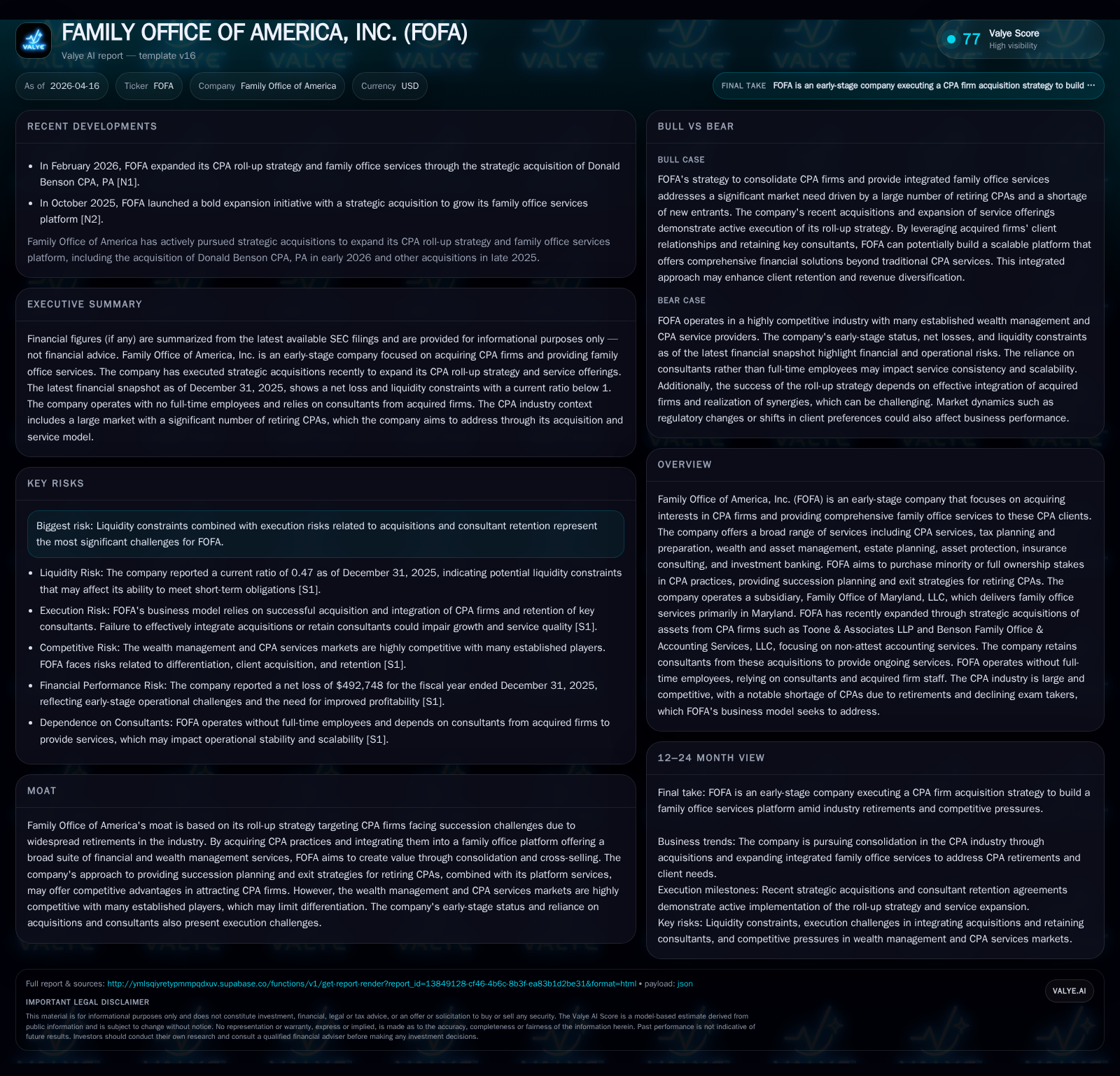
Family Office of America, Inc. (FOFA) has established a strategic focus on acquiring interests in CPA firms facing significant succession challenges due to widespread retirements. The company offers a comprehensive family office service platform including tax preparation, wealth management, and estate planning, delivered primarily through its subsidiary in Maryland. FOFA has completed acquisitions of non-attest accounting assets with earn-out provisions tied to revenue and EBITDA performance. Despite these initiatives, the company remains an early-stage roll-up with persistent operating losses, negative operating cash flows, and liquidity constraints reflected by a current ratio below 0.5. Capital allocation is concentrated on acquisitions and consultant retention agreements without dividends or share repurchases. Future growth depends on successful integration, expanding service cross-selling, and improving financial performance.
Company Background and Business Overview
Family Office of America, Inc. (FOFA), formerly Qualis Innovations, Inc., refocused its business strategy toward family office services after a name change in December 2024 following a reverse merger with mPathix Health Inc. in June 2021 [S1][S12]. Incorporated since 2006 under various prior entities with diverse business lines, FOFA now concentrates on acquiring interests in CPA firms to provide integrated financial services.
The company's core model involves purchasing minority to full ownership stakes in CPA practices facing succession challenges due to demographic shifts. It integrates these practices into a platform offering CPA services alongside tax planning, wealth management, estate planning, asset protection, insurance consulting, and investment banking [S3]. In 2025, FOFA formed Family Office of Maryland, LLC as its operational subsidiary focused on delivering these services locally [S7].
Industry Context
The U.S. CPA market was estimated at $147.5 billion in 2023 with approximately 1.44 million practitioners [S3]. Approximately 75% of CPAs are at or beyond retirement age according to AICPA data [S3], while new entrants have declined significantly—from roughly 50,000 exam takers in 2010 to about 32,000 by 2021—indicating tightening supply [S3]. These dynamics create consolidation opportunities for entities like FOFA that offer succession solutions.
Consolidation combined with automation and expanded service offerings is increasingly necessary for CPA firms to maintain revenues during workforce shortages [S3]. FOFA aims to capitalize on this through its acquisition-driven platform.
Historical Financial Performance
FOFA's financial results reflect typical early-stage roll-up characteristics with ongoing losses despite acquisition activity:
Historical performance (annual)
| FY | Net ($) | CFO ($) | OpInc ($) | Net YoY |
|---|---|---|---|---|
| 2025 | -492748 | -262188 | -501079 | -390.4% |
| 2024 | -100484 | -89370 | -96513 | +87.5% |
| 2023 | -805021 | -76529 | -230241 | +12.5% |
| 2022 | -920515 | -558426 | -920515 |
Source: SEC companyfacts cache [F1].
Capital returns and efficiency (annual)
| FY | ROE% |
|---|---|
| 2025 | -74.2 |
| 2024 | 428.7 |
| 2023 | 153.9 |
| 2022 | -411.0 |
Source: SEC companyfacts cache [F1].
Year-over-year operating income worsened by over fourfold from FY2024 to FY2025 (-419%), while net losses similarly increased (-390%) indicating elevated investments or integration costs outpacing revenue growth [F1]. Operating cash flow remained negative and deteriorated further by nearly double (-193%) over the same period [F1]. Equity turned positive by FY2025 after several years negative likely reflecting capital raises or recapitalization events associated with acquisitions and restructuring [F1][S12].
Liquidity remains constrained: as of December 31, 2025 the company held $270K in current assets against $579K in current liabilities resulting in a current ratio near 0.47—below typical healthy thresholds—highlighting short-term funding pressures amid acquisition phases [F1].
Acquisition Activity
Toone & Associates LLP Asset Purchase (October 2025): Through its Maryland subsidiary FO Maryland acquired non-attest accounting assets valued at approximately $1.5 million payable over installments through mid-2027. Payment terms include upfront cash plus future payments subject to adjustments based on revenue minimums (~$1.5M) and EBITDA thresholds ($500K) during the first twelve months post-closing [S7][S8][S9][S10][S16][S17]. The deal excludes attest/audit functions but includes client lists and intellectual property related to accounting services. Bruce Toone remains engaged as a consultant under a multi-year contract paying $216K annually covering client servicing and staff training responsibilities [S7][S9][S10].
Benson Family Office & Accounting Services LLC Asset Purchase (January 2026): A similar acquisition involving non-attest accounting assets valued at approximately $353K structured with staged payments contingent on performance metrics post-acquisition. Key consultant retention continues to ensure client continuity during transition periods [S7][S8].
These transactions exemplify FOFA’s operational approach focusing on acquiring segments of CPA-relevant practices facing ownership transitions or seeking broader service offerings through its platform.
Growth Outlook
Growth drivers include:
- Demographic trends driving retirement-related succession needs among independent CPAs.
- Cross-selling potential of wealth management and family office services onto acquired CPA client bases.
- Expansion beyond Maryland leveraging the subsidiary framework.
- Potential adoption of technology/automation aligning with industry digitization trends.
Challenges comprise:
- Competition from established large financial advisors and CPA networks.
- Risks inherent in integrating diverse small businesses with differing cultures.
- Dependence on consultants rather than full-time employees potentially affecting operational stability.
- Liquidity constraints limiting acquisition capacity absent capital raises or financing.
Key milestones will include monitoring acquisition volume growth; revenue progression post-integration; improvement in profitability; and liquidity enhancements—all critical given FOFA’s early development stage.
Capital Allocation
FOFA does not pay dividends or conduct share repurchases as per latest filings; capital is primarily allocated toward acquisitions financed via cash payments combined with equity issuances including stock warrants tied to acquisition deals [S4][F1][S12].
The company’s return on equity remains negative at approximately -74% based on FY2025 net loss relative to equity value [-$493K net loss / $665K equity] reflecting ongoing operating deficits typical for nascent roll-ups requiring operational scale before profitability materializes [F1].
Risk Factors
Principal risks include:
- Liquidity pressures necessitating careful working capital management and possible external financing given negative cash flow trends [F1][S6][S7][S8].
- Execution risks related to integration complexity across acquired firms reliant on consultant networks without full-time employee base [S6][S7].
- Competitive landscape dominated by larger incumbents potentially constraining market share gains for an early-stage platform player [S3].
- Geographic concentration risk currently centered around Maryland operations limiting diversification benefits [S7].
Conclusion
Family Office of America occupies a niche blending CPA practice aggregation with comprehensive family office solutions tailored for aging practitioners needing succession pathways. Favorable macro trends support consolidation plays like FOFA’s but are tempered by typical challenges associated with early-stage roll-ups including widening losses, liquidity constraints, execution complexity relying on consultants instead of full-time staff, and competitive pressures within financial services sectors.
Ongoing monitoring should focus on quarterly updates evidencing margin improvements; disciplined capital deployment; successful integration outcomes; and enhanced liquidity positioning to support sustainable growth amid further acquisitions.
This analysis is based solely on publicly available information up to April 16th, 2026 and does not constitute investment advice.
Disclaimer: This is research-only, informational analysis and not investment advice. It may include AI-generated interpretation and general industry context. Always verify important details using primary sources.

Comments