
GlobalTech Corp Grows Fiber Revenue but Faces Capital and Profitability Hurdles
GlobalTech Corporation leverages its fiber optic network contracts and emerging technology ventures to grow revenue, while continuing to grapple with significant financial and liquidity challenges.
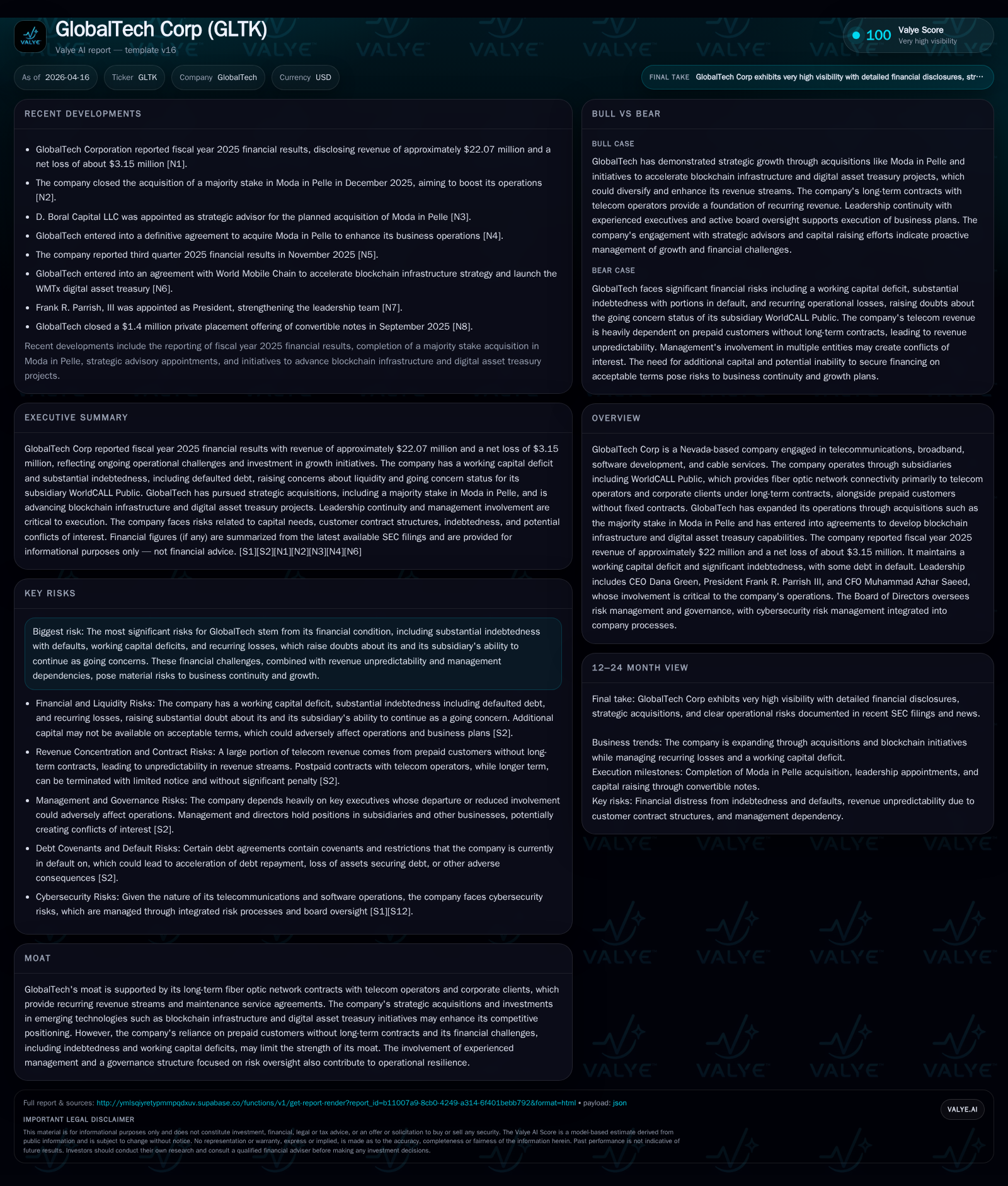
GlobalTech Corp reported fiscal year 2025 revenue of approximately $22.1 million, marking a 20.9% increase over the prior year, driven primarily by its long-term fiber optic network contracts through its subsidiary WorldCALL Public. Despite this growth, the company sustained operating losses near $3.7 million and a net loss of about $3.15 million, reflecting ongoing profitability pressures. GlobalTech’s working capital deficit and substantial indebtedness—including some debt in default—underscore liquidity constraints that challenge operational flexibility. Concurrently, the company’s strategic pursuits in blockchain infrastructure and digital asset treasury initiatives represent prospective catalysts for future expansion but also introduce execution risks under current governance frameworks.
Revenue Growth Trends Reflecting Mixed Telecom Segments
GlobalTech Corp has demonstrated meaningful revenue progression over recent years, highlighted by a rise from approximately $18.3 million in fiscal year 2024 to $22.1 million in fiscal year 2025—a 20.9% increase recorded in its latest annual results [F1]. This top-line expansion is largely attributable to the company's core fiber optic network connectivity services provided via its subsidiary, WorldCALL Public, which secures long-term contracts primarily with telecom operators and large corporate clients. These long-term contracts underpin a steady stream of recurring revenues mainly drawn from quarterly maintenance payments tied to fiber optic cable upkeep.
In addition to these postpaid contractual revenues, GlobalTech serves prepaid customers—individual consumers who subscribe without fixed-term commitments and pay upfront monthly fees—as part of its broadband and cable offerings. These prepaid billing cycles contribute additional revenue but carry higher volatility due to their short-term nature.
Operating income remains negative but showed modest improvement, narrowing from a loss of $4.06 million in FY2024 to roughly $3.73 million in FY2025 [F1]. This reflects consistent operating cost pressures intrinsic to telecom service delivery alongside ongoing investments in network infrastructure.
Operating cash flow deteriorated significantly year-on-year, turning negative by approximately $1.5 million in FY2025 compared with a positive $225 thousand in the prior year [F1]. Increased capital expenditures—rising about 150% year-over-year to just over $300 thousand—signal focused reinvestment into network assets essential to sustaining service quality and enabling future growth.
Historical performance (annual)
| FY | Rev ($mm) | Net ($mm) | CFO ($mm) | OpInc ($mm) | Rev YoY | Net YoY |
|---|---|---|---|---|---|---|
| 2025 | 22 | -3 | -2 | -4 | +20.9% | -6.8% |
| 2024 | 18 | -3 | 0 | -4 | +72.0% | +64.6% |
| 2023 | 11 | -8 | -3 | -10 | -8.7% | +33.0% |
| 2022 | 12 | -12 | -8 | -11 |
Source: SEC companyfacts cache [F1].
Capital returns and efficiency (annual)
| FY | FCF ($) | ROE% |
|---|---|---|
| 2025 | -1821875 | 15.5 |
| 2024 | 102674 | |
| 2023 | -68.1 | |
| 2022 | -67.7 |
Source: SEC companyfacts cache [F1].
Table: Historical Financial Performance Summary (FY2022–FY2025) [F1]
Contractual Strengths Versus Volatile Prepaid Customer Dynamics
GlobalTech's competitive moat stems substantially from WorldCALL Public's contracts securing access to an extensive fiber optic infrastructure under arrangements typically spanning two decades [S2]. These agreements obligate telecom operators and significant corporate clients to quarterly maintenance payments post-service delivery—constituting stable postpaid contractual revenues vital for predictable cash flow generation.
Conversely, prepaid customers account for a significant fraction of GlobalTech’s telecom revenue but are subject to usage unpredictability as no binding fixed contracts exist [S2]. Prepaid services cater mostly to individual households subscribing monthly without long-term commitments, leading to recurrent billing upfront yet exposing the company to potential swift fluctuations in subscriber volumes or usage intensity.
This dichotomy introduces an operational balancing act: while the fiber-based client base secures ongoing recurring revenue, prepaid customers diversify revenue streams but heighten overall volatility due to their short-term nature within telecom billing cycles.
Blockchain and Digital Asset Ventures: An Innovation Bet
In an effort to position itself within evolving technology frontiers intersecting telecommunications and finance, GlobalTech has embarked on blockchain infrastructure initiatives alongside digital asset treasury capabilities through new strategic agreements announced recently [N1].
These ventures aim to leverage distributed ledger technologies for enhanced transaction transparency and efficiency within its service ecosystems, representing potential future catalysts beyond traditional telecom operations [S7]. However, material risks accompany such innovation bets—they require proficient technology deployment and rigorous cybersecurity controls amidst a tightly regulated environment.
Management highlights governance structures focused on monitoring software development processes and cybersecurity compliance as integral to mitigating operational risks associated with these projects [S7]. The successful scaling of blockchain-based applications could open new revenue channels but remains contingent upon effective execution amidst existing financial constraints.
Financial Condition: Indebtedness, Working Capital, and Liquidity
Despite revenue improvements, GlobalTech continues facing acute financial headwinds characterized by a working capital deficit manifested by current assets of approx $25.5 million dwarfed by current liabilities exceeding $55 million, yielding a current ratio near 0.46 at fiscal year-end 2025 [F1]. This liquidity crunch constrains flexibility in day-to-day operations.
Further complicating this picture is sizable indebtedness with portions already in default as detailed in recent securities filings [S11], elevating debt covenant pressures and solvency scrutiny among creditors.
Equity stands deep in negative territory around negative $20 million as of FY2025 end—divergent from positive equity levels observed two years prior—reflecting accumulated losses that further hamper capitalization adequacy [F1]. Negative operating cash flows point toward continuing challenges converting earnings quality into sustainable free cash flows after capital reinvestment needs [F1].
Capital Allocation Decisions Under Financial Stress
Matching limited cash inflows against pressing investment requirements, GlobalTech’s capital expenditure surged approximately 149% year-over-year reaching around $307 thousand by end-2025 [F1]. This elevated capex primarily targets maintaining fiber optic assets critical for high-reliability service delivery necessary under long-term contracts.
No dividends or share buyback programs have been declared or indicated during this period, consistent with the priority placed on sustaining operations rather than returning capital under current cash flow deficits ([S4],[S6]). Board-level oversight encompasses multiple committees including audit and compensation functions; however, formal policies on insider trading timing around material nonpublic information or clawback mechanisms remain pending implementation—a factor illustrating governance maturation phases amid financial stress ([S4]).
Outlook and Potential Milestones to Monitor
Explicit future guidance from the company remains limited; therefore, monitoring progress on key contractual events such as maintenance contract renewals within WorldCALL Public will be critical given their sizable contribution to recurring revenue streams [N2].
Parallelly, watchers should track tangible milestones relating to blockchain infrastructure rollouts and digital asset treasury initiatives highlighted by management as strategic priorities [N1]. Improvement indicators would include enhancements in liquidity ratios such as the current ratio rising above one, reductions or restructuring of defaulted debt obligations, positive trends in EBITDA margins if disclosed prospectively, and eventual return toward free cash flow positivity through operating leverage gains.
Governance Framework Supporting Risk Oversight
Leadership is anchored by CEO Dana Green supported by President Frank R. Parrish III and CFO Muhammad Azhar Saeed—all dedicated full-time executives deeply involved in daily operations [S24]. The board currently maintains combined functional committees for audit, compensation, and nominations with all directors serving across each committee due to company scale; more formalized charters for independent oversight are planned subsequent to listing ambitions ([S4],[S9]).
Policies governing conflict-of-interest disclosures reflect awareness of potential fiduciary challenges inherent when officers pursue external opportunities overlapping company focus areas ([S5]). Although no formal insider trading or hedging prohibition policies currently exist given limited public trading volume characteristics ([S4]), corporate governance actions such as planned clawback policy adoption align with Sarbanes-Oxley regulatory expectations.
An emphasis on cybersecurity risk management consolidates both board-level oversight and executive accountability with regular incident reporting ensuring risk transparency given GlobalTech’s exposure across telecom networks and digital platforms ([S7],[S8]).
Disclaimer: This analysis is intended solely for informational purposes based on publicly available filings and news releases through April 16, 2026. It does not constitute investment advice or recommendations regarding any securities of GlobalTech Corporation.
Disclaimer: This is research-only, informational analysis and not investment advice. It may include AI-generated interpretation and general industry context. Always verify important details using primary sources.

Comments