
Data I/O Corporation's Strategic Reset: From Legacy Equipment to Security-Driven Growth
Data I/O Corp transitions from cyclical equipment sales toward recurring security services amidst semiconductor market headwinds.
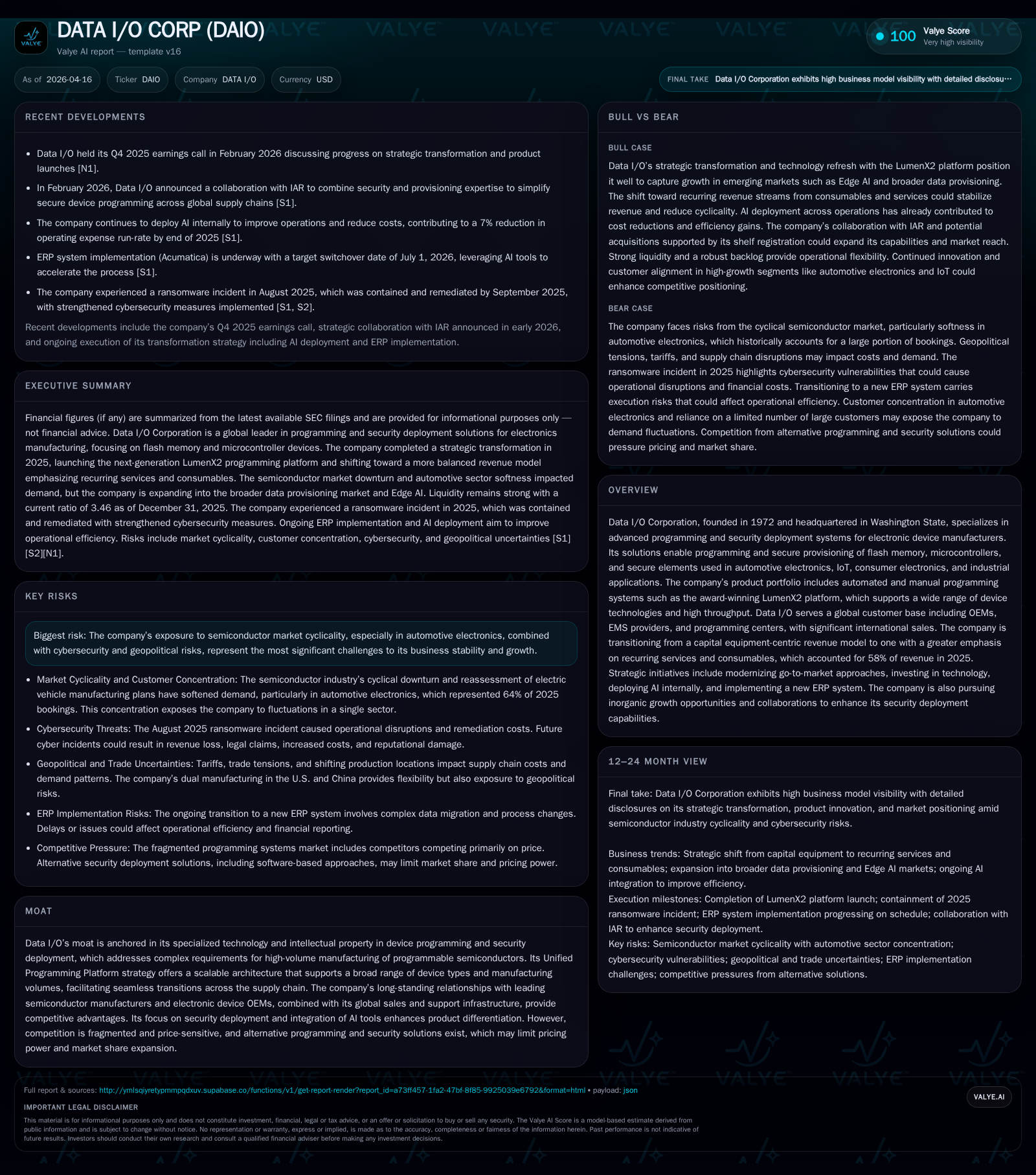
Data I/O Corporation’s financial trajectory from 2022 through 2025 reflects the pressures of a cyclical semiconductor downturn, particularly in automotive electronics, driving revenue softness and profitability challenges. The company initiated a strategic transformation in late 2024 under new leadership, focusing on the rollout of advanced programming platforms and integrating AI to enhance operational efficiency. This pivot emphasizes expanding recurring consumables and security deployment solutions, which now represent a majority of revenues, aiming to stabilize growth and diversify beyond capital equipment cycles. While cash flow pressures persist with negative operating income and net losses in 2025, a strong liquidity cushion and early signs of recovery supported by growing demand in emerging Edge AI applications provide a foundation for potential operational turnaround.
Historical Financial Performance Amid Market Shifts
Between fiscal years 2022 and 2025, Data I/O Corporation experienced pressured financial performance reflective of broader semiconductor industry headwinds, prominently within its largest end market—automotive electronics. Revenue peaked at approximately $28.1 million in FY2023 before contracting sequentially to $21.5 million by FY2025 [F1]. This decline corresponds with a reassessment of electric vehicle manufacturing capacity that dampened capital equipment demand during this period [S5][S10].
Operating income mirrored top-line challenges, moving from a marginal profit of $448 thousand in FY2023 to an operating loss exceeding $5.1 million by FY2025 [F1]. Similarly, net income worsened to a negative $5.2 million in the latest year after recording modest profits two years prior [F1]. These margin pressures were amplified by sustained investments in research and development aimed at modernizing product lines—a necessary response to evolving programmable semiconductor technologies and increasing device complexity [S15][S18].
Cash flow dynamics exhibited volatility aligned with revenue swings; operating cash flow shifted from positive inflows ($2.4 million) in FY2023 to negative $2.2 million in FY2025 [F1]. Capital expenditures moderated but remained part of ongoing platform development efforts [F1]. This combination culminated in stretched operating leverage manifesting as losses despite active cost management.
Historical performance (annual)
| FY | Rev ($mm) | Net ($mm) | CFO ($mm) | OpInc ($mm) | Rev YoY | Net YoY |
|---|---|---|---|---|---|---|
| 2025 | 22 | -5 | -2 | -5 | -1.2% | -69.3% |
| 2024 | 22 | -3 | -1 | -3 | -22.4% | -736.4% |
| 2023 | 28 | 0 | 2 | 0 | +15.9% | +143.4% |
| 2022 | 24 | -1 | -1 | -1 |
Source: SEC companyfacts cache [F1].
Capital returns and efficiency (annual)
| FY | FCF ($mm) | ROE% |
|---|---|---|
| 2025 | -3 | -38.7 |
| 2024 | -1 | -17.5 |
| 2023 | 1 | 2.4 |
| 2022 | -2 | -5.9 |
Source: SEC companyfacts cache [F1].
Source: Data I/O SEC filings [F1]
Strategic Transformation and Product Innovation in 2025
The close of 2024 marked a critical inflection point as William Wentworth assumed the CEO role, steering the company through an ambitious six-point strategic plan encompassing go-to-market modernization, technology reinvestment, customer engagement strengthening, operational IT optimization, process improvements, and enterprise-wide AI deployment [S1][S15]. The initiative notably advanced ahead of initial timelines by early 2026.
Core to this transformation was the expedited launch of the next-generation LumenX2 programming platform alongside its manual counterpart LumenX2-M4 at productronica Munich 2025 [S15][S18]. Characterized by higher programming pin counts enabling support for complex device mixes—including microcontrollers, eMMC, UFS flash, SPI NOR flash, Secure Elements—and enhanced power delivery, these platforms embody the Unified Programming Platform architecture promoting scalability across volumes.
The LumenX2-M4 introduces VerifyBoost technology enabling verify speeds up to an industry-leading ~750 MB/s—a salient feature supporting increased automation throughput efficiencies critical for demanding semiconductor manufacturing cycles [S15]. Recognition via multiple global technology awards underscores its market relevance.
AI integration permeated software algorithm acceleration for expanded device support alongside operational improvements including ERP system overhaul powered by AI-driven data migration and chart mapping techniques facilitating swifter digital transformation steps [S15][S18]. These sector-specific advances echo trends where hardware-based security provisioning is increasingly coupled with intelligent software tooling.
Recurring Revenue Emphasis and Market Diversification
Historically dependent on selling capital-intensive programming equipment subject to cyclical OEM capital budgets, Data I/O has recalibrated toward more resilient revenue streams comprising consumables such as adapter sales and expanding service offerings including programming-at-test solutions [S1][S24].
In FY2025, recurring revenue accounted for roughly 58% of total sales—representing a meaningful shift intended to smooth revenue volatility inherent in capital expenditure cycles especially prominent during semiconductor downswings [S24]. This evolution aligns with broader industry moves favoring 'recurrence' models over one-time hardware sales alone.
Furthermore, market repositioning targets a larger data provisioning ecosystem beyond traditional programming devices supporting growth drivers linked to IoT proliferation and Edge AI deployments requiring secure device provisioning across sprawling production chains [S10][S24][S21]. This strategy may mitigate concentration risks given automotive electronics bookings composed approximately 64% of bookings but face cyclical pressures amid EV capacity reassessments [S10][S11].
Competitive Positioning within Programming and Security Deployment
Competition within Data I/O’s core markets remains fragmented; regional players often compete principally on price while alternate programming modalities such as In Circuit Test (ICT), In System Programming (ISP), End of Line (EOL) downloads or Over The Air (OTA) exist as partial substitutes [S6]. Moreover, emerging software-centric security provisioning solutions challenge Data I/O’s historically hardware-rooted SentriX security provisioning offerings [S6].
Data I/O’s moat leans heavily on proprietary IP rights protecting its security deployment stack encompassing unique firmware programming methodologies aligned with scalable architectures—the Unified Programming Platform—which delivers flexibility across diverse programmable semiconductor devices [S6]. Its ability to integrate AI into algorithm generation further differentiates product evolution speed relative to less technologically robust rivals.
Maintaining close OEM relationships combined with extensive global distribution underpins competitive resilience though pricing pressures remain material given market sensitivity [S6]. The forecasted uptick in secure element device adoption for connected autonomous vehicles presents both opportunity and competition intensification catalysts.
Geographic Sales Footprint and Supply Chain Resilience
Data I/O generates over 90% of net sales internationally through subsidiaries in Germany and China alongside global distributor networks across nearly forty countries reflecting rich geographic diversification [S4][S5][S16]. The U.S., while comprising minor direct sales (~$1.3M in FY25), continues integral influence through channel relationships impacting broader shipment flows.
Manufacturing dual nodes—Redmond USA and Shanghai China—offer tariff optimization levers amidst ongoing US-China trade tensions with dynamic production shifts catering flexibly to customer relocation trends away from China where applicable [S1][S10][S22]. The dual-sourced manufacturing model exemplifies supply chain resilience tailoring against tariff volatility while supporting transitional capital intensity reductions.
Challenges remain regarding localized component single-sourcing risks mitigated via supplier diversification programs yet susceptible to geopolitical disruptions or part shortages characteristic for technologically complex assemblies including custom ICs or hybrid circuits [S19][S14]. Currency exposure also exerts margin impact given most costs are US-based whereas revenues are international weighted.
Financial Health: Capital Allocation, Cash Flow, and Return on Equity
As of December 31, 2025, Data I/O held total equity approximating $13.5 million alongside current assets near $17 million against liabilities under $5 million resulting in strong current ratio standing around ~3.46x denoting solid short-term liquidity coverage [F1][S26]. Cash reserves are sufficient according to management’s operating plan projections extending beyond near term.
Nonetheless, negative comprehensive free cash flow estimated at approximately -$2.8 million (calculated as operating cash flow minus capex) underscores ongoing cash burn related predominately to strategic transformation investments including R&D ramp-up for platform innovation and ERP implementation costs [F1][S15][S18].
Capital expenditures have moderated from pre-transformation peaks ($1M+) down closer to half a million USD annually signaling managed investment pacing aligned with scaling timing [F1]. Returns on equity remain substantially negative (-38.7%) reflective of sustained net losses suppressing shareholder return metrics that should improve only upon consistent profitable growth resumption [F1]. Notably absent are any recent share repurchases underscoring conservative capital deployment focus currently prioritizing growth initiatives over shareholder distributions.
Future Outlook: Technology Adoption, Market Recovery, and Risk Factors
While explicit long-term guidance is not provided publicly per se [N#], management has communicated confidence in tangible acceleration towards normalized revenue growth trajectories driven by deeper market penetration of upgraded programming platforms coupled with expanding service revenues [S1]. Early traction into emerging Edge AI use cases lends credence to new growth pathways beyond traditional automotive dominance constrained by present semiconductor cyclicality [S10][S24][S21].
Broad risk factors include persistent macroeconomic uncertainties reflected through fluctuating tariffs between U.S.-China trade relations potentially escalating cost bases or limiting market access; cybersecurity vulnerabilities evidenced by the August 2025 ransomware incident requiring extensive mitigation though fully remediated without known residual impact; geopolitical conflicts; currency fluctuations; supply chain disruptions including risks from single source components; plus competitive threats particularly from software-based security provisioning advancements challenging incumbent hardware solutions [S7][S17][S22]. These variables embed execution uncertainty around timely realization of strategic objectives.
What to Watch: Milestones and Key Catalysts Ahead
Investors tracking Data I/O should prioritize upcoming quarterly earnings reports revealing clarity on revenue stabilization patterns particularly within recurring services channels along with improvements or further strain on operating cash flow metrics post significant technology launches completed end-2025/beginning-2026 cycle timeframe.
Maintaining momentum on ERP switchover scheduled mid-2026 will be critical for improved operational transparency aiding tighter cost controls anticipated through AI-driven business process enhancements currently underway [S17][S18]. Additionally monitoring geopolitical developments affecting tariff regimes or renewed cyber incident exposure will be instrumental risk indicators for financial performance stability.
Competitive responses within hardware versus software-focused security segments remain potential catalysts either reinforcing or eroding DAIO’s market presence depending on innovation outcomes or partner alliances such as recently announced collaboration with embedded security leader IAR aiming for simplified frictionless provisioning solutions expansion early this year—a strategic partnership meriting close observation given industry consolidation trends concomitant with IoT/Edge AI growth dynamics [S16].
This analysis consolidates publicly available information sourced exclusively from verified SEC filings dated through April 16, 2026 ([F1], [S#]) without projecting unsubstantiated forward-looking statements or investment advice recommendations.
Disclaimer: This is research-only, informational analysis and not investment advice. It may include AI-generated interpretation and general industry context. Always verify important details using primary sources.

Comments