
SHF Holdings Charts Recovery Path with Compliant Cannabis Banking and Strategic Alliance
SHF Holdings leverages its Safe Harbor platform and a critical alliance with PCCU to rebuild financial performance amid sector headwinds.
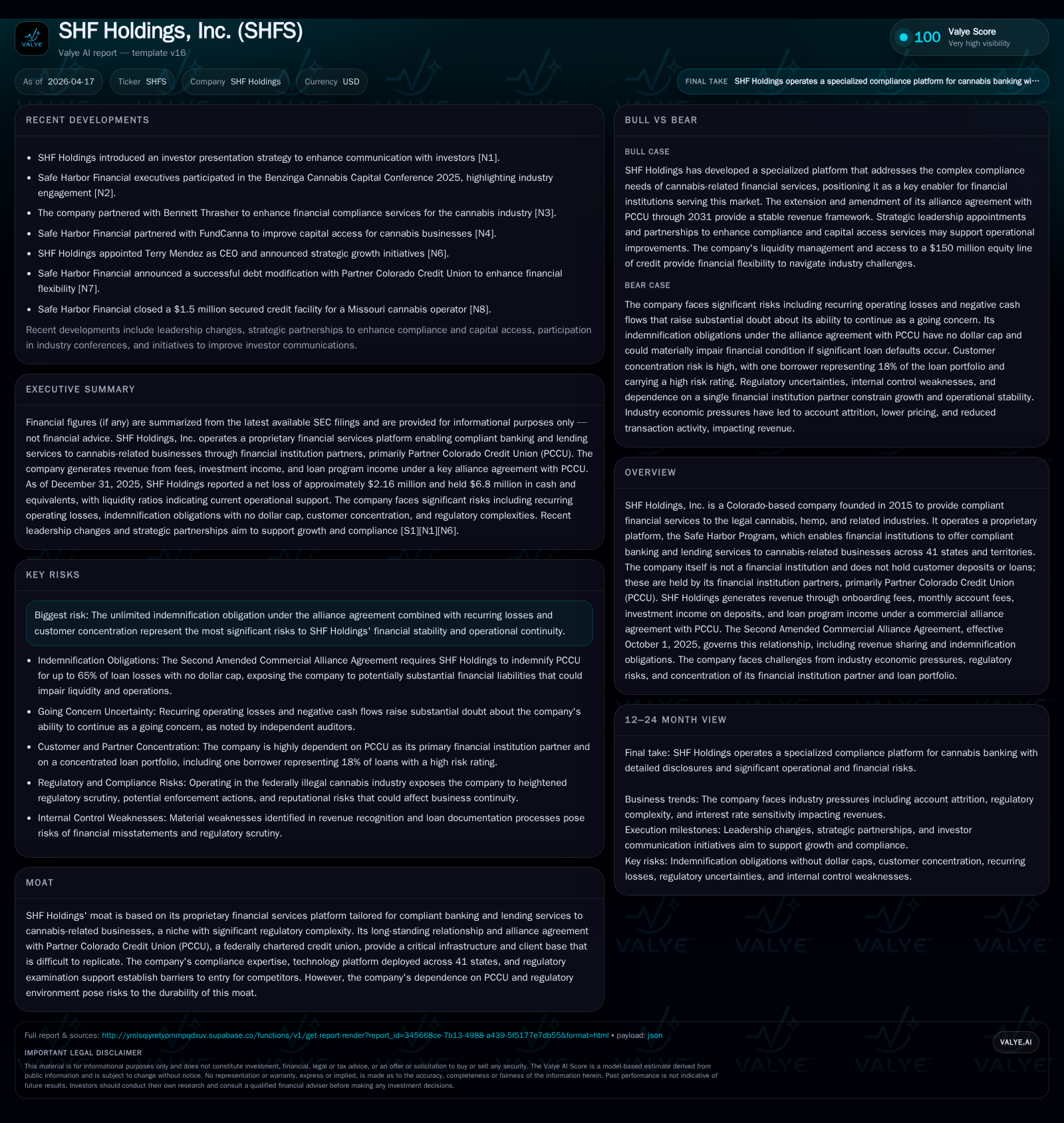
Founded in 2015, SHF Holdings operates a proprietary compliance platform enabling banking services to cannabis-related businesses (CRBs) across 41 states. Despite pioneering efforts, the company has faced significant revenue declines driven by client attrition, pricing pressures, and regulatory complexities, reflected in recurring operating losses through FY2025. Its pivotal relationship with Partner Colorado Credit Union (PCCU) under the Second Amended Commercial Alliance Agreement increases revenue share but imposes substantial indemnification risks that strain liquidity. Looking ahead, growth depends on navigating regulatory uncertainties, legal risks from ongoing litigation, and sustaining capital adequacy amid negative cash flows.
Historical Revenue Declines and Operating Performance Trends
SHF Holdings has experienced a challenging financial trajectory from FY2022 through FY2025. Operating income, though showing progressive improvement from the nadir in FY2023 (-$20.7 million), remained in negative territory at -$5.4 million by FY2025, representing a 23.9% year-over-year lessening in operating losses [F1]. Net income followed a similar contour with significant past losses—most notably -$48.3 million in FY2024—narrowing sharply to a -$2.16 million loss in FY2025, reflecting a 95.5% year-over-year improvement though still negative [F1].
This financial pressure stems predominantly from declining revenues attributable to multiple factors highlighted in company disclosures: attrition of active cannabis-related business (CRB) accounts on their platform; decreased average balances; introduction of money market accounts that share interest earned with depositors thereby lowering gross investment income per deposit; and an overall contraction in industry transaction activity due to depressed wholesale cannabis prices and constrained liquidity among CRB operators [S1].
Operating cash flow also turned sharply negative to -$3.4 million in FY2025 after fluctuating historically, with free cash flow further pressured by steady capital expenditure levels near $200 thousand annually [F1]. These trends underline persistent structural challenges within the business model despite tactical revenue sharing revisions under new alliance terms.
Historical performance (annual)
| FY | Net ($mm) | CFO ($mm) | OpInc ($mm) | Capex ($) | Net YoY |
|---|---|---|---|---|---|
| 2025 | -2 | -3 | -5 | +95.5% | |
| 2024 | -48 | 0 | -7 | 208434 | -179.6% |
| 2023 | -17 | -1 | -21 | 208434 | +50.8% |
| 2022 | -35 | 2 | -2 | 17318 |
Source: SEC companyfacts cache [F1].
Capital returns and efficiency (annual)
| FY | FCF ($) | ROE% |
|---|---|---|
| 2025 | -26.2 | |
| 2024 | 222043 | 393.2 |
| 2023 | -1040578 | -50.3 |
| 2022 | 1680062 | -687.0 |
Source: SEC companyfacts cache [F1].
Operating losses have narrowed but remain significant; net losses decreased in FY2025 but reflect ongoing pressure from reduced platform activity.
The Safe Harbor Platform: Regulatory Expertise as a Moat
At the core of SHF Holdings’ value proposition is its proprietary Safe Harbor Program — a technology platform designed to oversee the full lifecycle of compliant banking services offered to cannabis-related businesses across 41 states and territories ,[S6]. This system integrates critical regulatory compliance functions including Know Your Customer (KYC), Anti-Money Laundering (AML), Bank Secrecy Act (BSA) compliance monitoring alongside customer onboarding and ongoing examination assistance tailored for the complex regulatory environment governing cannabis finance.
Operating not as a direct financial institution but as a compliance facilitator augmented by specialized technology infrastructure distinguishes SHF from generic fintech providers. Its track record supporting over $35 billion in cannabis-related funds processed through partner institutions coupled with outcomes like assisting clients through more than 25 state and federal regulatory examinations reinforces its moat built around regulated niche expertise [S6]. Regulatory examination assistance emerges as an essential service because CRBs must continually satisfy evolving federal guidance such as FinCEN memos permitting limited banking access yet imposing intense due diligence.
SHF’s ability to embed its compliance protocols deeply into partner credit union operations offers both operational continuity and efficiency—creating substantial barriers to entry for new competitors lacking such domain-specific know-how or long-established alliances.
Interdependence with Partner Colorado Credit Union: Strengths and Vulnerabilities
The relationship with Partner Colorado Credit Union (PCCU) is central to SHF's operational model. Under the Second Amended Commercial Alliance Agreement (CAA), effective October 1, 2025, SHF benefits from an increased share of up to 65% of loan program income generated within PCCU's cannabis business lending portfolio; however this income share increase accompanies commensurate indemnification obligations for up to 65% of loan loss exposures without any dollar cap [S1],[S4],[S14].
This amplifies both opportunity and downside risk: while higher revenue participation could help SHF improve its top-line performance if defaults remain contained, any material loan losses translate directly into substantial contingent liabilities that go beyond traditional credit risk because SHF must ensure liquidity sufficiency through monthly certifications made to PCCU regarding balance sheet resources adequate for these indemnity obligations [S4],[S14]. This creates an asymmetric risk profile exposed to adverse credit events or collateral value impairments exacerbated by the federal illegality status exposing secured assets potentially to civil asset forfeiture [S17].
Operationally, PCCU provides the entire regulated infrastructure facilitating deposits and lending functions; loss or disruption at PCCU would cripplingly impair SHF’s revenue generation capabilities given it neither holds deposits nor directly lends itself [S6],[S18]. Furthermore, attempts to diversify partner institutions have not progressed significantly leaving SHF heavily concentrated in this singular institutional counterpart.
Legal Challenges and Indemnification Exposure Under the Second Amended CAA
Litigation arising from the acquisition terms of Abaca — contested by former executives disputing amendments affecting merger consideration — remains an unresolved financial liability risk facing SHF Holdings [S1],[S5],[S11]. The Company deposited $3 million into court escrow pending dispute resolution scheduled tentatively for May 2026 [S11]; however estimated exposure ranges between zero additional liability up to $7.8 million plus legal fees depending on outcome.
While management asserts confidence in the binding nature of amended agreements limiting ultimate cash settlement near $3 million escrowed value [S5], this legal uncertainty compounds balance sheet risk especially amidst already stretched liquidity requirements imposed by indemnification under the CAA.
Potential adverse judgments or protracted litigation could impose unexpected cash drains or reputational impacts that might deter partners or clients sensitive to stable operational continuity.
Liquidity Profile and Capital Structure Examination
SHF Holdings reported cash & equivalents totaling approximately $6.8 million as of December 31, 2025 against current liabilities near $6.5 million yielding a current ratio near 1.88—indicating nominal short-term liquidity sufficiency [F1]. However acute liquidity stress derives from obligations tied to indemnification payments which require maintaining sufficient reserve resources monthly certified under contractual obligations vis-à-vis PCCU [S4],[S14].
Negative operating cash flow of approximately $3.4 million for FY2025 combined with capital spending around $0.2 million results in free cash flow shortfalls restraining internal financing capability further [F1]. Management relies on external facilities such as an Equity Line of Credit (ELOC), but this source entails dilution risk with stringent draw conditions including no material adverse change clauses linked closely to stock price stability above Nasdaq continued listing thresholds ($1 per share minimum price rule) potentially imperiling capital access should investor sentiment waver [S21],[S26].
The capital structure carries noteworthy dilution potential via convertible preferred stock instruments issued during recapitalization efforts alongside outstanding warrants which amplify shareholder dilution risk when accessing ELOC draws or converting these instruments [S25],[S26]. The reported shareholders’ equity recovered positively reaching approximately $8.2 million by end-FY2025 after prior negative equity balances due mainly to restructuring efforts but remains modest relative to operating scale while reflecting historical loss carryovers [F1].
Future Growth Outlook Amid Industry Pressures and Regulatory Landscape
Growth prospects outlined by SHF are intrinsically tied to evolving federal policy shifts impacting cannabis banking access coupled with stabilization or expansion within state-legal cannabis markets where CRB profitability inversely influences deposit volumes and loan demand [N1],[S1]. Broader U.S. economic pressures on cannabis pricing constrain operator liquidity restricting account replenishment rates which directly hampers recurring fee income generation.
Federal legislative changes such as reclassification proposals from Schedule I status or enhanced FinCEN guidelines could unlock broadened banking participation creating scale opportunities for compliant platforms like Safe Harbor but timing remains uncertain meanwhile competitive entry barriers may erode moats if larger incumbents enter segment aggressively.
Management signals intent toward strategic partnerships potentially beyond PCCU aiming at geographic diversification but lacks definitive agreements publicly disclosed thus far making realization speculative absent future filings or announcements [N1]. The presence of large-scale regulatory exams continues evolving adding complexity around compliance monitoring offering scope expansion possibilities if managed effectively.
Key Milestones Awaited: What Investors Should Monitor
Investors should track several critical upcoming catalysts including:
- Resolution of Abaca litigation targeted for May 2026 court ruling which may clarify contingent liabilities impacting balance sheet strength [N1],[S3],[S11];
- Ongoing monthly liquidity certifications under the Second Amended CAA evidencing sustainability under current indemnification obligations;
- Customer retention metrics within Safe Harbor Program post-revenue sharing adjustment signaling if attrition trends taper;
- Federal Reserve interest rate changes influencing yields on CRB deposits thereby affecting investment income streams;
- Progress on onboarding additional financial institution partners which would alleviate concentration risks tied solely to PCCU dependence. Monitoring these metrics alongside quarterly SEC filings will shed light on whether operational adjustments translate into tangible recovery progress or if structural risks continue constraining profitability potential.
Capital Allocation, Dividend Policy, and Shareholder Returns Assessment
Given recurring net losses and negative free cash flows documented through FY2025 along with pressing liquidity demands posed by indemnification liabilities ([F1]), SHF Holdings has not engaged materially in shareholder returns via dividends or share repurchases recently.
The approximate return on equity calculated at about -26% underscores unsustainable profitability levels necessitating preservation of capital primarily dedicated toward operational continuity rather than distributions [F1]. The absence of discretionary capital allocation policies favoring buybacks reflects prudent management stance given ongoing recovery efforts entwined with high-risk contractual exposures restricting financial flexibility.
Disclaimer:
This analysis is intended solely for informational purposes focusing on factual company performance metrics and identified risks based on available disclosures as of April 2026. It does not constitute investment advice or recommendations regarding securities mentioned herein.
Disclaimer: This is research-only, informational analysis and not investment advice. It may include AI-generated interpretation and general industry context. Always verify important details using primary sources.

Comments