
Digital Brands Group Confronts Rising Losses and Debt Burden While Shifting To Digital Apparel Sales
DBGI pursues growth through digital direct-to-consumer transitions and licensing but faces significant financial and operational headwinds.
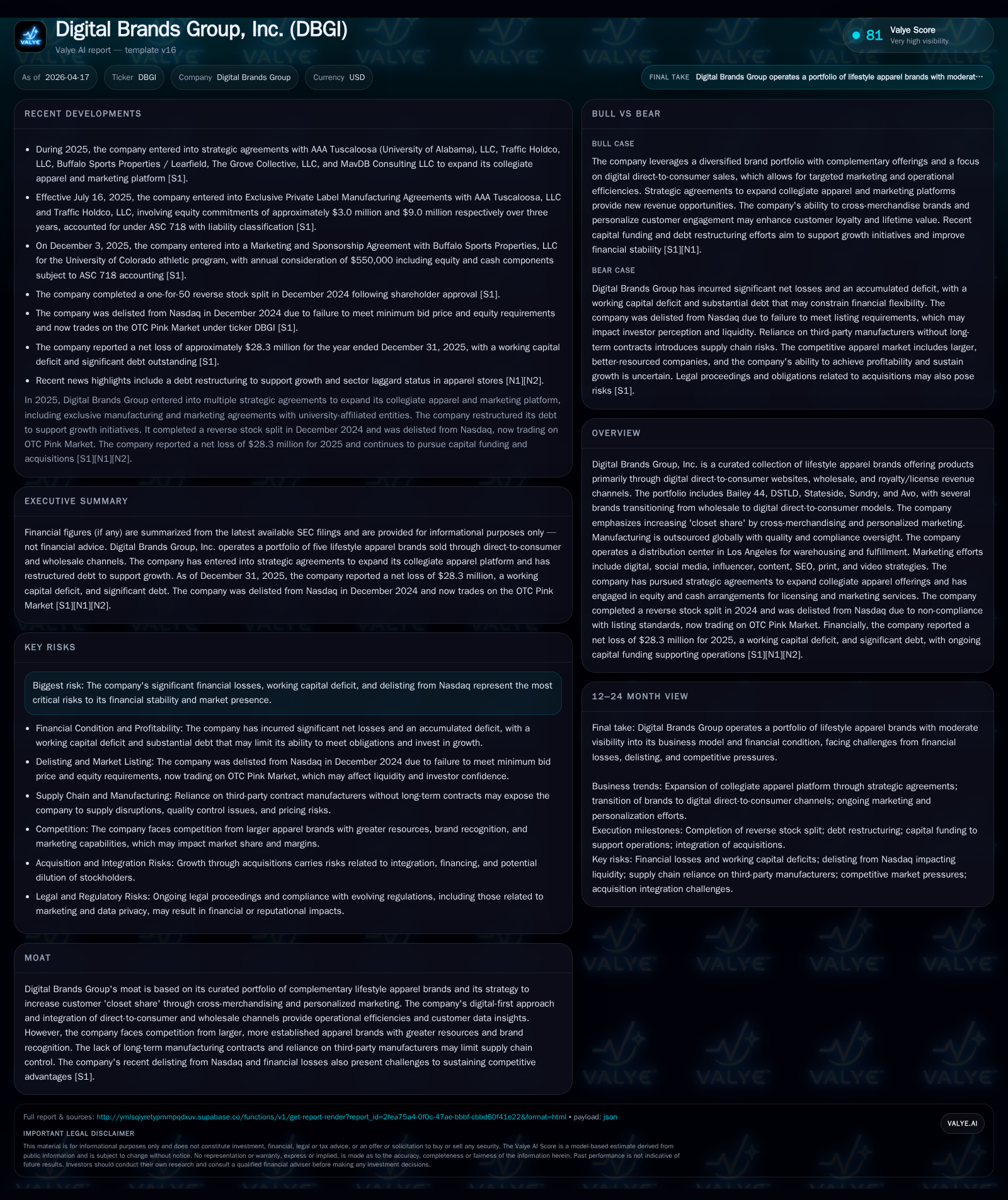
Digital Brands Group, Inc. operates a portfolio of lifestyle apparel brands primarily selling through direct-to-consumer websites, wholesale, and licensing. While focused on cross-merchandising to increase customer ‘closet share,’ the company continues to report widening net losses and negative operating cash flow indicative of structural profitability challenges. Recent strategic moves to expand collegiate apparel licensing and consolidate manufacturing may support future top-line growth, but DBGI’s heavy debt load and delisting from Nasdaq heighten financial risks. Monitoring execution of digital transitions, capital raising efforts, and expense control will be essential going forward.
Overview
Digital Brands Group, Inc. (DBGI) presents a varied portfolio of curated lifestyle apparel brands marketed primarily through digital direct-to-consumer (DTC) websites alongside wholesale and licensing channels. The flagship brands include Bailey 44, DSTLD, Stateside, Sundry, and Avo, each positioned within differentiated market segments offering contemporary women's fashion staples with a focus on style, quality, and comfort.
DBGI's strategic thrust emphasizes increasing what's described as "closet share" — the share of wardrobe purchases that customers make within the portfolio's distinct brands. This approach involves cross-merchandising synergy supported by data-driven personalized marketing techniques designed to enhance lifetime customer value via targeted cohorts.
The manufacturing footprint is entirely outsourced across global locations predominantly in Europe, Asia Pacific, and domestic U.S., with no binding long-term contracts but subject to rigorous quality control and compliance oversight procedures. Operational efficiencies are sought through concerted consolidation of fabric mills and factories, particularly shifting production emphasis from China and U.S.-based facilities toward European counterparts.
Marketing efforts leverage a full spectrum of digital channels including paid Facebook/Instagram campaigns as the primary acquisition vehicle, affiliate marketing with influencer revenue-sharing arrangements, retargeting technologies, optimized email marketing programs, SEO enhancements, content creation (video/blog), print advertising, public relations campaigns, and influencer partnerships prioritized on engagement quality rather than follower count.
Historical Performance
The company's financial results reflect ongoing operating challenges. Annual net losses have escalated markedly from approximately $10 million in FY2023 to over $28 million by FY2025 [F1], indicating deteriorating profitability despite expanding brand reach and product offerings.
Operating income follows a similar trend of deepening negative performance: losses tripled from around $10 million in FY2024 to nearly $30 million negative in FY2025 [F1]. Cash flow from operations remains negative for four consecutive years with the latest figure close to -$15.9 million free cash flow after accounting for capital expenditures [F1].
The firm exhibits stretched liquidity metrics; its current assets at year-end 2025 totaling around $20.6 million fall short of covering current liabilities approximating $26.1 million — yielding a current ratio of roughly 0.79 which underscores tight short-term financial flexibility [F1]. Moreover, equity improved from a negative balance in FY2024 (-$1.3 million) to a positive $8.7 million by end-2025 primarily due to stock issuances tied to acquisitions and capital funding rounds rather than operational earnings [F1].
Historical performance (annual)
| FY | Net ($mm) | CFO ($mm) | OpInc ($mm) | Net YoY |
|---|---|---|---|---|
| 2025 | -28 | -16 | -30 | -115.6% |
| 2024 | -13 | -6 | -10 | -27.9% |
| 2023 | -10 | -6 | -2 | +73.1% |
| 2022 | -38 | -11 | -32 |
Source: SEC companyfacts cache [F1].
Capital returns and efficiency (annual)
| FY | ROE% |
|---|---|
| 2025 | -322.2 |
| 2024 | 986.5 |
| 2023 | -639.4 |
| 2022 | 510.4 |
Source: SEC companyfacts cache [F1].
Note: Revenue figures are not explicitly reported; focus here is on operational outcomes derived from income statement line items.
Growth Prospects
DBGI pursues growth primarily through expanding its direct-to-consumer digital sales platforms while transitioning several traditionally wholesale-focused brands (like Bailey 44) toward e-commerce channels [S5][S17]. A noteworthy initiative includes aggressive expansion into collegiate apparel licensing starting mid-2025 with exclusive private label manufacturing agreements supporting university-branded apparel distribution through university channels such as the University of Alabama and University of Colorado athletic programs [S1][S27]. These licensing deals often combine cash payments with equity issuances valued at multi-million dollar levels over three-year terms providing potential recurring revenue streams via royalties.
Product development cycles remain agile owing to centralized design headquarters co-located with production/sample teams in Los Angeles enabling speed-to-market advantages crucial within fashion retail's fast cadence [S5]. The company seeks further manufacturing cost efficiency by consolidating its supplier base into fewer factories mainly in Europe rather than Asia or the US — a move expected to enhance margin profiles assuming stable demand conditions [S10][S12].
Marketing initiatives reinforce brand recognition and drive customer acquisition leveraging heavy investments in paid social media advertising targeting core demographics along with curated influencer partnerships that prioritize authentic engagement over sheer follower volume which is increasingly emphasized among fashion lifestyle brands seeking millennial and Gen Z consumers [S17][S24].
Milestones & Outlook
While no explicit revenue or profitability targets are disclosed for upcoming periods, recent debt restructuring efforts aim at boosting growth capacity underscoring management’s intent to stabilize finances while pursuing strategic expansion pathways including collegiate licensing scale-up [N1][S6]. Key developments to monitor include:
- Progress on collegiate private-label agreements ramping licensed product sales.
- Completion of factory consolidation efforts impacting production costs.
- Realization of cross-merchandising synergies enhancing average order values.
- Marketing ROI improvements leading to better customer acquisition costs and repeat purchase rates.
- Working capital management under tighter constraints following Nasdaq delisting-induced liquidity challenges.
Returns & Capital Allocation
DBGI has not declared dividends recently nor engaged in share buybacks as it navigates substantial operating losses combined with debt servicing constraints [S11][F1].
Return on equity stands deeply negative at approximately -322%, reflecting acute unprofitability paired with low equity base typical for companies balancing accumulated deficits against fresh equity raises via stock issuances for acquisitions/licensing services [F1].
Cash flows from operations remain highly negative resulting in reliance on financing activities for liquidity needs; capital allocation currently prioritizes investing in marketing capabilities alongside strategic acquisitions within collegiate apparel spaces supported by share issuances rather than organic free cash generation given persistent negative operating cash flows exceeding $15 million annually adjusted for capex [F1][S26].
Capital structure includes approximately $6.5 million aggregate principal debt outstanding—deemed significant relative to company size—heightening refinancing risks especially given ongoing operational losses and cash burn rate [S6][S7][S9]. The company’s delisting from Nasdaq effective December 18th 2024 followed failed appeals related chiefly to insufficient market capitalization/shareholder equity further restricts access to institutional liquidity sources complicating capital raising efforts [S19].
Competitive Positioning & Risks
DBGI competes within an intensely competitive landscape occupied by well-capitalized apparel entities boasting longer brand histories—e.g., Vince Holding Corp., James Perse—and established wholesale networks along with broad consumer loyalty bases that present barriers for relatively smaller players relying heavily on digital transformation routes alone [S15][S21]. Competitors’ scale enables deeper marketing reach including costly endorsements alongside sustained investment in R&D and supply chain optimization critical for success.
Risks compounded by DBGI’s significant indebtedness include potential defaults or forced restructuring if cash flow generation falters further; ongoing asset impairments registered signal past overvaluation risks concerning goodwill/intangible assets acquired amidst prior acquisition waves within brands Bailey 44 etc., possibly pressuring balance sheet strength anew under prolonged unprofitability scenarios [S6][F1]. The outsourcing manufacturing model delivers scalability but leaves DBGI susceptible to supplier disruptions or cost volatility given absence of long-haul fixed contracts coupled with geopolitical trade tensions impacting tariffs/duties rendering cost projections uncertain [S12][S8][S23].
Further reputational risk attaches to social media/influencer engagement tactics which must continuously evolve lest algorithm shifts or regulatory clampdowns undermine customer acquisition cost effectiveness or result in fines/legal action per emerging federal/state consumer protection frameworks towards online commercial practices affecting e-commerce reliant fashion brands critically sensitive to digital reputation health [S14][S21].
Summary & Outlook Considerations
Digital Brands Group’s business model strives to amalgamate multiple emerging lifestyle brands under a digitally-oriented distribution canopy aimed at modern consumer cohorts emphasizing convenience/fashion relevance backed by data-personalized cross-sell strategies. However the steep deterioration in operating results along with persistent negative cash flows accentuates fundamental profitability gaps requiring urgent remediation either via scale economies or drastic cost restructuring unlikely without intensified capital infusion.
Ongoing transition towards collegiate license-based products suggests diversification attempts away from pure retail dependence while maintaining digital spotlight; successful execution will be key monitorable drivers alongside working capital management especially given the company’s reduced financial cushion post Nasdaq delisting limiting traditional capital markets avenues.
Stakeholders should watch forthcoming quarterly filings for signs of stabilized margins or tangible reductions in cash burn rates plus updates on any new debt refinancing or equity funding rounds that might alter trajectory towards sustainability.
This analysis is based solely on publicly available filings and news releases as of April 17th 2026 provided above without speculative assumptions or forecasts beyond documented evidences stated herein. It does not constitute investment advice or recommendations regarding Digital Brands Group securities.
Disclaimer: This is research-only, informational analysis and not investment advice. It may include AI-generated interpretation and general industry context. Always verify important details using primary sources.

Comments