
Healthcare Triangle Grapples with Persistent Losses Despite Revenue Rebound in 2025
The company’s revenue growth contrasts with continued negative cash flows and increasing operating losses, spotlighting sustainability concerns.
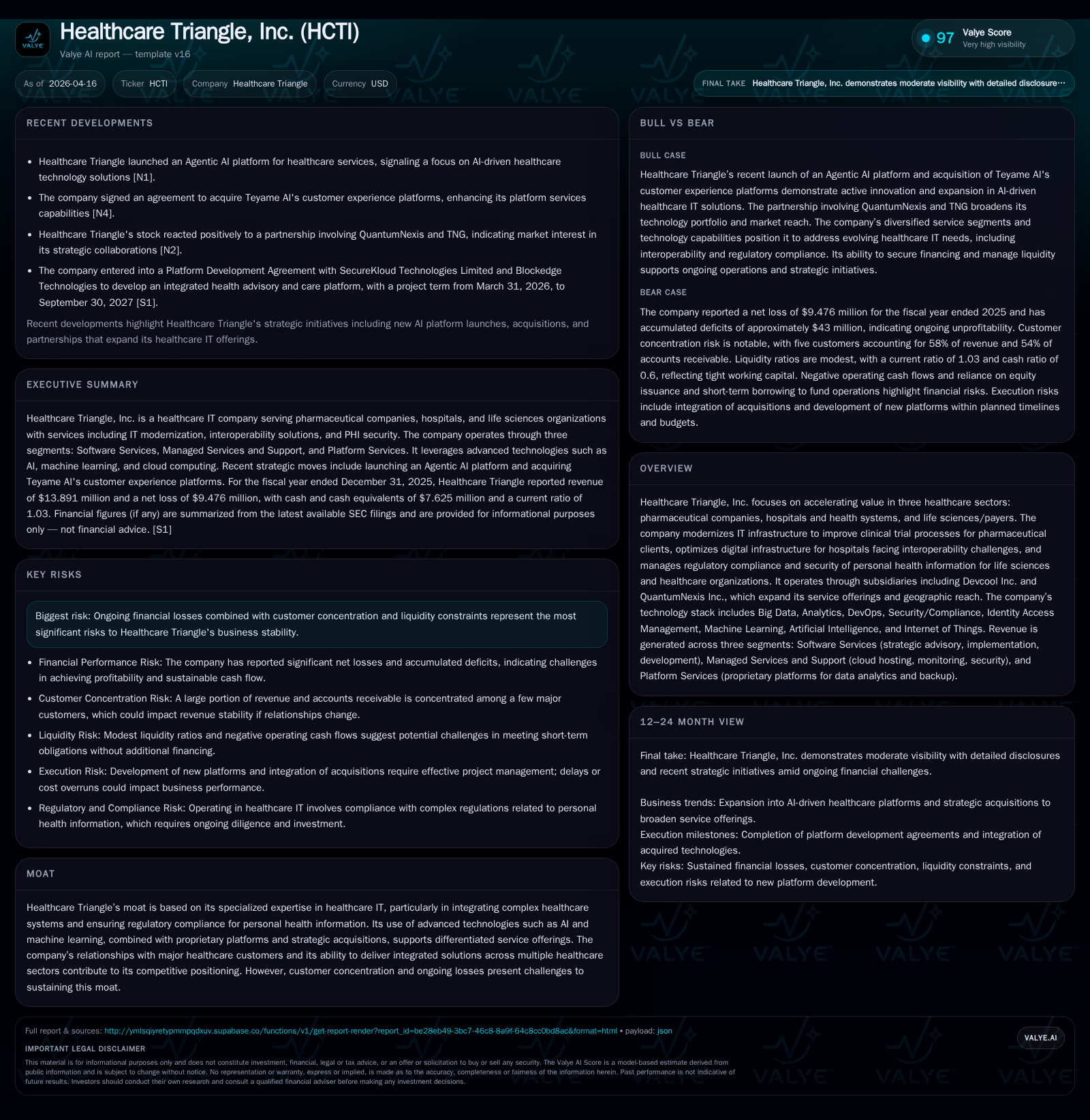
Healthcare Triangle, Inc. experienced an 18.8% revenue increase in 2025 following declines over prior years but simultaneously deepened its operating loss to $9.79 million, reflecting ongoing challenges in profitability and cash generation. Concentration risks loom as roughly 58% of sales are tied to five major customers, while liquidity remains pressured amid accumulated deficits exceeding $42 million. The firm pursues growth through subsidiaries and new technology platforms like Agentic AI, but capital allocation centers on a recently approved $2 million share repurchase amid no dividends. Monitoring operational cash flow trends and customer diversification will be critical near-term indicators of the company's financial health.
Company Overview and Historical Performance
Healthcare Triangle, Inc., through its subsidiaries including Devcool Inc. and QuantumNexis Inc., provides specialized IT solutions catering to pharmaceutical companies, hospitals, and life sciences organizations focused on regulatory compliance and data security. Their technology stack features Big Data analytics, AI/ML, DevOps, Security/Compliance protocols, and IoT integration aimed at modernizing clinical trials and healthcare infrastructure interoperability [S1,S4,S13].
Historically, Healthcare Triangle’s revenue trajectory has been uneven and marked by significant contraction between FY2022 ($45.9M) and FY2024 ($11.7M), before rebounding modestly to $13.9M in FY2025 [F1]. This volatile top-line is symptomatic of transitional challenges within their niche segments amid evolving client demands and competitive pressures.
Historical performance (annual)
| FY | Rev ($mm) | Net ($mm) | CFO ($mm) | OpInc ($mm) | Rev YoY | Net YoY |
|---|---|---|---|---|---|---|
| 2025 | 14 | -9 | -17 | -10 | +18.8% | -58.8% |
| 2024 | 12 | -6 | -1 | -5 | -64.8% | +31.3% |
| 2023 | 33 | -9 | -2 | -8 | -27.6% | +9.6% |
| 2022 | 46 | -10 | -3 | -10 |
Source: SEC companyfacts cache [F1].
Capital returns and efficiency (annual)
| FY | Buybacks ($) | FCF ($mm) | ROE% |
|---|---|---|---|
| 2025 | -17 | ||
| 2024 | -1 | 116.7 | |
| 2023 | 141000 | -2 | 624.4 |
| 2022 | 142000 | -77.0 |
Source: SEC companyfacts cache [F1].
Revenue declines from FY2022 were accompanied by persistently negative operating income across all four years analyzed [F1]. Operating income worsened sharply in FY2025 compared with FY2024 despite modest revenue recovery suggesting cost structure pressures or integration costs post acquisitions.
Drivers Behind Past Growth and Challenges
Revenue resilience in FY2025 was partly driven by the acquisition of QuantumNexis Inc., incorporating hospital information systems SaaS assets primarily targeting Asian markets including India and South East Asia [S12]. Moreover, contracts spanning software services (strategic advisory and implementations), managed services (cloud hosting and monitoring), and corporate platforms provide diversified but capital-intensive revenue streams [S7,S20].
Customer concentration presents a headwind; five customers accounted for approximately 58% of total revenue in both FY2024 and FY2025 [S4]. Concentrated reliance on a few large accounts poses credit risk for accounts receivable—about 54% of accounts receivable relate to these clients [S4,S9]. This concentration necessitates vigilant credit management due to potential non-collectability impacts.
Future Growth Prospects
The launch of an "Agentic AI" platform for healthcare services in March 2026 marks a strategic push towards leveraging artificial intelligence capabilities within their existing IT infrastructure solutions [N1]. This could augment client value propositions particularly for pharmaceutical clients seeking efficiency gains in clinical trial workflows.
Subsidiaries enable expansion into emerging healthcare IT markets internationally while broadening the service portfolio with greater managed platform capabilities [S13,S22]. Nevertheless, ongoing losses highlight the difficulty of scaling while achieving operating leverage within these technologically intensive domains.
Risk factors identified include liquidity constraints exacerbated by persistent operating losses totaling approximately $9.78 million in FY2025 alone [S13,F1], alongside regulatory compliance complexities inherent in handling personal health information across jurisdictions.
Financial Forecasts and Milestones to Watch
Although explicit forward guidance is not provided in the filings reviewed [S#], monitoring quarterly earnings releases for shifts toward positive operating cash flow would be indicative of operational stabilization.
Key upcoming milestones likely include achievement targets related to newly acquired businesses’ integration success metrics (such as Ezovion Solutions under QuantumNexis framework) [S11], alongside adoption rates for newly launched AI-powered platforms.
Equally important will be signs of improved customer diversification beyond the top five clients to mitigate concentration risks detailed above.
Returns and Capital Allocation Strategy
Healthcare Triangle has yet to demonstrate positive overall returns; the estimated return on equity based on net income relative to latest reported equity appears distorted due to accumulated deficits resulting in negative equity values at periods ending FY2023 (-$1.39M) transitioning more negative at FY2024 (-$5.11M) [F1]. This anomaly reflects substantial retained losses rather than operational efficiency or profitability improvements.
Operating cash flow deteriorated markedly from roughly negative $1.08 million in FY2024 to negative $16.52 million in FY2025 alongside reduced but minimal capex spend around $6,000 indicating focused expense control measures amidst operational challenges [F1]. Free cash flow remains deeply negative around -$16.52 million after capex deduction.
No dividends have been issued; instead, capital allocation has prioritized a recently approved share repurchase program authorized up to $2 million beginning early 2026 aiming potentially at stabilizing stock liquidity or signaling confidence despite fiscal headwinds [S5,S10,S17,S19].
Conclusion: Balancing Growth Innovation with Financial Sustainability Concerns
Healthcare Triangle seeks growth via advanced health IT solutions tailored for complex healthcare ecosystems including pharmaceuticals’ clinical trials modernization and hospital system interoperability amid regulatory landscapes involving PHI security [S13]. The recent Agentic AI platform launch and international acquisitions illustrate efforts toward technological innovation and geographic diversification.
However, persistent profitability erosion compounded by negative free cash flows underscores financing risks despite recent equity raises providing some liquidity cushion [S15]. Customer concentration remains a material risk factor demanding strategic attention.
Moving forward, watching operational margin improvement signs along with successful technology adoption curves will be key benchmarks against which market expectations can recalibrate given inherent challenges modernizing legacy healthcare infrastructure.
This analysis does not constitute investment advice or recommendations regarding Healthcare Triangle’s securities but aims to present an integrated view based strictly on publicly filed data as of April 16, 2026.
Disclaimer: This is research-only, informational analysis and not investment advice. It may include AI-generated interpretation and general industry context. Always verify important details using primary sources.

Comments