
KonaTel’s Revenue Plunge and Regulatory Risks Undermine Profitability and Cash Flow Through 2025
The end of key government subsidy programs and wholesale pricing pressures have driven KonaTel’s revenue down over 45%, leading to sustained operating losses despite a temporary profit in 2024.
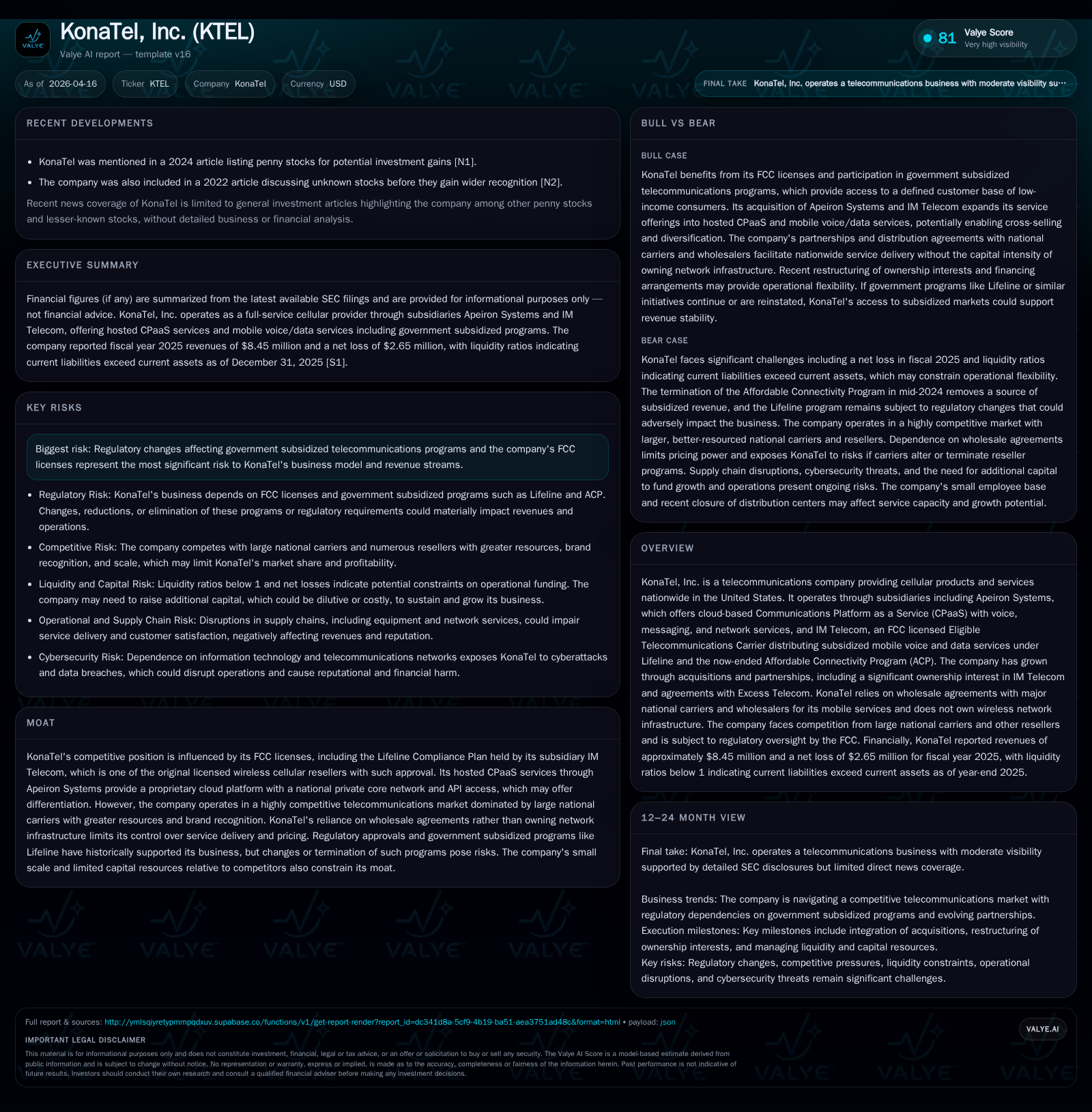
From 2022 through 2025, KonaTel experienced a marked revenue decline of over 45%, primarily due to the termination of the Affordable Connectivity Program and uncertainties surrounding the Lifeline program. Despite a profit in 2024 driven by other income, the company returned to losses in 2025 amid persistent negative operating cash flows. KonaTel operates as a wireless service reseller dependent on FCC licenses and wholesale agreements, facing competitive pressures and regulatory risks that constrain growth and profitability.
Historical Financial Performance
KonaTel’s financial results from FY2022 through FY2025 reveal significant revenue contraction alongside persistent operating losses. Revenue decreased from $20.0 million in FY2022 to $8.45 million in FY2025—a cumulative decline of approximately 58% driven largely by regulatory shifts affecting subsidized telecom programs [F1].
Operating income remained negative each year, ranging from -$2.55 million in 2022 to -$4.54 million in 2024 before improving somewhat to -$2.68 million in 2025. Net income was similarly volatile: losses were reported in FY2022 (-$2.95 million) and FY2023 (-$3.94 million), followed by a positive result of $4.49 million in FY2024 primarily due to other income contributions, then reverting to a loss of -$2.65 million in FY2025 [F1].
Operating cash flow was negative across all years measured, indicating ongoing liquidity challenges; it worsened to nearly -$4.0 million in FY2024 before improving moderately to -$1.91 million in FY2025 [F1]. Capital expenditures were minimal consistent with the company’s reseller business model.
Historical performance (annual)
| FY | Rev ($mm) | Net ($mm) | CFO ($mm) | OpInc ($mm) | Rev YoY | Net YoY |
|---|---|---|---|---|---|---|
| 2025 | 8 | -3 | -2 | -3 | -45.5% | -158.9% |
| 2024 | 16 | 4 | -4 | -5 | -14.9% | +214.0% |
| 2023 | 18 | -4 | -2 | -3 | -9.0% | -33.5% |
| 2022 | 20 | -3 | -2 | -3 |
Source: SEC companyfacts cache [F1].
Capital returns and efficiency (annual)
| FY | ROE% |
|---|---|
| 2025 | -689.0 |
| 2024 | 178.8 |
| 2023 | 130.8 |
| 2022 | -648.4 |
Source: SEC companyfacts cache [F1].
Figure: Annual Financial Summary highlighting revenue contraction and earnings volatility (FY2022-FY2025) [F1].
Business Model and Impact of Regulatory Changes
KonaTel operates primarily as a wireless service reseller relying on government-subsidized programs such as Lifeline and the Affordable Connectivity Program (ACP). The ACP officially ended on June 1, 2024 without Congressional renewal at this time [S9]. This termination materially affected core revenues tied to subsidized mobile voice/data services.
IM Telecom — a majority-owned subsidiary — holds FCC Eligible Telecommunications Carrier licenses along with Lifeline Compliance Plans allowing distribution of subsidized services across multiple states [S14]. However regulatory uncertainty persists regarding potential reductions or elimination of subsidies that could adversely affect revenue streams [S4][S7].
Additional operational risks include disruptions in supply chains for low-cost consumer devices essential for program participation and reductions in agent networks facilitating enrollments—all factors that may constrain future adoption rates [S7]. Market saturation also poses challenges as national carriers increase reseller participation leading to margin compression for smaller operators like KonaTel [S7][S16].
Competitive Landscape and Technology Considerations
The telecommunications sector is highly competitive with large facility-based carriers such as AT&T, Verizon and T-Mobile dominating market share supported by extensive infrastructure ownership [S14][S16]. KonaTel competes alongside regional carriers and MVNOs offering similar services often at aggressive price points.
Through Apeiron Systems — fully owned by KonaTel — the company offers Hosted Services including Communication Platform as a Service (CPaaS) solutions delivered over a proprietary national private core network backbone supporting voice/data traffic nationally [S9][S22]. This provides some differentiation relative to typical reseller models reliant solely on wholesaler infrastructure.
Technological risks include exposure to intellectual property claims related to licensed software platforms underpinning hosted services which could impose costly litigation or licensing burdens if unresolved [S5][S8]. Cybersecurity threats targeting operational systems or customer devices also require ongoing mitigation efforts [S17].
Dependency on wholesale agreements with major carriers exposes KonaTel to pricing risk and supply constraints; any unfavorable changes could materially impact margins or service capacity [S9][S29].
Capital Allocation and Financial Position
KonaTel has prioritized operational continuity and strategic acquisitions over shareholder returns amid sustained losses and liquidity constraints. No dividends have been declared since at least CY2020; share repurchases have not been reported recently [F1][S10].
The company maintains modest capital expenditures aligned with its asset-light reseller model.
At December 31, 2025 KonaTel reported cash & equivalents of approximately $705k against current liabilities exceeding $1.9 million resulting in a current ratio below one (0.73), indicative of tight short-term liquidity management requirements [F1]. Equity stood at roughly $384k reflecting balance sheet erosion amid cumulative deficits.
Return on equity for FY2025 approximates negative 689%, underscoring profitability challenges relative to equity base based on net loss versus book value data [F1].
Upcoming Milestones and Investor Considerations
Investors should monitor:
- FCC rulings concerning Lifeline program eligibility for resellers which directly affect IM Telecom’s operating license status.
- Wholesale pricing negotiations with national carriers that may alter cost structures or market access terms.
- Progress on pending acquisitions such as Tempo Telecom contingent upon regulatory approvals.
- Trends in operating cash flow signaling operational efficiency or further financial strain. These developments will be critical indicators of KonaTel's ability to stabilize operations amid ongoing regulatory headwinds [S7][S12][S21].
Summary
KonaTel’s financial trajectory illustrates the significant vulnerability of telecom resellers reliant on government subsidy programs subject to evolving regulatory environments. The termination of ACP coupled with uncertainties around Lifeline reimbursements has led to steep revenue declines and renewed losses despite interim profit periods.
While Apeiron Systems’ CPaaS platform offers product diversification opportunities beyond traditional handset resale services, substantial competitive pressures combined with dependence on wholesale agreements constrain margin expansion potential.
The company faces structural challenges balancing limited capital resources against the need for technological innovation amidst rapid industry evolution.
Absent renewed subsidy frameworks or successful strategic expansions supported by regulatory approvals and improved cash flows, KonaTel's ability to achieve sustainable profitability remains uncertain requiring close monitoring going forward.
This analysis is based exclusively on audited SEC filings through April 16th, 2026 ([F1],[S#]) without speculation beyond disclosed facts; investment decisions should consider individual circumstances.
Disclaimer: This is research-only, informational analysis and not investment advice. It may include AI-generated interpretation and general industry context. Always verify important details using primary sources.

Comments