
Lakeland Industries’ Struggle with Profitability Despite Steady Revenue Growth
Lakeland expanded top-line through acquisitions and global production but faced deepening losses and liquidity covenant breaches in FY26.
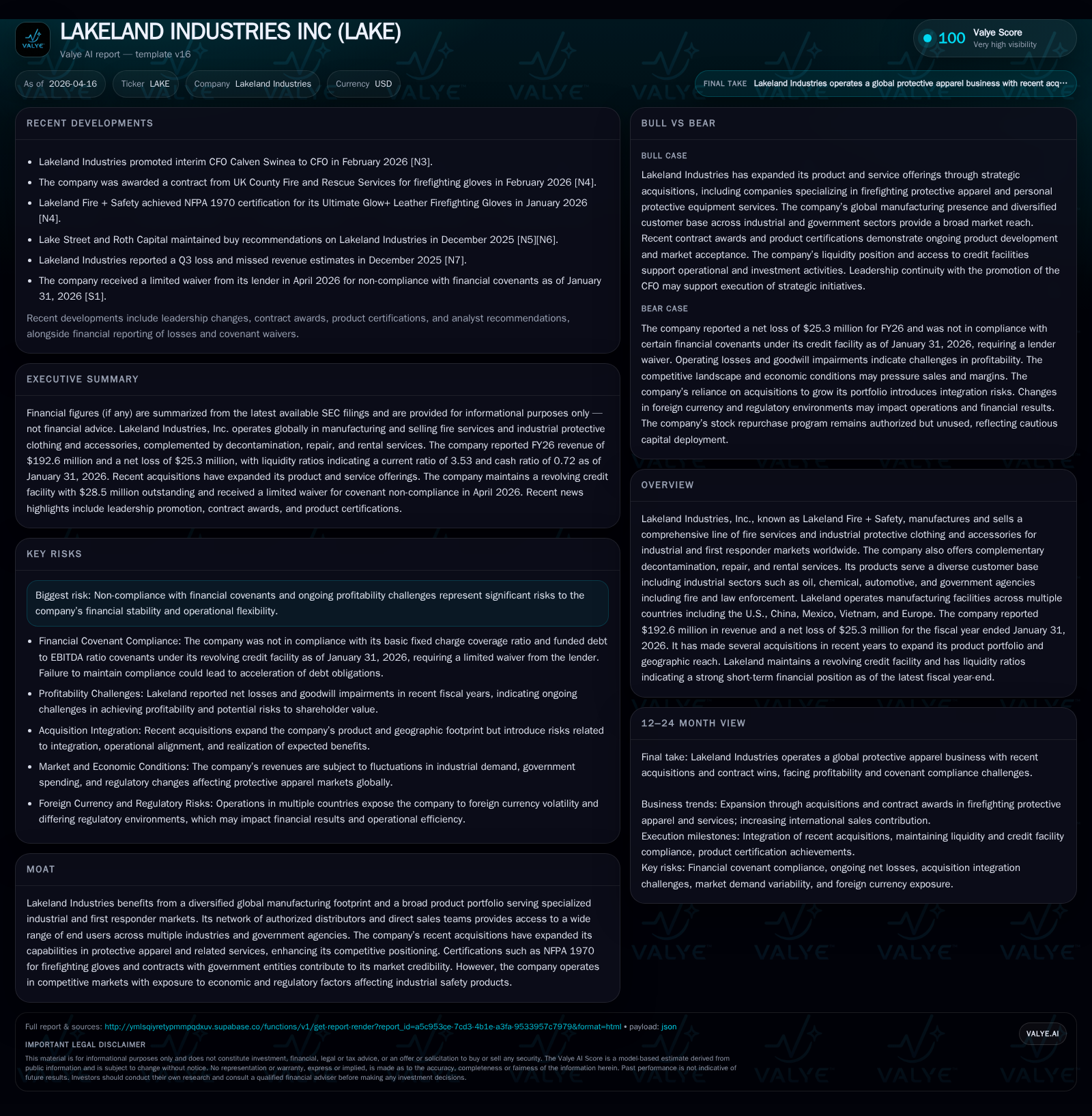
Lakeland Industries demonstrated a notable 15.2% revenue increase in fiscal 2026, fueled by strategic acquisitions and leveraging its broad manufacturing footprint. However, this growth masked deteriorating profitability, with operating income plunging by over 67% to a negative $15.5 million and net losses widening to $25.3 million. Concurrently, the company breached key financial covenants related to debt leverage and fixed charge coverage ratios, prompting a lender waiver that underscores liquidity pressures. Capital allocation remained cautious, with reduced capital expenditures and modest dividends amid negative free cash flow and diminishing return on equity.
From Expansion to Earnings: Tracing Lakeland’s Recent Growth Trajectory
Fiscal year 2026 marked an inflection for Lakeland Industries where top-line growth starkly contrasted with escalating earnings challenges. Revenue advanced by 15.2% year-over-year to $192.6 million [F1],[S1], propelled partly by acquisitions such as Arizona PPE and California PPE — providers specializing in protective equipment decontamination, repair, inspection, and rental services targeting regional firefighting markets [S1],[S25]. Such moves broadened product offerings and fortified geographic presence.
This surge was accompanied by increased inventories early in FY26 supporting anticipated demand growth; inventory reductions later suggest efforts at normalizing working capital [S1]. Yet amid these sales dynamics lurked troubling profitability results: operating income shifted from a negative $9.3 million in FY25 to a steeper loss of $15.5 million in FY26 (a nearly 67% decline) [F1],[S1]. The net loss expanded from $18.1 million to $25.3 million over the same period [F1], spotlighting margin compression.
Non-cash impairments contributed significantly — including $2.6 million in goodwill write-downs tied notably to acquired units — alongside a sizeable $3.6 million lease impairment related to underutilized assets [S1]. Stock-based compensation expense surged materially ($3.4 million), exacerbating operating expense pressure during this scaling phase [F1],[S1]. Timing variances in accounts receivable collections and liabilities partially suppressed cash generation [S1]. This encapsulates the tension between Lakeland's expansion trajectory and escalating cost structure impacting earnings resilience.
Acquisition Strategy and Geographic Diversification: A Double-Edged Sword
Lakeland’s acquisition activity underpins much of its recent revenue ascent but introduces balancing challenges reflective of operational complexity inherent to integrating diverse businesses across geographies [S8],[S25]. Both Arizona PPE (acquired for approximately $4.1 million in cash) and California PPE (consideration split between cash and equity totaling around $5.7 million) reinforced footholds in critical U.S. firefighting apparel services markets [S25]. These businesses hold UL certifications vital for servicing NFPA-compliant firefighting gear — an essential credential underpinning end-user trust and government contracts.
Internationally, Lakeland operates manufacturing centers across China, Mexico, Vietnam, Romania, Argentina, New Zealand, and India [S8]. This footprint supports tailored product production spanning disposable suits to fire-resistant garments while optimizing tariff exposure through regional supply chains.
Despite channel depth via direct sales forces and distributor networks covering over 50 countries globally [S8],[S23], this scale entails amplified overheads — including freight costs rising from $4.1 million to $4.8 million year-over-year — alongside complexities managing compliance with varying regional standards such as NFPA certifications.
Financial Performance Review: Profitability Challenges Deepen in FY26
Lakeland's P&L reflects significant margin pressure stemming from integration costs compounded by impairments weighing down core operating leverage benefits expected from scale gains [F1],[S1]. Operating income deteriorated by nearly two-thirds from a negative $9.3 million in FY25 down to negative $15.5 million in FY26 despite top-line scaling [F1]. Stock-based compensation nearly doubled prior year levels ($3.4M vs $1.6M), contributing materially alongside depreciation ($2.8M) embedded within SG&A overhead.
Goodwill partial impairments totaling approximately $2.6 million reflected recalibrations against acquired unit recoverable values amid softer-than-anticipated performance or market headwinds [S1],[S19]. Lease impairment charges ($3.6M) arose due to exit or downsizing of assets possibly linked to warehouse divestitures (proceeds partially offsetting some non-cash hits) [S1]. Operating cash flows hovered around -$15.7M consistent with net losses while capex spending was curtailed (-56% YoY down to ~$0.7M), signifying stressed liquidity balanced against maintenance needs [F1],[S14].
Working capital fluctuations featured increases in accounts receivable (+$2.7M) weighing on cash alongside modest inventory drawdowns (-$1.8M), indicative of pivoting away from earlier inventory stacking strategies implemented during prior periods for growth anticipation [S1]. Pressure on operating leverage is apparent given capacity expansion dilutes margin benefits when not complemented by efficiency gains.
Liquidity and Capital Structure: Navigating Debt Covenants and Waivers
By January 31, 2026 Lakeland violated two pivotal financial covenants tied to its Amended Loan Agreement — the basic fixed charge coverage ratio fell below the mandated minimum of 1.20x while funded debt-to-EBITDA exceeded the ceiling of 3.5x (with step-down targets tightening through FY27) [S4],[S6],[S7],[S16]. Such breaches expose the company to potential acceleration risks if unremedied.
In recognition of this breach yet balanced against management efforts toward deleveraging or profitability improvements,the lender granted a limited waiver on April 13, 2026 protecting Lakeland from near-term default consequences while reaffirming existing loan terms inclusive of a secured revolving credit line capped at $40 million maturing late 2029 [S4],[S5],[S16]. This revolver carries variable interest tied predominantly to SOFR plus margin scaling between ~1.25%-2% dependent on leverage metrics; payments are due at maturity without mandatory amortization except one-time conversion options into longer-term loans up to $5 million principal [S5],[S9].
Credit agreement restrictions impose caps on acquisitions exceeding $26 million per transaction or cumulatively above $36 million post-Amendment No.5 emphasizing disciplined M&A given fragile covenant room[S11]. Negative covenants also curtail liens grants or additional indebtedness layering that could exacerbate liquidity risk.[S7].
As of fiscal year-end borrowings stood at approximately $28.5 million drawn against available lines versus prior year balances near $13 million indicating elevated leverage accompanying expansion but stirring tighter liquidity dynamics[S12],[F1].
Outlook and Industry Headwinds: Assessing Growth Constraints Ahead
Industry conditions present mixed implications for Lakeland's near-term trajectory. Government contracts anchored by certifications like NFPA encourage stable demand for firefighter PPE servicing,[N/A analysis] but escalating regulatory scrutiny particularly related to PFAS-associated litigation potentially casts contingent liability uncertainty.[S19] Economic cyclicality affecting industrial sectors such as petrochemical or automotive may suppress discretionary spending despite mandatory safety requirements.[ N/A analysis]
Elevated leverage constrains capital expenditure freedom despite plans for moderate increases (~$3.2M expected capex for FY27) focused on fire services capacity enhancements funded primarily via operating cash flow once stabilized.[S14] Regulatory pressures plus profit margin sensitivity driven by raw materials inflation or logistics disruptions suggest persistent headwinds vying against growth ambitions.
Lakeland faces balancing sustaining acquisitive growth strategies while restoring profitability critical for covenant compliance restoration and shareholder value preservation.
Capital Allocation Decisions Amidst Financial Strain
Capital discipline dominates stewardship amid persistent losses with evident prioritization from sharply curtailed capital expenditures declining more than half from $1.54M in FY25 down to $0.67M last fiscal year[F1],[S14]. Planned ramp-up forecasts for FY27 ($3.2M) suggest intent toward selective manufacturing asset replacement coupled with targeted expansion within fire service products infrastructure aimed at stabilizing production efficiencies.[S14]
Dividends edged higher modestly reaching about $1.15M representing continued albeit cautious shareholder returns while share repurchases remain suspended absent buyback activity during FY26.[F1],[S14] Operating cash generation remains negative (-$15.75M), only marginally improved relative previous years exacerbated further when capital commitments factored leaving free cash flow underwater nearing -$16.42M.[F1]
Return on equity plunged into deeply negative territory pegged near -19.6% consistent with net losses eroding retained earnings base reflecting significant strain on capital returns while signaling urgent turnaround needs.[F1]
Key Metrics Snapshot: Historical Financial Performance Table
Historical performance (annual)
| FY | Rev ($mm) | Net ($mm) | CFO ($mm) | OpInc ($mm) | Rev YoY | Net YoY |
|---|---|---|---|---|---|---|
| 2026 | 193 | -25 | -16 | -16 | +15.2% | -40.0% |
| 2025 | 167 | -18 | -16 | -9 | +34.1% | -433.2% |
| 2024 | 125 | 5 | 11 | 6 | +1879.2% | +189.6% |
| 2023 | 6 | 2 | -5 | 6 |
Source: SEC companyfacts cache [F1].
Capital returns and efficiency (annual)
| FY | Div ($) | FCF ($mm) | ROE% |
|---|---|---|---|
| 2026 | 1152000 | -16 | -19.6 |
| 2025 | 887000 | -17 | -12.3 |
| 2024 | 9 | 4.4 | |
| 2023 | -7 | 1.6 |
Source: SEC companyfacts cache [F1]. All figures expressed in millions USD except percentages.
This analysis contextualizes Lakeland Industries’ contrasting narrative of sustained revenue expansion alongside deteriorating profitability manifested through impairments, rising expenses, and debt covenant challenges as it confronts operational scale complexities amplified by recent acquisitions amidst evolving market dynamics.
Disclaimer: This report is intended solely for informational purposes based on disclosed filings; it does not constitute investment advice or recommendations.
Disclaimer: This is research-only, informational analysis and not investment advice. It may include AI-generated interpretation and general industry context. Always verify important details using primary sources.

Comments