
Capstone Holding Corp.'s Expansion Faces Profitability and Liquidity Challenges in 2025
Acquisitions broaden footprint and product offerings, but ongoing losses and refinancing risks cloud near-term outlook.
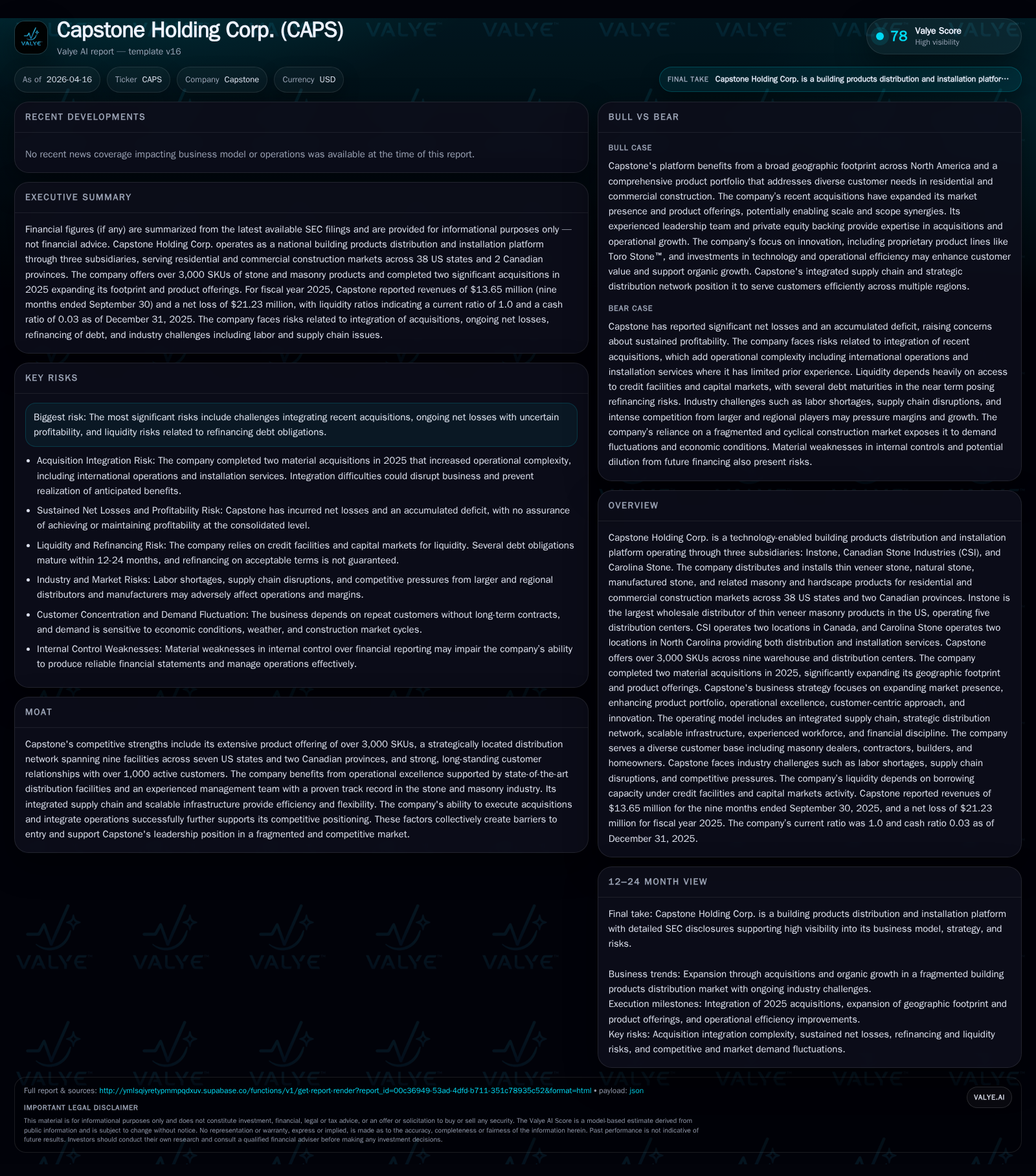
Capstone Holding Corp. saw substantial revenue growth in 2024, fueled by acquisitions expanding its North American distribution network and product portfolio. However, 2025 performance highlights persistent operating losses and cash flow negative results amid integration costs and macroeconomic headwinds in construction markets. The company’s liquidity position is balanced on its ability to refinance debt maturing within the next two years and generate operational improvements from recent acquisitions. Key uncertainties remain regarding sustainable profitability and working capital management under current economic conditions.
Company Overview
Capstone Holding Corp. operates as a technology-enabled platform distributing and installing building products focused on stone veneer materials across residential and commercial sectors. Its operations are conducted through three main subsidiaries: Instone (U.S.), Canadian Stone Industries (CSI) in Canada, and Carolina Stone servicing the Southeast U.S. market. Together these subsidiaries span 38 states plus two Canadian provinces with nine strategically located distribution centers.
Instone is the largest wholesale distributor of thin veneer masonry products in the U.S., leveraging five regional warehouses across critical markets including Massachusetts, New Jersey, Ohio, California, and Illinois. CSI contributes two locations in British Columbia and Ontario specializing in both natural and manufactured stone wholesale distribution. Carolina Stone operates dual North Carolina locations offering both product distribution and installation services for multi-family residential and commercial projects.
The company features an extensive product portfolio with more than 3,000 SKUs encompassing natural stone variants like Pangaea®, mechanical attachment systems such as Beon Stone’s patented D-Rain™, hardscape products like Aura Natural Landscapes®, modular fireplaces under Isokern®, as well as proprietary manufactured stones under Toro®.
Historical Performance & Growth Drivers
From a below-scale baseline revenue of approximately -$2 million in fiscal 2018 (reflecting earlier-stage or restructuring phases), Capstone grew top-line markedly to $44.9 million by fiscal year-end 2024 [F1]. This explosive revenue expansion primarily reflects strategic acquisitions—the April 2020 Instone acquisition baseline saw revenues rise from approximately $32.2 million to about $44.2 million by end-2025—as well as organic expansion efforts into new territories.
However, profitability metrics have lagged behind revenue growth momentum. Operating income swung from a small positive $181 thousand in FY2018 to an operating loss of nearly $11 million by end-2025 [F1], largely due to integration costs from recent acquisitions completed in late 2025—specifically Fraser Canyon Holdings/CSI on December 1, 2025—and Carolina Stone during FY2025 [S4]. Net losses deepened accordingly to -$21.2 million for the full fiscal year ending December 31, 2025.
Operating cash flows reversed course sharply from positive $3.8 million in FY2024 to negative $4.4 million in FY2025 amid working capital build associated with inventory ramp-up across an expanded footprint [F1]. Capital expenditures remained minimal (~$120 thousand annually), likely reflecting conscious cost management during liquidity pressures.
Historical performance (annual)
| FY | Rev ($mm) | Net ($mm) | CFO ($mm) | OpInc ($mm) | Net YoY |
|---|---|---|---|---|---|
| 2025 | -21 | -4 | -11 | -728.3% | |
| 2024 | 45 | -3 | 4 | -1 | |
| 2018 | -2 | 0 | 0 | 0 | +121.7% |
| 2017 | -2 | -2 |
Source: SEC companyfacts cache [F1].
Capital returns and efficiency (annual)
| FY | FCF ($mm) | ROE% |
|---|---|---|
| 2025 | -5 | -170.5 |
| 2024 | 4 | 83.8 |
| 2018 | -30.5 | |
| 2017 | 199.7 |
Source: SEC companyfacts cache [F1].
Table: Selected Annual Financial Performance [F1]
Market & Industry Context
Capstone’s primary end-markets—the residential repair/remodel sector and commercial construction—remain sensitive to macroeconomic factors such as mortgage rates, consumer confidence, inflationary cost pressures, access to credit, and overall construction activity [S1]. While housing supply deficits support underlying demand for building product inputs long term, near-term remodeling activity faces a tempered recovery relative to prior cycles due to high borrowing costs dampening discretionary project spends [S1]. According to Zonda Home forecasts cited by management, residential building product spend growth is projected at just around +1% in 2026 with modest repair/remodel growth of ~3.6% — significantly restrained compared to historic post-deferral surges [S1].
Competition is robust with fragmentation among large national distributors versus smaller regional players alongside quarry operators who may sell directly [S14]. Key competitive facets include breadth of product selection nuances across masonry finishes, pricing agility amid inflation cycles, logistics reliability via optimized distribution hubs that cut delivery times, customer service quality including technical support on innovative product lines (e.g., patented moisture management systems), as well as longstanding customer relationships [S14][S18].
Recent Developments & Strategic Initiatives
In calendar year 2025 Capstone undertook two notable acquisitions:
- Fraser Canyon Holdings Inc./Canadian Stone Industries (CSI): Completed December 1st; added substantial Canadian presence with facilities in British Columbia and Ontario plus integration of San Leandro operations into Instone's U.S.-based facilities enhancing cross-border supply chain synergies [S4][S27].
- Carolina Stone Products: Acquired during FY2025 expanding Southeast U.S. coverage via two North Carolina locations offering both wholesale distribution and professional installation; total purchase consideration approximated $4.2 million including earn-outs tied to EBITDA milestones through December 2027 [S4].
These acquisitions underpin Capstone's multi-pronged expansion strategy focusing on geographic reach augmentation (adding six new states), broadening product assortments including complementary masonry-related lines beyond traditional natural stone offerings [S4][S21][S26]. The company also launched its proprietary Toro® line—a curated portfolio of manufactured stone veneer designed for premium aesthetics at competitive pricing expected to drive organic revenue growth over the medium term [S19].
Marketing initiatives emphasize digital tools enabling customers—masonry dealers, contractors—to streamline ordering via business-to-business web platforms listing real-time inventory/pricing consolidated across product categories increasing wallet share opportunities [S5][S19].
Capital Structure & Liquidity Profile
Since going public with an uplisting on Nasdaq Capital Market in March 2025 raising gross proceeds of approximately $5 million via common stock issuance [S9], Capstone has reinforced its liquidity buffer through multiple facilities:
- A revolving line of credit facility now managed by Beacon Bank & Trust allows advances based on eligible accounts receivable plus inventory formulas; outstanding borrowings reached $10.3 million as of December-end 2025 [S20].
- TD Bank credit facilities established alongside CSI acquisition lend CAD$5 million revolver available for working capital purposes [S3].
- Convertible note financing remains significant with ~$3.86 million principal balance outstanding at December-end 2025 [S9].
- Additionally maintained a $20 million equity line of credit with minimal drawdown providing dry powder capacity if required [S11][S22].
Despite these sources, the company generated a net loss of $21.2 million in FY2025 along with negative operating cash flow of -$4.4 million complicating free cash flow generation which remained negative around -$4.53 million after minimal capex outlays [F1]. Current assets roughly equal current liabilities ($23M each), signaling working capital management remains tight under expanded operational scale.
Upcoming debt maturities approaching nearly $6 million due within fiscal year ending December 31, 2026 pose material refinancing risk [S11][S13]. Management acknowledges the potential going concern implications but expresses confidence based on:
- The March 2025 public equity raise,
- Undrawn capacity under equity lines,
- Revolving credit availability,
- And expected operational improvements derived from full-year contributions of recent acquisitions expected to improve EBITDA generation capacity.
However, absence of profitability traction into consolidated net earnings beyond structural integration costs adds uncertainty toward sustained financial stability.[S11]
Returns & Capital Allocation
Given persistent net losses through FY25 and accumulated deficit increasing significantly to approximately $218 million as noted on balance sheet disclosures [F1], Capstone currently does not return capital via dividends or share repurchases nor reports meaningful positive equity returns proxied by approximate negative return-on-equity exceeding -170% based on trailing net income divided by equity base at year-end ([F1]).
Capital allocation priorities appear focused on acquisition funding supplemented through debt/equity raises while maintaining minimal fixed asset investment consistent with distribution model requirements evidenced by steady low capex figures around $120K annually despite scaling operations [F1][S20].
Future potential capital deployment toward operational technology enhancements or expanded warehouse functionality might emerge given stated commitments to operational excellence investments but must be balanced against tightening liquidity constraints.
Risks & Considerations
Capstone’s business model contends with inherent cyclical sensitivity endemic to its end markets tied closely to macro conditions including interest rate levels affecting mortgage rates impacting homebuilding/remodeling willingness among consumers [S1][S15]. Inflationary pressures affect inputs such as labor costs—masonry skills are specialized—and freight/energy expenses further compress margins particularly when pricing pass-through capabilities lag or reduce volume demand.[S6][S25]
Integration risk looms large given back-to-back acquisitions diluting management focus potentially disrupting service levels or leading to unanticipated cost escalations.[S15][S23] Maintaining cohesion among diverse geographic markets between U.S.-based Instone/Carolina Stone versus Canadian CSI amidst varying regulatory environments presents additional complexity.[S16]
Competitive fragmentation persists requiring ongoing differentiation via product innovation (Toro®), service quality enhancements (digital order platforms), broad assortments exceeding typical local distributors’ footprints, all while fending off direct quarry sales channel competition.[S14]
Financially the company must navigate upcoming considerable refinancing needs under potentially volatile credit markets coupled with recurring losses eroding shareholder equity cushions that could prompt covenant breaches absent improved operating results or timely financing solutions.[S13][S22]
Outlook & What To Watch (Analysis)
Looking ahead through mid-2026 key indicators warrant close monitoring:
- Progress on integration synergies from CSI and Carolina Stone acquisitions reflected in narrowed operating losses or improved EBITDA margins.
- Stabilization or modest improvements in core markets repayment/remodel spend consistency matching Zonda forecasts.
- Debt covenant compliance signals confirming ability to refinance maturing ~$6M obligations given limited internal funds.
- Organic growth trajectory driven by new state penetrations expanding customer base beyond historical footprints evidencing scalable sales infrastructure.
- Adoption uptake rates for proprietary Toro® brand signaling effective competitive positioning within manufactured stone veneer sector.
- Potential capital raises or asset divestitures influencing liquidity backdrop.
Success depends largely on execution capabilities against tough economic headwinds prevalent industry-wide requiring operational discipline coupled with prudent financial stewardship.
This report is prepared solely for informational purposes reflecting analysis based strictly on publicly filed documents without investment recommendations or price targets.
Disclaimer: This is research-only, informational analysis and not investment advice. It may include AI-generated interpretation and general industry context. Always verify important details using primary sources.

Comments