
XPENG INC Expands Electric Vehicle Portfolio While Managing Regulatory and Supply Chain Pressures
Strong volume growth in 2025 propelled revenues and margins, yet regulatory and competitiveness risks remain key.
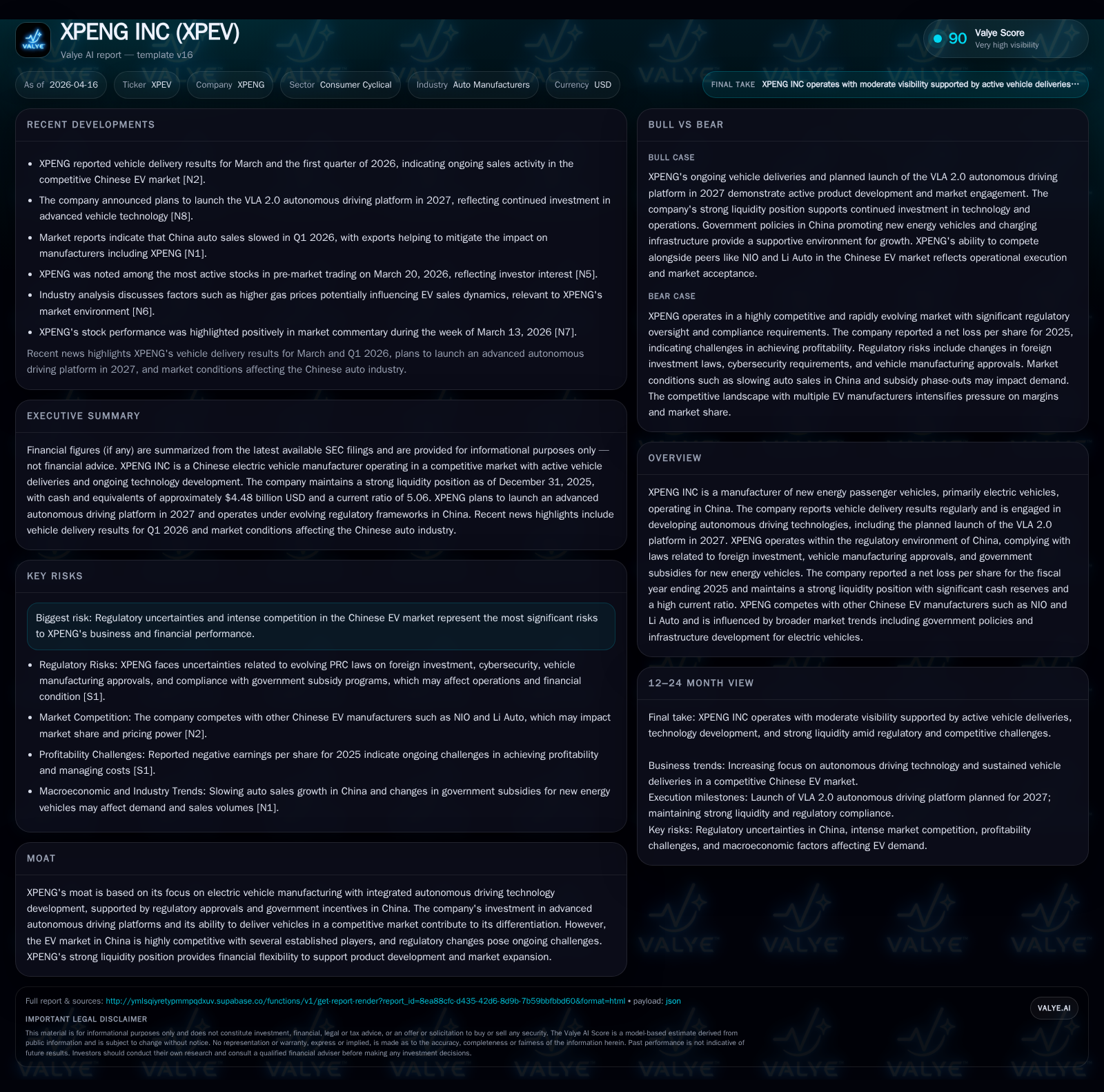
XPENG Inc experienced rapid growth in vehicle deliveries and revenue in recent years, supported by a diversified lineup of electric vehicles targeting mid- to high-end markets. The company leverages in-house software development and advanced autonomous driving technologies to differentiate its offerings within China’s competitive EV industry. Despite losses, XPENG’s margins expanded notably in 2025 alongside increased R&D and sales investments. Going forward, growth will be driven by new model introductions, geographic expansion, and the upcoming launch of the VLA 2.0 autonomous driving platform. However, evolving regulatory frameworks and reliance on certain suppliers pose ongoing operational risks.
Historical Performance and Growth Drivers
XPENG's financial trajectory through the latest reported fiscal year (ending December 31, 2025) reveals a period of accelerated expansion founded largely on vehicle delivery volume growth and margin improvement amid significant investment commitments [S5][S9][F1].
Deliveries of XPENG's Smart EVs (Battery Electric Vehicles) and NEVs (New Energy Vehicles encompassing Extended-Range Electric Vehicles) surged from around 190,000 units in 2024 to approximately 429,445 units by end-2025 — representing a sharp year-over-year increase of about 126% [S5]. Correspondingly, revenues nearly doubled from RMB40.9 billion to RMB76.7 billion over the same interval [S5][S26]. This jump was paired with a rise in gross profit margin from roughly 14.3% to an enhanced level of roughly 18.9%, reflecting operational leverage and improved product mix effects including higher-margin services revenues such as technical R&D services and carbon credit trading [S9][S26].
A compact summary table captures XPENG’s vital financials for recent years:
Historical performance (annual)
| FY |
|---|
| 2020 |
Source: SEC companyfacts cache [F1].
Revenues include vehicle sales plus services; R&D and SG&A reflect company disclosures [S5][S9]
XPENG primarily targets China's burgeoning middle-class consumer base with smart features integrated into its vehicles: advanced driver assistance (ADAS), smart connectivity, over-the-air (OTA) firmware updates that allow continual enhancements post-sale—all serving as components of its differentiated mobility experience [S15][S6]. The company deploys scalable vehicle platforms supporting several models including MONA M03 (BEV sedan), Next P7 (BEV sedan), G6/G7/G9 SUVs with BEV and EREV variants, and the X9 MPV with plug-in hybrid options [S22].
Product Expansion and Innovation as Growth Catalysts
Product expansion remains central to XPENG's growth strategy. Throughout the past two years leading into early 2026, XPENG introduced upgraded editions (e.g., G6,G7,G9 P7+ versions) featuring extended range battery options as well as enhanced electric drive capabilities [S22]. In March-April 2026 alone, it rolled out upgrades such as the EREV version of G6 plus facelifts for the MONA M03 lineup while launching presales for the GX model [N2][N5][S22].
Crucially, XPENG invests heavily in developing autonomous driving technologies with an upcoming VLA (Vision Level Autonomous) system version slated for release in calendar year 2027 [N3]. This full-stack ADAS platform integrates proprietary software with hardware sensors—representing a technological platform expected to elevate competitive positioning by offering higher degrees of driver assistance beyond currently deployed XNGP systems [S6][N3].
The company complements automotive innovation with an expanding sales network—currently totaling over seven hundred stores distributed across more than two hundred cities—and robust online marketing efforts targeting new customer acquisition while aiming for cost efficiencies via asset-light franchise operations [S4][S15]. Concurrently XPENG increased its charging infrastructure footprint expanding its self-owned supercharging stations network to more than three thousand by end-2025 across tier-1 through emerging Chinese cities [S15].
Financial Expectations and Forward Indicators
While explicit guidance is limited within filings and announcements up to April 2026 [N5][S1], key milestones to monitor include:
- Progress on customer adoption rates measured via monthly vehicle deliveries influenced by overall economic environment impacting China’s automotive market demand [N4].
- Successful commercial launch of VLA 2.0 autonomous platform scheduled for next calendar year that could trigger uptick in value proposition [N3].
- Expansion into international markets beyond initial European rollouts to diversify revenue sources amid intensifying domestic competition [S4].
- Cost management effectiveness especially regarding supply chain resilience given XPENG’s dependency on single-source suppliers for some critical components [S8].
Ongoing R&D spending reflects commitment toward these innovation efforts but sustains pressure on near-term profitability metrics given raised expenses incurred. Meanwhile increasing SG&A outlays align with sales volume gains but also reflect investments to bolster brand recognition [S16][S25].
Returns Profile and Capital Allocation
Up-to-date granular return metrics like ROE are unavailable post-2020 from official financial snapshots; however historical data indicated negative returns with an approximate -7.9% ROE at end of last audited fiscal year available from SEC filings dating back prior to the explosive growth phase covered here [F1]. Operating cash flow trends have remained negative after capital expenditures (~$145 million FCF deficit latest known) consistent with aggressive expansion mode rather than mature cash generation profile at this stage [F1].
No dividends or share repurchase programs have been reported recently given reinvestment priorities coupled with net losses per share acknowledged for fiscal year ending December 31 2025 [S1][F1]. The strong liquidity position highlighted through multi-billion USD cash reserves and high current ratio signals adequate financial flexibility though efficient capital deployment remains essential moving forward [F1][S12][S13].
Risk Assessment: Regulation and Competition
XPENG operates under complex regulatory conditions characterized by frequent adjustments encompassing foreign investment laws, cybersecurity measures impacting Internet-connected features onboard vehicles, evolving safety certification requirements for new energy vehicles including OTA software updates regulations, alongside permissions pertaining to vehicle manufacturing approvals issued by Chinese government authorities (e.g., MIIT) [S8][S19][S21]. These layers introduce execution uncertainty requiring continuous compliance investments.
Further complicating execution is reliance on select suppliers providing key parts under contractual single-source arrangements creating supply chain vulnerability particularly if quality or timing expectations fail versus targets—a familiar challenge across Chinese EV manufacturers [S8]. Industry-wise competition remains intense not only against established Chinese peers NIO and Li Auto but also greater influx of international EV brands increasing pricing pressures potentially constraining profitable unit volumes despite volume ramp-ups observed recently [N2][N10][S6].
Conclusion
XPENG marks itself as one of China's prominent pure electric vehicle manufacturers combining scalable product platforms with smart software-driven differentiation harnessing advanced ADAS technology stacks. The company’s recent stellar growth metrics underscore resonant consumer demand boosted by its innovative suite coupled with expansion across geography.
Nevertheless sustaining this momentum necessitates navigating multi-faceted operational risks—from securing uninterrupted supply channels and managing cost curves amid rising competition to maintaining compliance within China's shifting regulatory landscape governing automotive products embedded with complex data-driven functionalities.
Capital allocation has prudently favored reinvestment to fuel product development pipelines including the forthcoming VLA 2.0 system launch poised for impactful advancement next year while supporting necessary sales infrastructure expansion driving broad-based revenue scales.
Investors should track delivery volumes closely alongside cost trajectories for signs of improving profitability dynamics balanced against regulatory developments affecting business licensing or data security related regulation enforcement.
Disclaimer: This analysis is provided solely for informational purposes based on available data without any recommendation or investment advice.
Disclaimer: This is research-only, informational analysis and not investment advice. It may include AI-generated interpretation and general industry context. Always verify important details using primary sources.

Comments