
ENvue Medical Inc Aims for Growth With Innovative Feeding Tube Navigation Amid Financial Headwinds
ENvue Medical is commercializing a patented electromagnetic navigation system to improve enteral feeding safety while managing substantial operating losses and capital constraints.
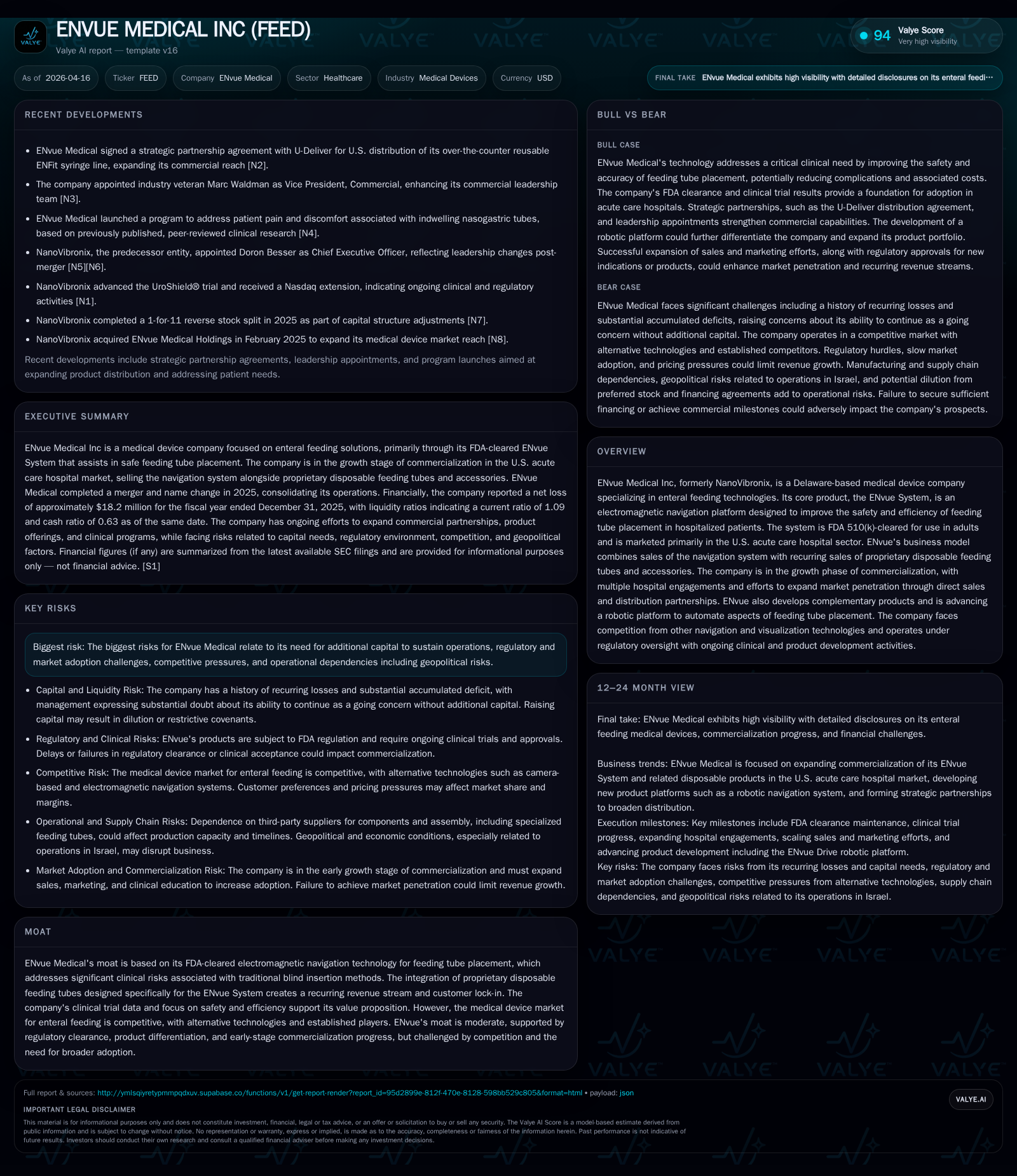
ENvue Medical Inc specializes in FDA-cleared electromagnetic navigation technology designed to improve the safety and efficiency of feeding tube placement in acute care hospitals. The company has experienced modest revenue growth driven by initial market adoption efforts but continues to burn cash with widening net losses due to heavy commercialization investments. The business model relies on proprietary disposable feeding tubes creating recurring revenue amid a competitive landscape with alternative products. Tight liquidity and preferred stock dilution risks underpin notable financial pressures, while regulatory compliance and reimbursement challenges present further adoption hurdles. Key milestones to monitor include progress in ongoing clinical trials and expanding hospital engagements.
Track Record: Historical Financial Performance and Growth Drivers
ENvue Medical Inc's journey as a medical device company has been marked by modest revenue increments alongside mounting operating losses driven largely by investments into commercialization and product development. Revenue increased from $239K in 2017 to approximately $318K in 2018, equating to an approximate annual growth rate of over 33% in the latest comparative period [F1]. Despite this growth trajectory in top line, the company's operating income deteriorated sharply — from an operating loss of roughly $3.58M in 2024 to a much steeper loss of about $22.89M by the end of 2025 [F1].
This disproportionate expansion in operating losses relative to revenues reflects ENvue’s aggressive scale-up approach during its nascent commercialization phase. Net income followed this trend with a nearly fourfold increase in losses to $18.19M by 2025 [F1], evidencing that profitability remains elusive as the company prioritizes market penetration.
Operating cash flow has remained negative and deteriorated year-over-year from -$2.52M (2024) to -$9.37M (2025), underlining persistent cash burn associated with sales deployment expenses without corresponding efficiencies yet realized [F1]. Capital expenditure levels are minimal (approx. $60K in 2025), reflecting a business dependent on outsourced manufacturing and focused more on scaling sales and R&D rather than heavy asset investments [F1].
Historical performance (annual)
| FY | Net ($mm) | CFO ($mm) | OpInc ($mm) | Capex ($) | Net YoY |
|---|---|---|---|---|---|
| 2025 | -18 | -9 | -23 | 60000 | -390.8% |
| 2024 | -4 | -3 | -4 | 3000 | +0.2% |
| 2023 | -4 | -4 | -3 | 1000 | +31.9% |
| 2022 | -5 | -7 | -5 | 3000 |
Source: SEC companyfacts cache [F1].
Capital returns and efficiency (annual)
| FY | FCF ($mm) | ROE% |
|---|---|---|
| 2025 | -9 | -54.3 |
| 2024 | -3 | -590.9 |
| 2023 | -4 | -93.1 |
| 2022 | -7 | -168.5 |
Source: SEC companyfacts cache [F1].
Note: Operating income and net income years for recent two periods only due to data availability.
Technology Differentiation and Market Positioning in Enteral Feeding
At the core of ENvue Medical's product offering is its FDA-cleared electromagnetic navigation system designed to facilitate safer nasogastric and nasoenteric feeding tube placements in hospitalized adult patients [S21]. Traditional feeding tube insertion relies heavily on blind placement methods which carry increased risks such as misplacement leading to serious complications or even death.
The electromagnetic system enhances "enteral access safety" by providing real-time visualization during insertion procedures—addressing critical points such as reducing esophageal or pulmonary misplacements—which historically have resulted in adverse patient outcomes [S21]. These risk mitigations resonate strongly in hospital workflows where minimizing procedural complications directly influences care quality metrics and downstream costs.
ENvue extends its moat via integration of proprietary feeding tubes engineered specifically for compatibility with its navigation technology—this creates "device lock-in dynamics" whereby buyers are incentivized toward recurring purchases of these disposable consumables alongside capital equipment deployments [S21]. This recurring revenue model is fundamental given the intense pricing pressures typical for electromechanical medical devices competing against legacy blind methods or alternative marks such as camera-assisted systems.
Nonetheless, ENvue operates within a competitive milieu populated by established players offering different modality solutions—with some competitors having recalled devices due to safety issues underscoring the high stakes involved—heightening the importance of proven clinical efficacy backed by robust trial data supporting both safety and efficiency gains for physicians [S21].
Emerging Growth Pathway and Market Expansion Initiatives
The company’s commercialization strategy primarily seeks footholds within U.S.-based acute care hospitals where enteral feeding represents a standard clinical procedure but one fraught with recognized safety gaps amenable to technological advances [S6]. Initial customer acquisition combines direct sales forces working alongside distribution partnerships catering to hospital networks.
Such dual-channel models balance scale breadth against service depth but can encounter elongated sales cycles given institutional purchaser procurement complexities common within healthcare establishments. These engagements often demand extensive training programs targeting nursing staff and physicians due to workflow impacts inherent when introducing novel procedural devices.
Parallel innovation trajectories include development efforts towards a robotic platform aimed at automating aspects of feeding tube placement — representing potential longer-term differentiation beyond baseline technology offerings currently available [N1]. Moreover, progress advancing clinical trials for adjunctive products like UroShield implies ambitions extending capabilities beyond core enteral feeding applications, providing diversification avenues amid commercialization challenges [N1].
Market appetite for new technologies integrating into existing hospital protocols remains cautious; reimbursement pathways lack full clarity thereby tempering immediate large-scale adoption rates. As such, growth prospects hinge on demonstrable clinical benefit claims coupled with effective payer engagement strategies.
Capital Structure, Funding Needs, and Shareholder Returns
Financially, ENvue Medical faces notable capital constraints underscored by year-end 2025 figures showing approximately $4.22 million in cash assets versus current liabilities tallying around $6.67 million—a current ratio near parity at 1.09—implying limited liquidity buffers under existing operational trajectories [F1].
Aside from working capital limitations, dilution risk looms via outstanding Series H Preferred Stock featuring cumulative dividends accruing at a rate of 9% annually payable in common stock shares subject to conversion price adjustments per anti-dilution provisions detailed within their certification terms [S2]. Such mechanisms heighten shareholders’ exposure to equity dilution especially if dividend obligations cannot be settled with available authorized shares causing structural pressure on share price performance.
Historically ENvue has not distributed dividends nor conducted share repurchases reflecting retention policies aligned with sustained investment into commercialization rather than capital returns at this enterprise stage [F1]. Return on equity calculations derived from the latest fiscal results approximate -54%, indicative predominantly of net loss-driven erosion after factoring equity base effects—the negative ROE reflects ongoing developmental business risks rather than capital misallocation per se given sector typicalities at early market phases [F1].
Present funding challenges imply future capital raises are probable prerequisites for continued operations; however, restrictive covenants linked with existing preferred stock agreements may constrain financing flexibility or impose operational limitations impacting strategic options moving forward.
Regulatory Landscape and Competitive Risks to Adoption
ENvue operates squarely within extensive regulatory frameworks governing medical devices including but not limited to FDA oversight requirements related to clearance maintenance under Section 510(k), post-market surveillance obligations reporting adverse device experiences promptly as mandated by federal protocols . Failure or delay in compliance could result in enforcement actions adversely affecting product availability or reputational standing.
Additionally, adherence to healthcare fraud statutes such as the Anti-Kickback Statute, False Claims Act provisions and transparency obligations including disclosures under Physician Payments Sunshine Act generate layers of compliance complexity impacting interactions with providers and marketing practices . Violations—even inadvertent—carry substantial penalties that could disrupt commercial operations substantially.
Moreover, third-party reimbursement coverage uncertainty remains salient; without favorable payer policies recognizing differential value for technologies improving patient outcomes or cost offsets through reduced complications market size expansions may stall leaving commercial opportunities limited relative to theoretical addressable populations [S4–S5].
Data privacy regulations spanning HIPAA mandates domestically plus analogous international laws complicate data handling particularly when connected care platforms or cloud-based device integrations come online potentially exposing additional compliance vectors needing constant monitoring . Finally geopolitical considerations linked predominantly with Israeli operations expose operational risks that must be actively managed given regional volatility consequences on supply chains or personnel deployment reliability [S6,S1].
Key Milestones To Watch And Strategic Outlook
Critical upcoming milestones include progress updates on pivotal clinical trials such as UroShield which may validate broader applications beyond core feeding tube navigation if successful clinically and regulatorily approved [N1]. Monitoring announcements regarding expanded distribution agreements will also serve as indicators of scaling momentum within target hospital networks.
While management has not provided explicit profitability timelines publicly due possibly to prevailing operational uncertainties amid liquidity constraints, movement toward sustainable revenue growth balanced against controlled expense structures will remain key investor focus areas.
Risks From Capital Constraints And Operational Dependencies
Operational continuity remains conditioned on successful capital procurement plans; management explicitly acknowledges "going concern" considerations amid tight cash positions including risk exposures should financing avenues fail or materially delay impacting clinical trial progressions or marketing initiatives [S1,S2].
Geographic concentration involving Israel-centric manufacturing/design units adds political/operational vulnerability layers from unpredictable regional escalations possibly impairing workflows or component supply logistics critical to consistent product availability demanded by healthcare customers reliant on uninterrupted equipment use [S6,S1].
Investor apprehension around potential dilutive events related partly to cumulative dividend obligations inherent within Series H Preferred stock certificates creates volatility triggers likely exacerbated by fundraising negotiations/emerging macroeconomic uncertainties compounding overall risk profiles attached inherently within emerging medtech businesses seeking systemic adoption across complex hospital ecosystems.
This analysis provides an informed overview based on publicly available filings relating to ENvue Medical Inc's current operational state without imparting investment recommendations.
Disclaimer: This is research-only, informational analysis and not investment advice. It may include AI-generated interpretation and general industry context. Always verify important details using primary sources.

Comments