
United Health Products Navigates FDA PMA Challenges Amid Ongoing Financial Losses
The company’s CelluSTAT hemostatic gauze awaits critical FDA approval for surgical use while managing capital constraints and strategic partnership discussions.
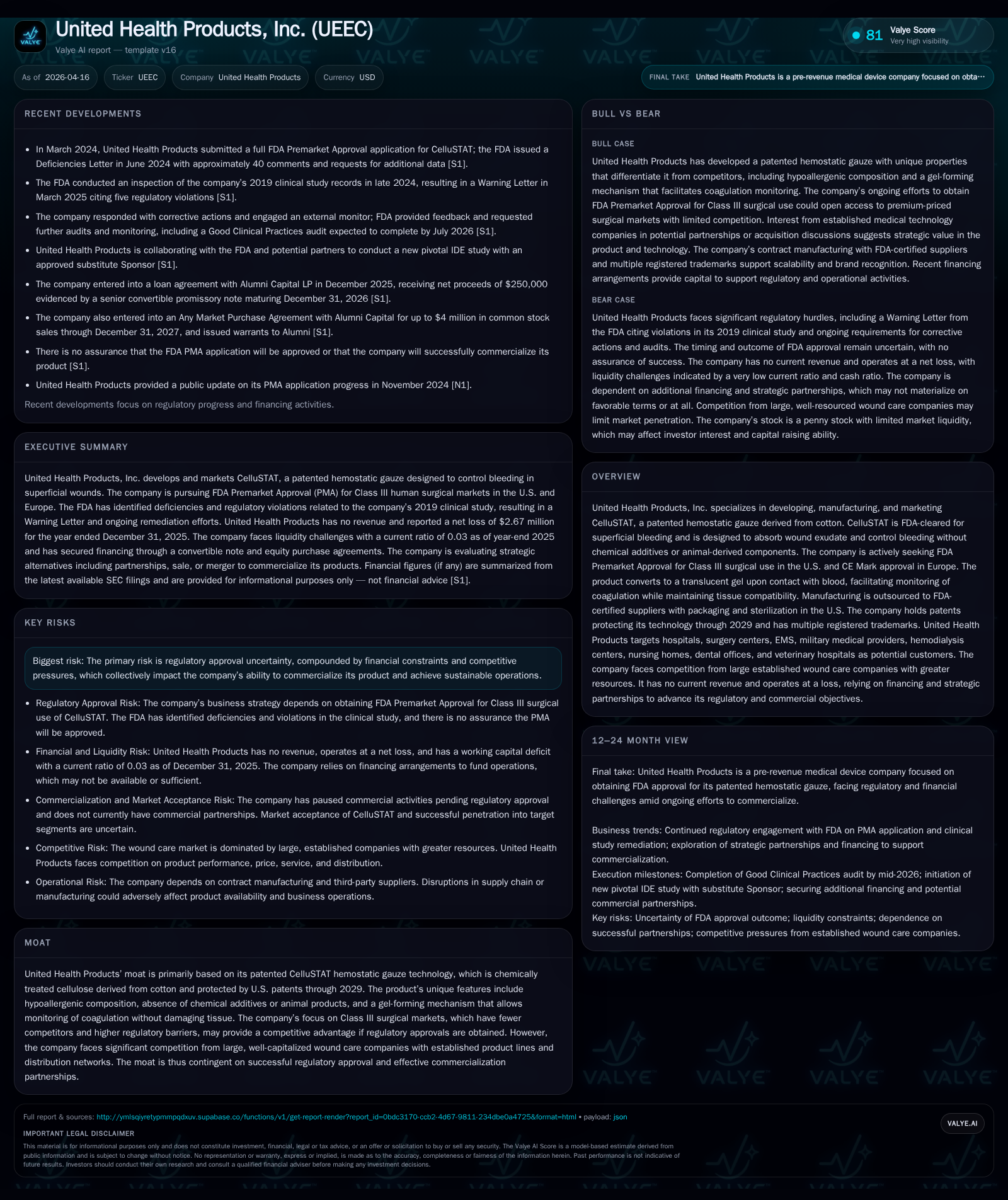
United Health Products, Inc. develops CelluSTAT®, a patented hemostatic gauze cleared for superficial bleeding but currently seeking FDA Premarket Approval (PMA) for Class III surgical applications. The company has recorded no product revenue since at least 2022, sustaining operating losses driven by regulatory, clinical, and development expenses. Its near-term growth depends on resolving regulatory deficiencies identified by the FDA and securing commercial partnerships or strategic transactions. Liquidity remains tight, with financing arrangements from Alumni Capital supporting ongoing operations. The company faces significant risks including regulatory uncertainty, competitive pressures, and operational challenges tied to manufacturing and internal controls.
Company Overview and Product Description
United Health Products, Inc. (UEEC) develops CelluSTAT®, a patented hemostatic gauze constructed from chemically treated cotton cellulose designed to absorb exudate and control superficial bleeding without chemical additives or animal-derived ingredients. Upon contact with blood, CelluSTAT forms a translucent gel enabling visual coagulation monitoring while maintaining tissue compatibility [S1][S22].
CelluSTAT has been FDA-cleared since 2012 for external or superficial bleeding via a 510(k) clearance but the company is pursuing Premarket Approval (PMA) for Class III internal surgical applications in the U.S., as well as CE Mark approval in Europe. Achieving PMA approval is critical to accessing higher-value surgical markets characterized by fewer competitors and premium pricing [S1][S22].
Historical Financial Performance
United Health Products has yet to generate revenue from product sales since at least fiscal year 2022. The business continues to incur operating losses associated with research and development, regulatory compliance, clinical trials, and administrative costs.
Historical performance (annual)
| FY | Rev ($) | Net ($mm) | CFO ($mm) | OpInc ($mm) | Rev YoY | Net YoY |
|---|---|---|---|---|---|---|
| 2025 | 0 | -3 | -1 | -2 | -33.4% | |
| 2024 | 0 | -2 | -1 | -2 | +23.7% | |
| 2023 | 0 | -3 | -2 | -2 | -100.0% | -55.5% |
| 2022 | 37500 | -2 | -1 | -3 |
Source: SEC companyfacts cache [F1].
Capital returns and efficiency (annual)
| FY | Buybacks ($) | ROE% |
|---|---|---|
| 2025 | 68.9 | |
| 2024 | 81.9 | |
| 2023 | 0 | 153.0 |
| 2022 | 50000 | 81.7 |
Source: SEC companyfacts cache [F1].
Net losses increased approximately 33% year-over-year from 2024 to 2025 [F1]. Operating cash flows remain deeply negative reflecting ongoing cash burn primarily related to regulatory submissions and clinical activities.
Regulatory Developments
The company submitted its initial PMA application in 2021; after revisions delayed by the COVID-19 pandemic, an updated application was filed in March 2024 [S1][S22]. In June 2024 the FDA issued a Deficiencies Letter citing around forty specific issues spanning device description through clinical data completeness.
An FDA Bioresearch Monitoring Program inspection of the pivotal clinical study conducted in 2019 uncovered multiple violations including failure to submit an Investigational Device Exemption (IDE), inadequate monitoring of investigators’ compliance with protocols resulting in a March 2025 Warning Letter [S1][S25].
In response United Health Products initiated Corrective and Preventative Actions (CAPAs), engaged third-party audits focused on Good Clinical Practices (GCP), and proposed conducting a supplemental clinical trial targeting intestinal and thoracic organ surgeries where safety data was insufficient [S25][S26]. The FDA approved plans for an external sponsor to lead this pivotal study while UHP retains exclusive rights to reference the data in future PMA submissions [S25][S26].
The timeline for full PMA approval remains uncertain pending satisfactory resolution of these issues and successful supplemental study outcomes. There is no assurance that approval will be granted [S1][S23].
Competitive Positioning
CelluSTAT’s patented technology protects its unique chemically treated cellulose formulation through at least 2029 [S7]. Its hypoallergenic nature without chemical or animal additives alongside gel formation offers surgeons visual confirmation of coagulation without tissue damage.
The company targets Class III surgical markets where fewer competitors operate relative to more commoditized superficial wound care sectors dominated by large firms such as Johnson & Johnson (Ethicon), Baxter International, Becton Dickinson & Company (BD), Teleflex Corporation and 3M Company [S7]. These competitors have substantially greater capital resources and distribution networks.
However, CelluSTAT's market penetration depends entirely on obtaining required regulatory approvals; failure would require reassessment of strategy toward lower-margin markets or partnerships.
Business Strategy and Growth Outlook
With no recorded revenues since fiscal year-end 2022 [F1], United Health Products’ growth prospects hinge on successfully navigating FDA approval processes and establishing commercial relationships across healthcare verticals including hospitals/surgery centers EMS/first responders military medical providers hemodialysis centers nursing homes dental offices veterinary hospitals [S14].
Management is exploring strategic alternatives including licensing agreements or outright sale/merger transactions instead of independent commercialization given limited internal resources [S21]. Several medical technology companies have expressed interest potentially enabling monetization through partnerships or acquisition.
Options under consideration include leveraging established partners’ marketing capabilities post-approval or merging with industry leaders capable of scaling distribution [S21]. These remain contingent on regulatory progress.
Capital Structure and Liquidity
As of December 31, 2025 United Health Products reported current assets of $105K against current liabilities exceeding $3.94 million resulting in a working capital deficit and a current ratio near 0.03—a severe liquidity constraint [F1].
In December 2025 the company secured financing from Alumni Capital LP via a senior convertible promissory note with net proceeds of $250K alongside an Any Market Purchase Agreement allowing up to $4 million in equity sales at discounted prices plus warrants exercisable through late 2030 [S20][S27][S28]. These funds underpin ongoing operations but dilute existing shareholders.
The company lacks positive cash flow generation capability requiring continued external financing or strategic partnership contributions to sustain operations beyond its current runway [F1][S12].
Returns Profile and Capital Allocation Policy
Given its development-stage status marked by consistent losses and negative equity balances United Health Products has not paid dividends nor repurchased shares recently [F1][S8][S24]. Estimated return on equity is not meaningful due to persistent negative net income relative to negative shareholder equity balances.
Capital allocation priorities focus exclusively on securing financing to fund regulatory compliance activities and clinical studies required for market entry. There is no indication of capital returned directly to shareholders at this stage.
Key Risks Summary
- Regulatory uncertainty arising from significant deficiencies identified during pivotal clinical studies leading to potential delays or denial of PMA approval;
- Severe liquidity pressure raising existential risks absent additional funding;
- Intense competition from large incumbent wound care firms with entrenched hospital relationships;
- Operational vulnerabilities including reliance on contract manufacturing facilities abroad subject to disruption;
- Material weaknesses in internal financial controls affecting reporting reliability;
- Key personnel concentration increasing execution risk;
- Dependence solely on CelluSTAT product line limiting diversification;
- Uncertain realization of value from potential partnership or sale negotiations under indefinite timelines. These factors collectively contribute to a speculative investment profile highly sensitive to near-term regulatory developments [S1][S3][S5][S11][S17].
Outlook: Milestones to Monitor
Investors should watch for:
- Completion and results of the FDA-approved supplemental clinical study focusing on intestinal/thoracic surgeries;
- Outcomes from ongoing Good Clinical Practice audits expected by mid-2026;
- Progression toward strategic partnerships or potential sale/merger transactions;
- Updates from regulators regarding PMA application status;
- Developments in funding availability impacting operational continuity;
- Competitive dynamics within the healthcare device sector influencing market prospects. No explicit financial guidance has been provided; investors must rely on public SEC disclosures for updates .
Disclaimer: This report is based solely on publicly available SEC filings dated April 15, 2026. Financial data are extracted strictly from these filings without forward-looking projections or estimates. Readers should carefully consider all disclosed risks before forming investment decisions.
Disclaimer: This is research-only, informational analysis and not investment advice. It may include AI-generated interpretation and general industry context. Always verify important details using primary sources.

Comments