
Atlantic International Corp. Expands Staffing Footprint While Grappling With Debt Restructuring and Operating Losses
Atlantic International leverages acquisitions and AI-driven workforce solutions amid liquidity pressures and ongoing restructuring efforts.
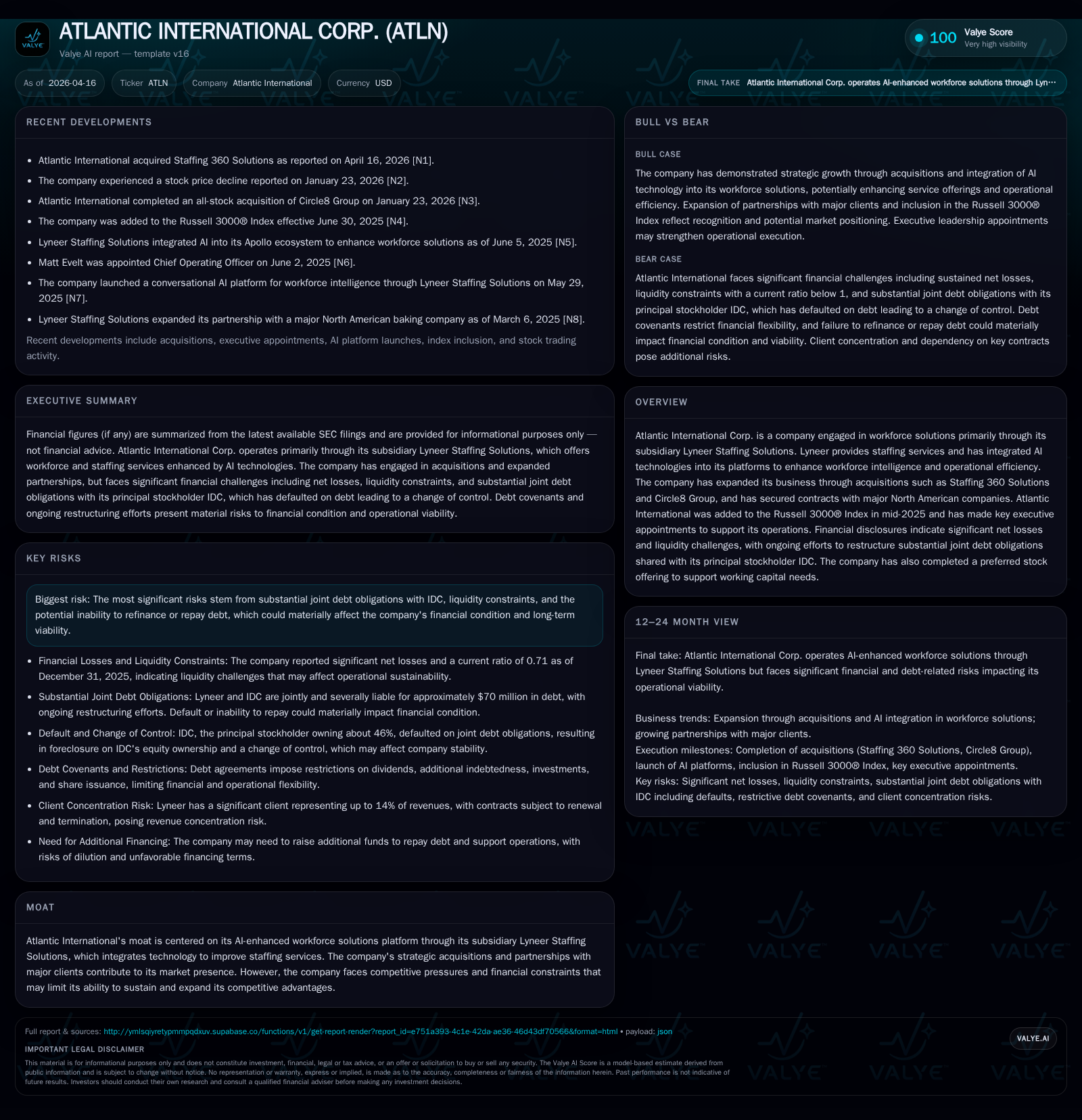
Atlantic International Corp. operates primarily through its subsidiary Lyneer Staffing Solutions, providing workforce staffing solutions with integrated AI technology across North America and Europe. The company has pursued an aggressive acquisition strategy, notably acquiring Staffing 360 Solutions and Circle8 Group, enhancing its presence in industrial and IT staffing sectors. Despite expansion and innovation strides, Atlantic faces significant financial headwinds including sustained operating losses, complex joint debt obligations with its principal stockholder IDC, liquidity constraints, and a going concern qualification in its audited financials. The recent preferred stock offering aims to bolster working capital but substantial refinancing remains necessary. Monitoring debt restructuring progress, client retention, and operational efficiency improvements will be key.
Company Overview
Atlantic International Corp., trading under ticker ATLN, transformed itself into a strategic player in the workforce solutions industry after acquiring Lyneer Investments LLC in mid-2024. Lyneer Staffing Solutions constitutes its principal operating segment, offering embedded AI-driven tools to optimize labor sourcing primarily across the food production, manufacturing, and logistics industries throughout North America [S1]. Recent acquisitions include the April 2026 purchase of Staffing 360 Solutions [N1] and January 2026 acquisition of Circle8 Group, a European IT technology staffing platform focused on software development, data analytics, cybersecurity, and emerging technologies [S1]. This geographic and sector diversification via acquisition positions Atlantic as a transatlantic competitor with specialized industrial and IT staffing capabilities.
The management team's combined experience exceeds two centuries, contributing deep industry knowledge and access to capital markets for growth initiatives [S1]. Despite these credentials and growth ambitions that focus on leveraging AI-enhanced platforms to streamline hiring processes at scale, Atlantic confronts severe financial distress that casts doubt on sustainable profitability.
Historical Financial Performance
Revenue stagnated at $78.7 million in both FY2021 and FY2022 following a steep decline from $210 million in FY2021 prior to a corporate transition [F1]. Operating income has remained negative throughout this period, deteriorating sharply from a loss of approximately $4 million in FY2022 to over $50 million in FY2025 [F1]. Correspondingly, net losses ballooned from roughly -$4.1 million in FY2022 to nearly -$59.4 million in FY2025 [F1]. This downward trend reflects heavy selling, general and administrative expenses driven by payroll increases, stock-based compensation charges, and transaction-related expenses post-merger [S10].
Free cash flow remains deeply negative with operating cash flows at about -$4.4 million against modest capital expenditures north of $66 thousand in FY2025 [F1]. Equity value swung from positive territory ($600k) in FY2023 to a negative net equity position (-$32 million) by end-2025 highlighting eroding net asset value [F1]. The following table summarizes key annual figures:
Historical performance (annual)
| FY | Rev ($) | Net ($mm) | CFO ($mm) | OpInc ($mm) | Rev YoY | Net YoY |
|---|---|---|---|---|---|---|
| 2025 | -59 | -4 | -50 | +56.1% | ||
| 2024 | -135 | -6 | -22 | -2307.4% | ||
| 2023 | 78659 | -6 | -5 | -6 | 0.0% | -37.4% |
| 2022 | 78659 | -4 | -4 | -4 | -62.5% |
Source: SEC companyfacts cache [F1].
Capital returns and efficiency (annual)
| FY | FCF ($mm) | ROE% |
|---|---|---|
| 2025 | -4 | 185.2 |
| 2024 | -6 | 1127.4 |
| 2023 | -5 | -926.0 |
| 2022 | -4 | -93.8 |
Source: SEC companyfacts cache [F1].
Note: Revenue figures for FY2024 are not separately available likely due to fiscal periods overlapping acquisitions.
Growth Drivers and Constraints
Atlantic's growth has been historically reliant on strategic acquisitions enabling market penetration into complementary segments. The addition of Circle8 broadens Atlantic’s reach into European IT staffing — a higher-margin vertical — while maintaining core industrial staffing operations through Lyneer [S1]. Integration of advanced AI technologies into recruitment platforms serves as a competitive differentiator by enhancing workforce intelligence accuracy and operational efficiencies.
However, substantial concentration risk exists due to dependence on a single client representing up to 14% of revenues as recently as Q3 2025; contract renewals are ever subject to termination without penalty [S5]. Furthermore, rapid changes in client needs across industries coupled with tight competition from low-barrier-to-entry employment services expose Atlantic to attrition risk.
The company’s indebtedness severely constrains agility: joint debt obligations with IDC result in legal entanglements and creditor foreclosures after IDC's defaults compromised control [S11]. Covenants restrict dividend payments or buybacks; thus capital return initiatives are suspended while balance sheet stabilization is prioritized.
Scaling EBITDA-positive operations will require successful integration of recent acquisitions fueled by new client contracts and prudent cost controls — factors not yet demonstrated sustainably [S9]. Regulatory compliance across North American and European labor laws introduces operational complexity impacting margins.
Capital Structure & Liquidity Position
As of December 31, 2025, Atlantic reported cash equivalents of roughly $81 thousand against current liabilities exceeding $115 million yielding a current ratio near 0.71 — underscoring pressing liquidity dangers [F1]. Joint outstanding indebtedness with IDC hovers around $70 million secured by pledges of equity interests which were partially foreclosed upon due to defaults [S6][S11].
To navigate these strains, the company issued Series B Convertible Preferred Stock raising net proceeds of approximately $5.57 million in March 2026 aimed at bolstering working capital needs [S13][S14][S15]. While this injection provides temporary relief, management acknowledges ongoing need for additional financing before the March 31, 2027 maturity date for the Merger Note [S10][S14]. Failure to refinance or meet debt obligations threatens asset foreclosures from lenders leading potentially to loss of control or liquidation.
The company's audited financial statements have been prepared under the going concern assumption but include explicit qualifications referencing significant uncertainty stemming from EBITDA deficits alongside debt servicing inability absent successful refinancing or capital raises [S1][S9].
Outlook & Milestones to Watch (Analysis)
Neither explicit revenue nor profitability guidance is publicly disclosed post-acquisition integration phase; forward-looking statements emphasize intentions around executing acquisition synergies while stabilizing financial conditions [S2][S16][S17]. Key near-term milestones include:
- Progress made on restructuring joint Lyneer-IDC debts or obtaining waivers preventing events of default.
- Renewal or expansion of significant client contracts minimizing concentration risks.
- Operational integration success metrics encompassing cost synergies between domestic industrial staffing and European IT talent platforms.
- Further equity or convertible security offerings balancing dilution with capital needs.
- Management's execution against stated plans leveraging their institutional investment banking experience.
Given historically unprofitable operations aggravated by litigation exposures related to former lenders and indemnification claims totaling over $1 million structured for payment through installments [S1], upside hinges heavily on execution while downside includes potential creditor enforcement actions.
Returns & Capital Allocation History
Return on equity calculations are distorted by deeply negative equity balances (-$32 million end-FY25), rendering standard ROE measures non-informative despite net loss magnitudes indicative of cash burn intensity rather than returns generation [F1]. The absence of dividends or share repurchases aligns with restrictive debt covenants curbing distributions during restructuring phases [S4][S10][S22][S23].
Free cash flow approximates negative $4.46 million in FY2025 after deducting capital expenditure outlays from operating cash flows indicating continued funding deficiencies requiring external infusions or debt amendments [F1].
The recent preferred stock issuance accompanied by attached warrants provides some cushion but only partially addresses impending maturities necessitating material refinancing efforts within the next fiscal year cycle [S15].[N1]
Industry Context (Analysis)
Workforce solutions remain dynamic with growing emphasis on digital transformation such as AI-process augmentations reflecting broader labor market digitization trends witnessed across major tier-one providers like ManpowerGroup or Randstad that balance high volume temporary placements with specialized IT contract talent provisioning. Emergent challenges include evolving labor regulations globally especially for contingent workforce classification risks plus geopolitical uncertainties affecting cross-border staffing operations prevalent since post-pandemic labor market shifts pushed hybrid remote models requiring tailored solutions offering scale alongside compliance safeguards.
In this light, Atlantic's positioning straddling essential industrial sectors domestically aligned with niche technology skills internationally constitutes differentiated breadth but requires overcoming mid-size player constraints including capital scarcity relative to incumbents specializing either purely regionally or segmentally.
Conclusion
Atlantic International Corp.'s strategic ambition championing AI-enhanced workforce solutions supported by acquisitive expansion into IT staffing markets reflects savvy positioning aiming at sustained growth potential. Yet profound financial stresses centered around legacy debt obligations interlocked with IDC's defaults cast a long shadow over near-term viability absent successful recapitalization or refinancing interventions. Persistent operating losses reveal underlying challenges synchronizing enhanced technological capabilities with operational scale economics.
Thus Atlantic occupies a precarious inflection point where execution effectiveness on integration efficiencies paired with strengthening liquidity will ultimately dictate trajectory amid intense competition providing limited margin for error.
Disclaimer: This analysis is based solely on publicly available information cited herein. It does not constitute investment advice or recommendations.
Disclaimer: This is research-only, informational analysis and not investment advice. It may include AI-generated interpretation and general industry context. Always verify important details using primary sources.

Comments