
LQR House Inc. Evaluates Recovery Paths Amid Persistent Operating Losses
An analysis of LQR House’s business model and financial trajectory highlights the challenges in scaling its integrated alcohol e-commerce and marketing platform amidst significant losses and distribution risks.
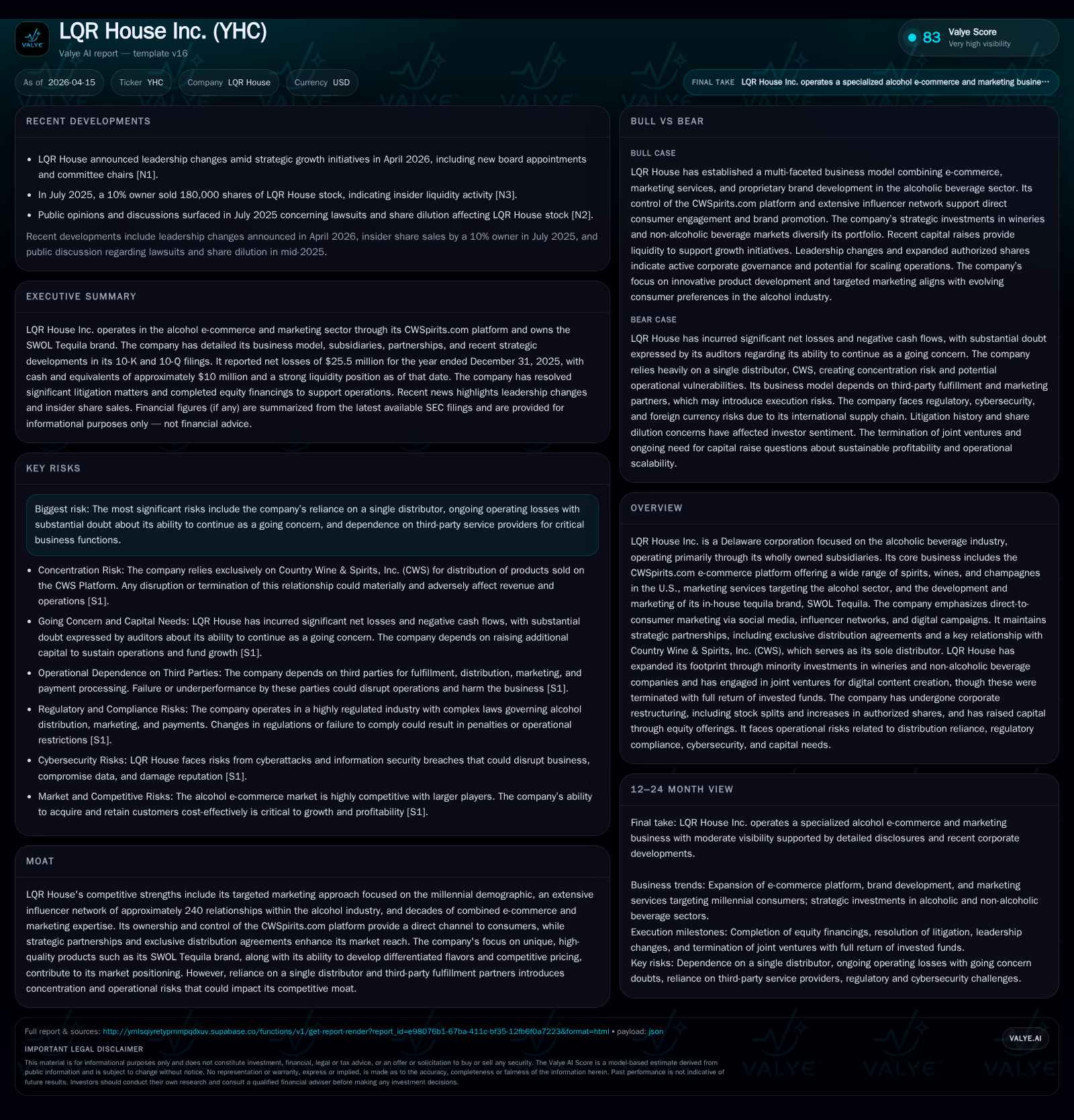
LQR House Inc., operating primarily through its CWSpirits.com platform and SWOL Tequila brand, pursues growth through targeted millennial marketing and exclusive partnerships. Despite these strengths, the company recorded escalating net losses reaching over $25 million in FY2025, compounded by extreme negative operating cash flow and dependence on a single distributor. Management recently introduced leadership changes while expanding investments in product development and digital content. Key liquidity indicators remain strong but ongoing operating deficits and operational concentration risks pose significant constraints on profitability and sustainability.
Historical Financial Trends and Drivers of Performance
LQR House Inc. has experienced a challenging financial trajectory characterized by persistently deepening operating losses alongside relatively low revenue levels. As of fiscal year end 2025, revenue stood at approximately $1.12 million (FY2023 figure available), overshadowed by an operating loss of nearly $11.4 million — though this marked a roughly 38% year-over-year improvement from the prior year's larger operating loss of about $18.5 million [F1]. Despite this encouraging narrowing in the operating loss margin, net income worsened by approximately 12% to a loss exceeding $25 million for FY2025 versus FY2024's $22.75 million net loss, suggesting increased non-operating costs or provisions affecting bottom-line results.
The company's struggle is further evidenced by the steep deterioration in operating cash flows (CFO), plunging from a negative $6.6 million in FY2024 to a deeply negative $33.8 million in FY2025 — over a fourfold increase in cash burn rate [F1]. Capital expenditures expanded sharply to approximately $340 thousand in FY2025 compared to nominal prior years; however, this remains marginal relative to the scale of operating cash deficits. The company's equity position improved substantially to nearly $29.3 million by end-FY2025 after being slightly negative (-$518K) at end-FY2024, possibly due to capital raises [F1].
Historical performance (annual)
| FY | Net ($mm) | CFO ($mm) | OpInc ($mm) | Capex ($) | Net YoY |
|---|---|---|---|---|---|
| 2025 | -26 | -34 | -11 | 340541 | -12.2% |
| 2024 | -23 | -7 | -18 | 10000 | -44.5% |
| 2023 | -16 | -9 | -16 | 10000 |
Source: SEC companyfacts cache [F1].
Capital returns and efficiency (annual)
| FY | Buybacks ($) | FCF ($mm) | ROE% |
|---|---|---|---|
| 2025 | 547415 | -34 | -87.0 |
| 2024 | 547415 | -7 | 4393.0 |
| 2023 | 1458852 | -9 | -107.7 |
Source: SEC companyfacts cache [F1].
Note: Revenue data is only confirmed at FY2023.
This financial profile illustrates a stark imbalance between top-line generation and costs related to operations and growth initiatives amid high cash consumption.
Operating Model Strengths: Marketing Expertise and Distribution Partnerships
At the core of LQR House’s strategy is a vertically integrated model combining e-commerce operations via CWSpirits.com with specialized marketing services tailored to alcoholic beverage brands. The company harnesses direct-to-consumer (DTC) campaigns leveraging an extensive influencer ecosystem comprising roughly 240 relationships spanning bartenders to social media personalities within the alcohol sector [S10],[S16],[S21]. This network enables targeted engagement with millennial demographics prized for lifestyle-oriented brand affinity.
The CWSpirits.com platform acts as the company’s primary sales portal for spirits including its proprietary SWOL Tequila line and third-party client brands. This dual role as both marketer and marketplace owner allows LQR House to maintain exclusivity as the sole authorized advertiser on CWS Platform products — establishing channel exclusivity that theoretically enhances market penetration opportunities [S21].
A critical facet supporting distribution is LQR House’s exclusive arrangement with Country Wine & Spirits Inc. (CWS), which handles all product fulfillment nationwide. However, this concentrated channel relationship creates significant single-distributor exposure risk: any disruption or regulatory challenge affecting CWS’s license could materially impair LQR’s sales flow and damage brand reputation due to interrupted customer experience [S4],[S8].
Remarkably for an emerging player combating large retail competitors like Amazon or established wholesalers with substantial capital backing, LQR House prioritizes differentiated product development — introducing novel tequila flavors such as SWOL Peach — and competitive pricing rooted in verified quality sourcing validated through producer site visits [S10],[S16]. Removable branded patches affixed post-consumption serve as unique labeling innovations aimed at sustained consumer engagement beyond initial purchase.
Evolving Growth Initiatives and Market Extensions
Expanding beyond foundational e-commerce sales and influencer campaigns, LQR House is pursuing a multifaceted growth agenda centered on acquisitions and joint ventures aimed at broadening brand portfolio breadth and digital monetization capabilities.
A notable minority stake acquisition occurred in Cannon Estate Winery Ltd., based in British Columbia with an established vineyard footprint comprising multiple varietals across 20 acres. The investment seeks synergy by amplifying Cannon’s online reach into U.S.-based alcohol consumers via LQR’s marketing prowess while benefiting Cannon’s access to LQR’s distributor network domestically [N1],[S7].
Simultaneously,the company continues developing its branded lineup under 'SWOL' through increasing purchase volumes for broader market availability and upgrading marketing intensity via digital channels to accelerate brand recognition [S7],[S16]. Product innovation efforts introduce flavors aligned with consumer trends aiming at premium positioning.
Complementing physical beverage assets are strategic joint ventures launched around December 2025 focusing on digital content creation designed both for enhanced audience engagement via influencer marketing as well as supplemental revenue streams through advertising and licensing models [N1],[S3]. Such initiatives reflect attempts to diversify beyond traditional beverage sales towards integrated lifestyle branding.
However,several factors temper near-term scaling potential: intricate multi-jurisdictional alcohol regulations raise compliance complexity; dependence on third-party service providers including fulfillment logistics introduces execution risk;and organic brand growth may face headwinds from competitive saturation within fragmented specialty spirits markets [S8],[S16].
Balance Sheet Health and Liquidity Position
Liquidity parameters provide one of LQR House’s few bright spots amid operational challenges. By the close of FY2025,the company reported current assets approximating $16 million against total current liabilities near $1.86 million — yielding an exceptionally healthy current ratio around 8.6 [F1]. This implies ample short-term asset coverage over obligations.
Cash balances stood near $10 million as of Q3 2025 providing substantial runway given expected near-term monthly burn rates from operational deficits [F1],[S5],[S18]. Still,the company acknowledges possible future capital needs tied to growth pacing,cost structure adjustment timing,and unforeseen expense areas including regulatory or market developments which could pressure liquidity horizons requiring fresh equity or debt financing interventions [S18].
The equity position swinging from slight deficit status at end-FY2024 into reported positive equity nearing $29 million post-capital raises underscores balance sheet strengthening efforts supporting ongoing operations despite cumulative losses [F1].[S18] highlights continuing uncertainty regarding access to timely funding given macroeconomic volatility impacting the broader financial services sector.
In summary,LQR House currently retains working capital adequacy sufficient to sustain business activity short-term but will face pressing needs to achieve cash flow stabilization or secure incremental financing absent profit inflection.
Capital Allocation Patterns: Cash Flows, Buybacks, and Investment Priorities
Investigating capital deployment reveals contrasting priorities amid adverse results. Capital expenditures leaped dramatically from nominal amounts ($10K previously) up to roughly $340K in FY2025 marking a focused spending phase likely aligned with product development or platform upgrades – albeit still dwarfed by massive negative CFO totaling over $33M which drives acute free cash flow strain after subtracting capex (~$34M net outflow) [F1].
Despite sizeable operating losses reducing liquidity buffers,LQR House has maintained a disciplined share repurchase program instituted since September 2023 reflecting buybacks around $547K annually documented in FY2024 filings with consistent execution evident into latest disclosures[F1],[S9]. Share repurchases in an unprofitable context suggest management confidence signaling but also raise tradeoffs concerning opportunity costs against reinvestment imperatives into scalable marketing infrastructure or brand extensions.
Given limited dividend distributions historically , capital returns primarily occur via these buybacks alongside reinvestment activities balancing value signal formation versus sustaining cash reserve adequacy vital under highly uncertain profit pathways.[S9]
From a buy-side perspective,this warrants vigilance regarding the sustainability of buyback programs relative to evolving cash generation dynamics especially if external funding conditions tighten or operational performance fails to improve meaningfully.
Navigating Single-Distributor Exposure and Operational Risks
Concentration risk stemming from exclusive reliance on CWS as sole product distributor stands prominent among LQR House’s vulnerabilities.[S4],[S8] portray scenarios where any disruption—whether regulatory revocation of CWS licenses,state-level restrictions on alcohol DTC sales or logistic failures—could abruptly sever key revenue channels.
Such single point of failure exposes supply chain fragility uncommon among more diversified competitors who mitigate through multi-tier distribution networks.[S4] emphasizes that inability to secure alternative distributors quickly would interrupt client service offerings damaging market reputation adversely impacting margins/profitability prospects.
Moreover,the company depends heavily on other third parties for crucial activities spanning customer service,to legal compliance,to fulfillment logistics increasing exposure further regarding service level reliability risking delays/errors harmful for brand equity.[S8] emphasize outsourcing constraints impeding full operational control.
From sector perspectives,this combination elevates operational risk premiums necessitating proactive contingency planning addressing replacement supplier negotiations,data security hardening,and diversified logistics integration strategies critical for sustainable commerce execution amidst evolving regulatory regimes.[S19] reinforces complexity arising from fragmented U.S state alcohol law matrices complicating uniform compliance.
Key Milestones Ahead: What Investors Should Monitor
Recent leadership adjustments announced April 11th, 2026 aim at bolstering strategic execution capabilities during pivotal scale-up phases underscoring governance realignment intentions following challenging financial periods[N1].[S3] details contemporaneous entry into material definitive agreements related possibly to expansion initiatives revealing management focus areas.
Forward-looking milestones hinge upon:
- Measurable top-line growth acceleration particularly within e-commerce sales channels;
- Marketing campaign ROI improvements driven by enhanced influencer network monetization efficiency;
- Visible cost structure optimization including overhead reductions mitigating prior losses;
- Progression or alterations regarding exclusive distribution arrangements involving CWS potentially influencing revenue continuity;
- Execution success relating joint venture partnerships initiated late FY2025 targeting digital content monetization augmenting revenue diversification;
- Regulatory developments impacting online alcohol sales frameworks requiring nimble compliance adaptations.
Monitoring quarterly updates covering customer acquisition rates,new product launches notably SWOL variants adoption,and subsidy utilization will help assess trajectory toward profitability inflection points.
This report synthesizes data derived from regulatory filings ([F1], [S#]) and recent news releases ([N#]) without issuing investment recommendations or price forecasts. It aims strictly to illuminate LQR House Inc.'s operational realities juxtaposed against strategic aspirations within the alcoholic beverage e-commerce domain under prevailing external constraints.
Disclaimer: This is research-only, informational analysis and not investment advice. It may include AI-generated interpretation and general industry context. Always verify important details using primary sources.

Comments