
Quantum Genesis AI Corp.'s Enzyme Innovation and Critical Liquidity Challenges
Quantum Genesis AI pioneers quantum-augmented enzyme engineering for pharmaceutical synthesis while confronting severe funding constraints.
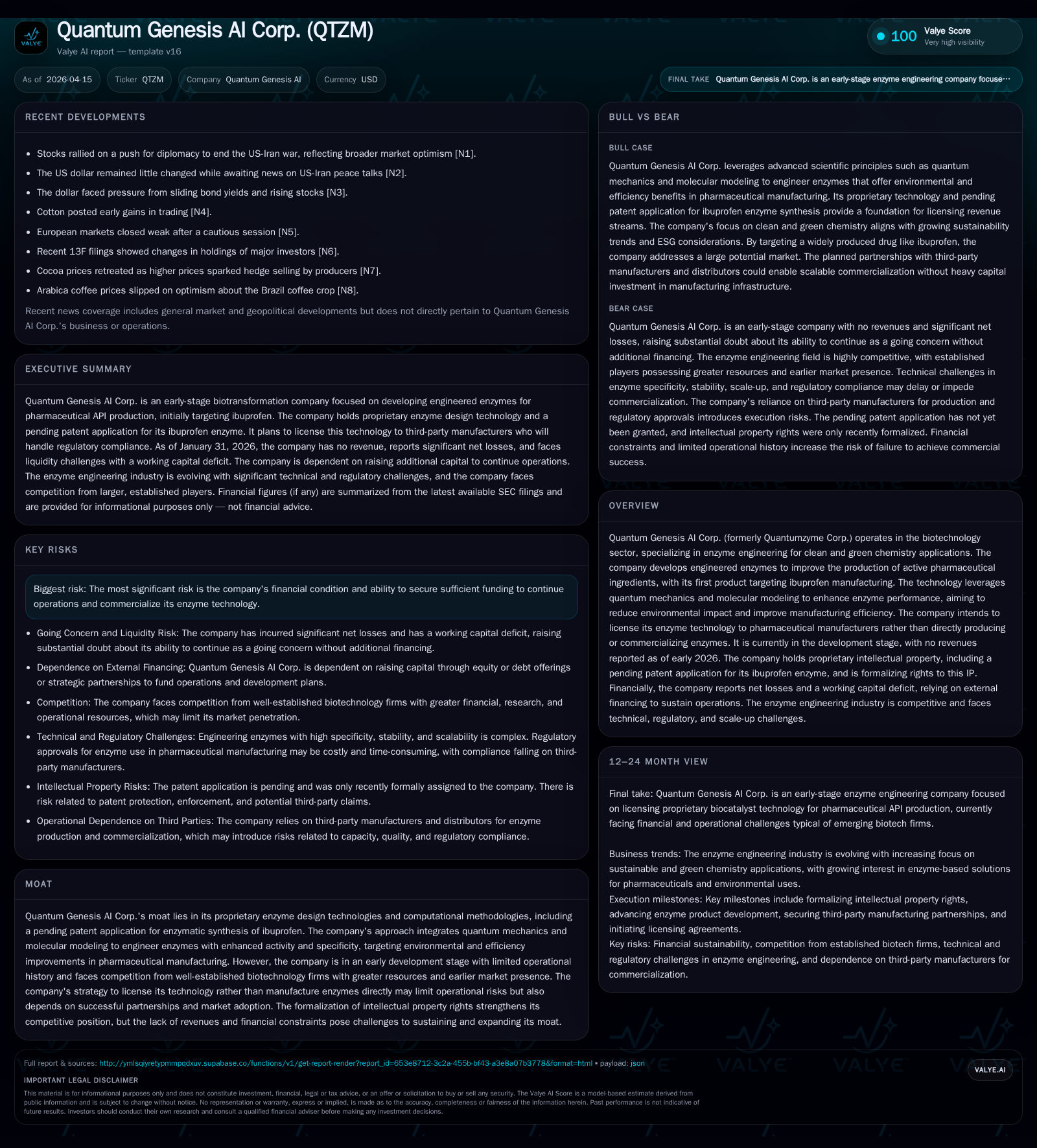
Quantum Genesis AI Corp. is focused on developing engineered enzymes using quantum mechanics and molecular modeling to improve pharmaceutical API synthesis, particularly ibuprofen. Despite progressing intellectual property formalization and proprietary technological approaches, the company reported no revenues as of FY2025 and operates with minimal personnel. Its licensing business model reduces manufacturing risks but depends heavily on forming strategic partnerships amid a critical liquidity crisis that raises going-concern concerns.
Historical Financial Performance
Quantum Genesis AI Corp., formerly Quantumzyme Corp., has not generated revenues since FY2018, underscoring its current status as a pre-commercial biotech focused on enzyme engineering for pharmaceutical active ingredients (APIs). Historical financial data reveals revenue declined from $128K in FY2017 to zero by FY2025, accompanied by escalating net losses from approximately -$33K in FY2017 to nearly -$199K in FY2025 alongside operating cash flow deficits reaching -$125K [F1].
Historical performance (annual)
| FY | Rev ($) | Net ($) | CFO ($) | Rev YoY | Net YoY |
|---|---|---|---|---|---|
| 2025 | 0 | -199269 | -125181 | ||
| 2018 | 93550 | -28167 | -2744 | -27.0% | +14.3% |
| 2017 | 128147 | -32858 | -37077 |
Source: SEC companyfacts cache [F1].
Capital returns and efficiency (annual)
| FY | ROE% |
|---|---|
| 2025 | 45.2 |
| 2018 | 330.4 |
| 2017 | -183.1 |
Source: SEC companyfacts cache [F1].
This financial trajectory aligns with the company's focus on research and development activities preceding commercial product launches.
Technological Differentiation via Quantum Mechanics
The company leverages advanced quantum mechanical principles integrated with molecular modeling to engineer enzymes exhibiting enhanced activity, selectivity, and substrate specificity. This approach aims to streamline biotransformation pathways for cleaner chemical synthesis in pharmaceutical API production, differentiating it from conventional enzyme engineering methods that may not account for quantum effects influencing catalysis [S1].
Intellectual Property Developments
A key recent milestone was the confirmatory Intellectual Property Assignment Agreement executed on April 9, 2026, which legally transferred all rights related to the pending U.S. Patent Application US20250146029A1—covering "Modified Polypeptides for Enzymatic Synthesis of Ibuprofen"—from CEO Naveen Kulkarni to Quantum Genesis AI Corp. [S3]. This formalization strengthens the company's proprietary position over its core technology.
However, risks remain given the patent's pending status and potential challenges in enforcing IP rights internationally where protections may be less robust [S7][S10][S24].
Capital Structure and Liquidity Constraints
As of January 31, 2026, the company reported cash and equivalents of only $59 against current liabilities exceeding $418,000—yielding a critically low current ratio that signals substantial liquidity risk [F1][S13][S15][S18]. Additionally, shareholders' equity is negative at approximately -$440,700 due to accumulated losses [F1].
The company anticipates the need for additional capital through equity or debt financings to support continued operations and commercialization efforts; however, such raises could result in dilution or restrictive covenants [S8][S15].
Licensing Business Model: Opportunities and Dependencies
Quantum Genesis AI’s strategy centers on licensing its enzyme technology rather than engaging directly in manufacturing. This reduces capital expenditure and operational complexity but places significant reliance on establishing partnerships with pharmaceutical manufacturers capable of scaling production and adopting novel enzymatic processes [S1].
The success of this model depends heavily on market acceptance among generic drug producers and regulatory approvals related to pharmaceutical APIs.
Organizational Risks Due to Limited Workforce
The company operates with a single employee—CEO Naveen Kulkarni—who oversees all management and R&D functions [S1]. This concentrated human capital poses risks including operational bottlenecks, knowledge concentration vulnerability, and limited capacity to advance multiple projects or satisfy regulatory requirements promptly.
Loss or incapacitation of this key individual could adversely impact business continuity [S14].
Near-Term Milestones to Watch
Critical developments analysts should monitor include:
- Progress toward granting of the pending ibuprofen enzyme patent;
- Identification and engagement of third-party manufacturers for scale-up;
- Execution of licensing agreements with pharmaceutical companies targeting ibuprofen or other APIs [N1][S3][S1].
Achievement of these milestones will be crucial for derisking commercial prospects amid ongoing financial pressures.
Investor Return Considerations
Despite recurring net losses and negative equity (~-$440k), a superficial calculation yields a positive return-on-equity figure due to the negative denominator; however, this does not reflect actual profitability prospects [F1].
No dividends or share repurchases have been made or announced historically [S27][S28], making investor returns fully dependent on successful commercialization events.
Given substantial capital needs ahead, dilution risk is significant if further financing rounds are pursued.
This report synthesizes publicly available SEC filings and company data as of April 2026. It is intended solely for informational purposes and does not constitute investment advice.
Disclaimer: This is research-only, informational analysis and not investment advice. It may include AI-generated interpretation and general industry context. Always verify important details using primary sources.

Comments