
Mentor Capital Rebuilds Through Energy Investments and Strategic Capital Management
Mentor Capital has transitioned from diverse ventures to targeting low-cost energy royalties amid strained financial conditions and audit complexities.
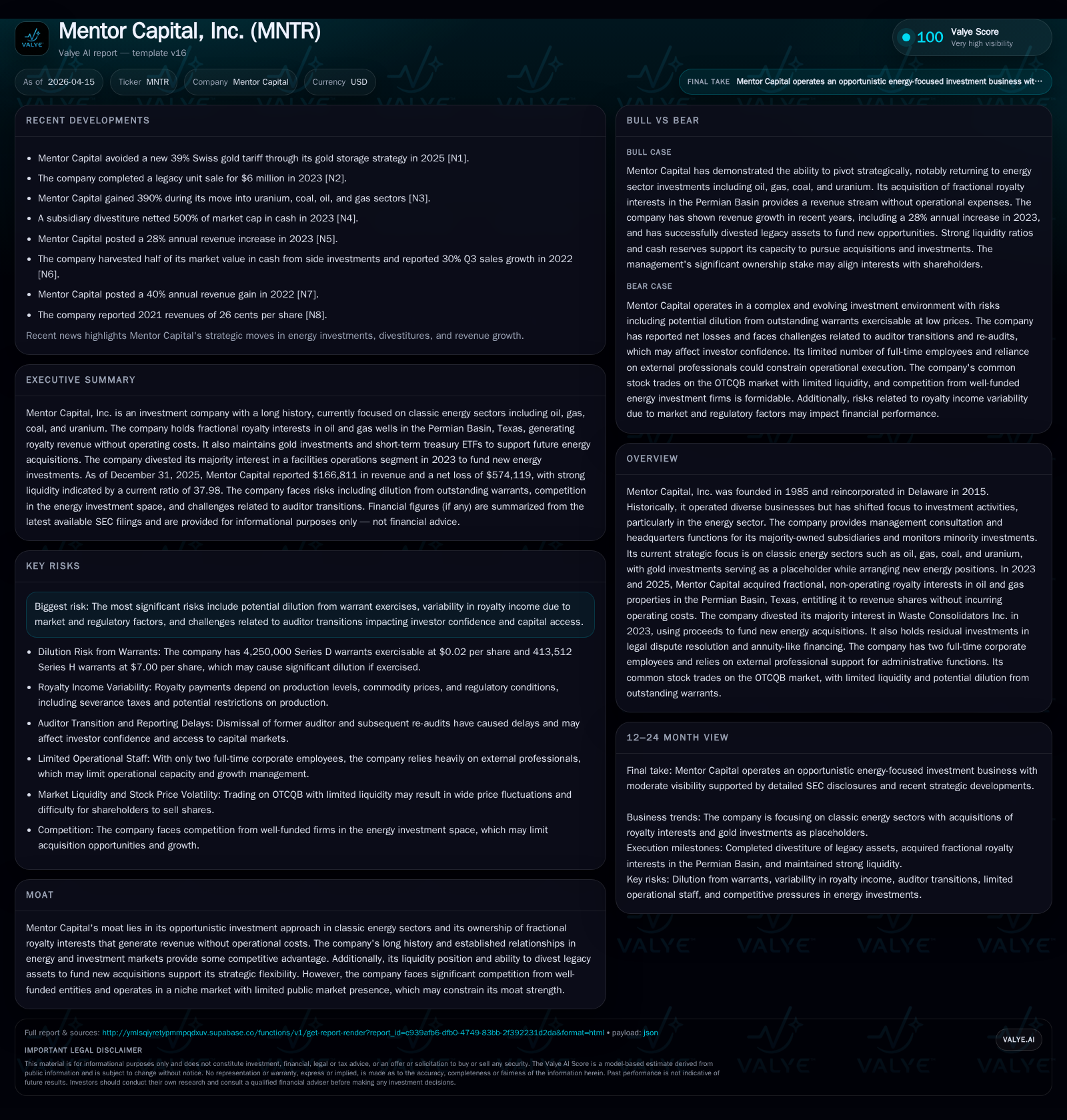
Mentor Capital, Inc. traces a long arc from diversified business operations, including athletic clubs and trucking, toward focusing sharply on non-operating royalty interests in the classic energy sector, specifically in oil, gas, coal, and uranium. Recent years have seen volatile revenue performance culminating in significant operational losses and negative cash flows, compounded by auditor changes that have delayed filings and constrained capital market access. The company’s strategic acquisitions of fractional royalty interests in the Permian Basin represent an effort to generate steady revenue streams without incurring lifting costs. However, the capital structure remains fragile with notable dilution risks from outstanding warrants. Monitoring successful financing and audit cycle completions will be key to the company’s ability to scale its new energy investment model.
Historical Trajectory: From Diversification to Energy-Centric Focus
Mentor Capital’s origins date back to 1985 when it operated primarily as an investment partnership incorporating activities across athletic clubs, trucking operations, food companies, and other ventures [S1][F1]. This diversified approach proved challenging; notably, a merger with multiple oil and gas partnerships led to a Chapter 11 bankruptcy filing in 1998 designed to reduce debt surpassing asset values. Post-bankruptcy restructuring granted warrant issuances to creditors that continue to influence present-day capital structure [S1]. A significant corporate pivot occurred following reincorporation in Delaware in 2015 and relocation of headquarters to Texas by 2020 [S1][S22].
By the early 2020s, Mentor refocused strategically on classic energy sectors—oil, gas, coal, uranium—while divesting prior legacy industrial or services investments such as Waste Consolidators Inc. in 2023 [S22]. Proceeds from such divestitures funded purchases of fractional non-operating royalty interests (NOIs) primarily within Permian Basin oil and gas properties starting 2023 through 2025 [S19]. This progression reflects a deliberate shift away from direct operations towards asset-light investments tied directly to hydrocarbon revenue streams.
Revenue and Earnings Evolution: Dissecting Fluctuations and Operational Performance
Examining Mentor’s financials reveals marked volatility around its structural transformation (all figures sourced from [F1]):
Historical performance (annual)
| FY | Rev ($mm) | Net ($mm) | CFO ($) | OpInc ($) | Rev YoY | Net YoY |
|---|---|---|---|---|---|---|
| 2025 | 0 | -1 | -497071 | -626633 | +31.6% | |
| 2024 | -1 | -780212 | -126.6% | |||
| 2023 | 0 | 3 | -1775210 | -99.5% | +769.9% | |
| 2022 | 8 | 0 | 172415 | -1625298 | +28.2% |
Source: SEC companyfacts cache [F1].
Capital returns and efficiency (annual)
| FY | Buybacks ($) | FCF ($) | ROE% |
|---|---|---|---|
| 2025 | 183693 | -503063 | -24.8 |
| 2024 | 183693 | -29.0 | |
| 2023 | 7884 | 80.6 | |
| 2022 | 131806 | -27.3 |
Source: SEC companyfacts cache [F1].
- Buyback data reported only for FY2024 and FY2023. ** Sharp revenue drop transitioning towards royalty revenues rather than operating earnings.
Revenue growth attributed partly to legacy segments before strategic refocus.
Despite elevated revenues in early years driven by legacy businesses or sizable one-off items (such as settlements), sustained operational losses exacerbated by declining revenues reflect structural stress [F1]. Operating income remains negative every year since at least FY2022 reflecting ongoing expenses exceeding inflows even as Mentor shifts its portfolio focus. Negative operating cash flows since FY2023 (-$497K in FY2025) paired with modest capital expenditures illustrate constrained liquidity and investment ability amid restructuring.
Energy Royalties Strategy: Low-Operational-Cost Assets in Permian Basin and Portfolio Positioning
A critical pillar of Mentor's reinvention is its targeted acquisition of fractional non-operating royalty interests within the Permian Basin’s Spraberry Field—encompassing roughly 121 producing wells secured through public auctions for approximately $1.37 million consideration as of March 2025 [S1][S19]. These NOI positions entitle Mentor Capital to a proportionate share of the hydrocarbon production revenues without shouldering the traditional lifting costs nor operational liabilities associated with field management or capex overruns.
This asset-light model is increasingly attractive given volatile upstream capital markets and operating cost pressures facing operators. By maintaining revenue exposure while avoiding operator risk—including rig availability constraints or environmental regulatory compliance costs—Mentor benefits from cash flow predictability aligned with commodity cycles but insulated from direct operational volatility.
Additionally, the company retains a gold investment alongside low-risk short-term Treasury exchange-traded funds intended as portfolio ballast facilitating liquidity while awaiting further energy acquisition opportunities [S19][S23]. Emphasizing classic carbon fuel resources signals confidence in enduring demand for these commodities despite broader energy transition momentum.
Capital Structure and Auditor Transitions: Implications for Finance and Market Confidence
Mentor's recent financial reporting landscape has been significantly complicated by auditor changes impacting transparency and market perceptions. The dismissal of former auditor BF Borgers following regulatory prohibition induced transitions first to Spicer Jeffries—which performed necessary re-audits for years ended FY2022–FY2024—and ultimately acquisition of Spicer Jeffries by Cherry Bekaert brought continued audit responsibilities [S1][S2][S5].
These layered auditor shifts have prompted three major consequences:
- Delays in timely SEC filings causing potential non-compliance risks.
- Increased audit expenses translating into higher overhead during a financially constrained period.
- Investor confidence challenges reflected in lower trading volumes and constrained access to capital markets.
Such audit activities are disruptive for any small-cap firm but particularly impactful for Mentor given its delicate liquidity position [S5][S13]. The inability to rely on previously audited statements also creates friction when negotiating with lenders or potential acquisition counterparts waiting on firm financial assurance.
Investment Capability: Liquidity, Financing Challenges, and Risk of Dilution
As of December 31, 2025 data indicates Mentor holds current assets approximating $1.48 million versus current liabilities near $39 thousand yielding a robust current ratio of about 38 [F1]. However this reflects sizeable non-cash working capital elements rather than liquid resources—operating cash flow stands deeply negative (-$497K) while only minimal cash & equivalents ($49K) affords little buffer amid ongoing expenditure commitments.
Capital raising efforts remain pivotal yet precarious given:
- Outstanding warrants totaling roughly 4.25 million Series D units exerciseable at $0.02/share plus a $0.10 redemption fee subject to court-approved reorganization terms; exercise likelihood increases if stock exceeds this price creating latent dilution risk [S11][S14].
- Additionally approximately 413K Series H warrants priced at $7 each held by institutional affiliates feature cashless exercise options implying variable dilution depending on stock price trajectories.
- Continuing reliance on equity or convertible debt financing exposes existing shareholders to ownership dilution or unfavorable financing terms amid market skepticism.
Management projects sufficient cash runway beyond four years assuming no external funding influx but stresses intent on monetizing mature assets alongside securing fresh capital sources remain critical for expansion plans [S3][S4][S14].
Monitoring Forward-Looking Indicators: What Investors Should Watch
While explicit guidance is absent aside from cautionary notes on financing unpredictability and audit milestones [S2], key observable metrics could signal trajectory shifts:
- Completion status of re-audit processes under Cherry Bekaert clearing backlog regulatory hurdles enabling consistent filings.
- Timing and terms of announced additional equity or debt financings which would underpin future acquisitions capacity.
- Development pace integrating newly acquired NOI assets vis-à-vis realized revenue inflows confirming assumptions underlying royalty income forecasts.
- Resolution progress on litigation claims such as G FarmaLabs-related judgment collection impacting receivable recoveries.
- Changes in warrant exercise patterns reflecting actual dilution magnitude versus theoretical risk.
Successful navigation across these indicators will materially influence operational scalability and shareholder valuation dynamics.
Shareholder Returns: Buybacks, Dividends, and Return on Equity Analysis
Historical evidence indicates no regular dividend payments have been made reflecting reinvestment priorities characteristic during portfolio restructuring phases typical among royalties investors striving for scale before yield distribution [F1].
Reported share repurchases totaled approximately $183K during FY2024 demonstrating limited buyback activity presumably aimed at modest float consolidation rather than significant capital return programs [F1].
Approximate trailing ROE derived from latest net income (-$574K) divided by shareholders’ equity (~$2.32M) highlights persistent negative returns near -25%, indicative of ongoing profitability pressures amidst transformation efforts [F1]. This underscores retention needs over distributions until profitability stabilizes under new operational paradigms.
Risk Landscape: Key Legal and Market Risks Affecting Prospects
Mentor faces an array of legal challenges including unsettled litigation linked primarily to G FarmaLabs Limited resulting in a court judgment totaling approximately $2.54 million plus accrued interest fully reserved against company books indicating recognition of collection uncertainty [S16][S23].
On the market side royalty revenues depend heavily on commodity price fluctuations sensitive not only to global economic cycles but also regulatory frameworks governing drilling activities including environmental mandates influencing operators’ drilling capital allocation decisions [S17][S24]. Such exposure introduces earnings volatility despite nominal operational risk coverage inherent in NOIs.
Further risks arise from:
- Potential dilution eroding shareholder value arising from substantial warrant exercises if share prices exceed minimal strike levels driving sudden ownership base expansion.
- Challenges maintaining adequate internal controls per Sarbanes-Oxley provisions essential for reliable financial reporting impacting investor trust [S9][S25].
- Reputation risks stemming from negative publicity linked to historic auditor controversies potentially depressing stock liquidity especially given OTCQB trading limitations characterized by thin volumes restricting price discovery mechanisms.[S6][S10]
Overall these factors combine into a complex risk profile demanding careful ongoing management scrutiny.
Disclaimer: This analysis synthesizes information exclusively from provided SEC filings and official disclosures without projecting unsubstantiated forecasts or investment recommendations.
Disclaimer: This is research-only, informational analysis and not investment advice. It may include AI-generated interpretation and general industry context. Always verify important details using primary sources.

Comments