
TORO CORP. Manages Fleet Optimization and Capital Structure Amid Shipping Market Volatility
Despite a contraction in revenue and operating losses, TORO Corp. maintains strong liquidity and strategic capital allocation.
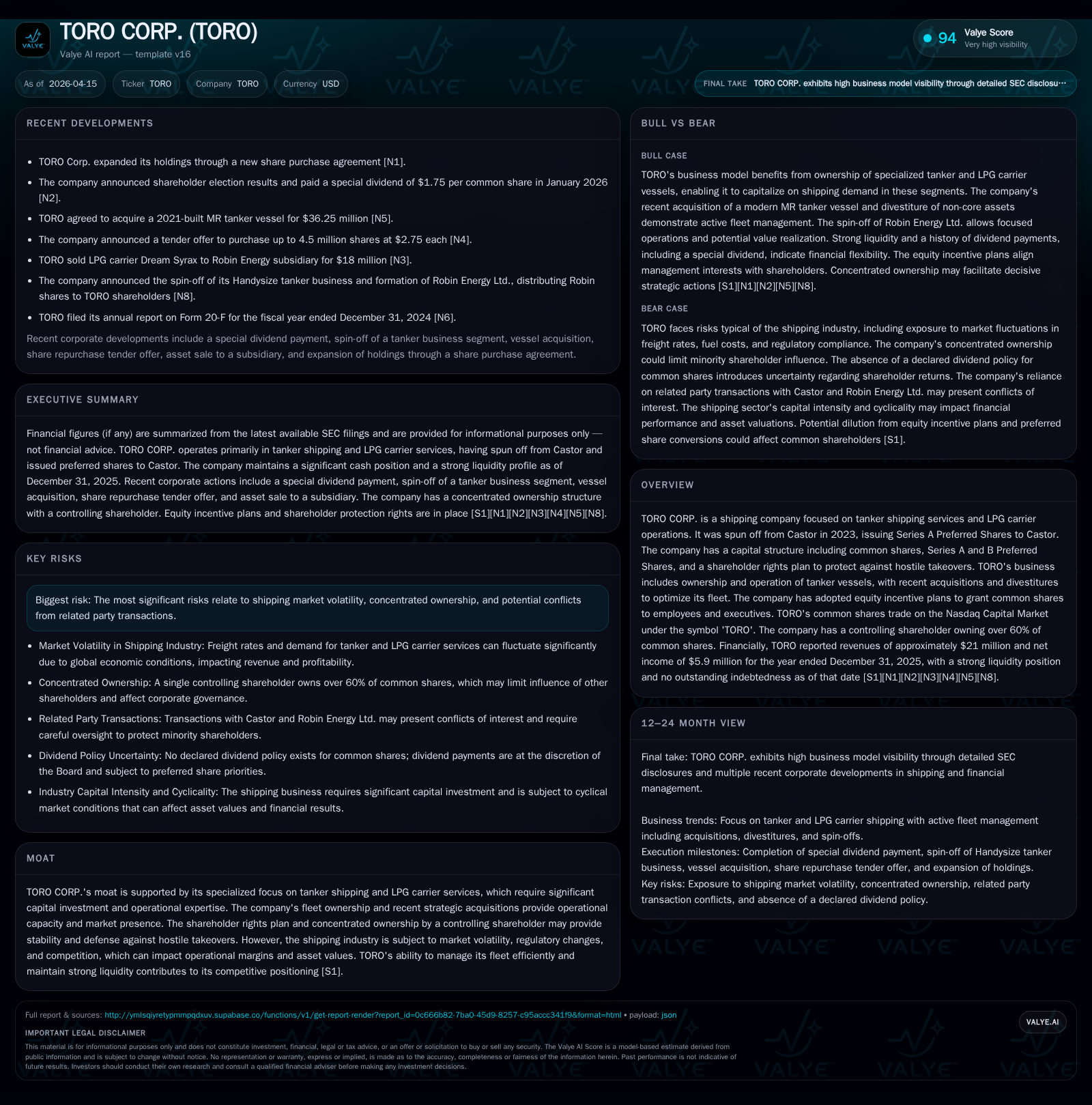
Toro Corp., a tanker and LPG shipping company spun off in 2023, has experienced declining revenues and operating income losses in recent years, with net income falling sharply in 2025. The company’s strategic decisions include fleet optimization through acquisitions and divestitures, adoption of equity incentive plans, and a shareholder rights plan that supports corporate defense and stability. While liquidity remains robust with over $87 million in cash and equivalents at year-end 2025, the shipping sector’s inherent volatility and regulatory risks present ongoing challenges. TORO’s concentrated ownership by a controlling shareholder provides stability but also introduces potential governance risks. Capital allocation has favored share repurchases in prior years although no repurchases occurred in 2025, and dividend policies remain discretionary under priority to preferred shareholders.
Company Overview
Toro Corp. emerged as a focused tanker shipping company following its spin-off from Castor in March 2023. It specializes primarily in tanker shipping services alongside growing operations in Liquefied Petroleum Gas (LPG) carriers. The firm is based in Limassol, Cyprus, and trades on Nasdaq under the ticker "TORO" [S1][N1]. Its corporate structure features common shares alongside Series A and B Preferred Shares issued primarily to Castor during the spin-off to support capital needs.
Historical Financial Performance
Since inception through full-year reporting periods ending December 31, Toro’s financials reflect a transition phase marked by significant shifts in revenue and profitability linked substantially to fleet adjustments and operational realignments:
Historical performance (annual)
| FY | Rev ($mm) | Net ($mm) | CFO ($mm) | OpInc ($mm) | Rev YoY | Net YoY |
|---|---|---|---|---|---|---|
| 2025 | 21 | 6 | -5 | -5.9% | -76.5% | |
| 2024 | 22 | 25 | -6 | -71.5% | -82.1% | |
| 2023 | 78 | 141 | 56 | 137 | -29.9% | +181.7% |
| 2022 | 112 | 50 | 42 | 52 |
Source: SEC companyfacts cache [F1].
Capital returns and efficiency (annual)
| FY | Buybacks ($mm) | FCF ($mm) | ROE% |
|---|---|---|---|
| 2025 | 0 | 3.6 | |
| 2024 | 4 | 12.7 | |
| 2023 | 1 | -16 | 79.6 |
| 2022 | 41 | 35.5 |
Source: SEC companyfacts cache [F1].
Source: Toro Corp. annual reports and SEC filings [F1]
Key observations:
- Revenues contracted sharply post-2023 reflecting divestitures or spin-offs of segments such as "Robin" completed April 2025.
- Operating losses appeared starting in fiscal year ended Dec. 2024 continuing into 2025 despite positive net income outcomes driven partly by non-operating items.
- Capital expenditures escalated sharply in 2023 and again in 2025 indicating investment into fleet renewal or expansion.
- Share repurchases were material through early 2024 but absent for the full year of 2025.
Strategic Growth Drivers & Constraints
TORO’s growth hinges on optimizing its fleet mix towards highly specialized tanker vessels including LPG carriers that require advanced operational capability with high barriers to entry. Recent acquisitions have expanded operational capacity whereas disposals aim at improving fleet efficiency [S1]. The company benefits from considerable capital backing via Preferred Shareholdings by Castor that provide stable funding but limit dividend flexibility for common shareholders due to preferred dividend priorities [S1][S10].
Further growth prospects are contingent on:
- Market demand for tanker services particularly driven by global oil and LPG trade flows;
- Ability to navigate volatile freight rates impacted by geopolitical events and regulatory changes affecting emissions standards;
- Maintaining solid liquidity given capital-intensive nature of fleet ownership;
- Managing currency exposure since some expenses are Euro-denominated while revenues are U.S. dollar-based.[S24][S26]
Constraints involve cyclical sector downturns impacting operating margins plus the risk posed by concentration of ownership exceedng60%, potentially constraining strategic agility or raising minority shareholder concerns [S15][S24].
Financial Outlook & Milestones
Explicit forward guidance is not disclosed; however emerging milestones include:
- Implementation of the $60 million revolving credit facility signed March-April 2026 with drawdown flexibility – a resource signalizing readiness for tactical investments or liquidity buffering [S3][S12].
- Management focus on capital efficiencies implied via recent equity incentive plans approved for executive retention tied to long-term stock performance incentives [S8].
- Shareholder rights plan active as of spin-off date safeguards against hostile takeover attempts while ensuring stability amid evolving equity base dynamics [S22].[N1]
Upcoming aspects worthy of monitoring include quarterly operational results post-fleet restructuring impacts as well as any announcements on dividend declarations aside from the one-time special dividend paid January 16th 2026 totaling approximately $9.3M in cash plus share issuance elected by shareholders [S6].
Returns & Capital Allocation
Near-term return metrics demonstrate subdued performance relative to initial years post-spin-off:
- Approximate Return on Equity stands at ~3.6% for FY25 driven by net income of roughly $5.9 million against equity of $163.6 million at year end [F1];
- Operating Cash Flow remained undisclosed for FY25 but notable capital spending drove free cash flow negative;
- No share buybacks occurred during FY25 after active repurchases through early FY24 that saw cancellation of nearly 870K shares averaging $5.50 each [S4][F1];
- Dividend policy remains undeclared with dividends subject to Board discretion prioritizing cumulative Series A Preferred Shares which currently incur a modest annualized rate near 1% before reset terms escalate it after seven years from issuance date [S19].[S26]
The bulk of dividends declared relate primarily to preferred issuances held by Castor with common shareholders receiving an ad hoc special payout rather than regular yields.[S10][S19]
Industry Context & Competitive Positioning (Analysis)
The global tanker shipping segment is characterized by intense market volatility influenced notably by worldwide crude oil demand cycles alongside regulatory pressures such as IMO emissions rules pushing fleet modernization or alternative fuel usage upgrades. Its moat requires significant capital outlays for owning specialized vessels capable of safe transportation of hazardous liquids like LPG.
TORO’s concentrated ownership structure may aid expedient decision-making but also introduces friction points related to minority investor protections common within family-controlled shipping enterprises where aligned long-term vision must balance governance transparency risks.
Its rights plan enhances takeover defenses which is increasingly important given enhanced activist investor activity across maritime asset plays recently observed industry-wide.
Currency risk management remains imperative; although Euro costs form a minor portion currently (~5%), increases could impact expense predictability without proactive hedging solutions visible at present.[S12]
Risks Summary
Notable risk factors highlighted explicitly include:
- Sector volatility causing revenue swings leading to fluctuating operating results;
- Ownership concentration with control vested heavily (>60%) limiting contestability;
- Related party transactions from its origin structure with Castor introduce potential conflict dynamics requiring ongoing disclosure vigilance.[S24][N1]
Conclusion
Toro Corp.’s brief operating history following the spin-off illustrates an evolving business maneuvering through the cyclicality inherent to tanker shipping markets while striving for operational stability via strategic fleet management backed by robust liquidity reserves. Its layered capital structure involving multiple classes of preferred equity constrains traditional shareholder returns but provides essential funding flexibility that supports ongoing investment demands. Monitoring market freight rate trends alongside execution against planned capital programs will be critical indicators linking organic growth prospects with valuation prospects despite pronounced sector headwinds.
This report is prepared solely for informational purposes based on publicly available data as of April 15th 2026 without offering investment advice.
Disclaimer: This is research-only, informational analysis and not investment advice. It may include AI-generated interpretation and general industry context. Always verify important details using primary sources.

Comments