
Nixxy, Inc. Navigates Transition to AI-Driven Telecommunications Amid Financial and Leadership Challenges
Following a strategic shift from recruitment to AI-enabled telecom infrastructure, Nixxy reports substantial revenue growth in 2025 but continues to grapple with operating losses and liquidity constraints.
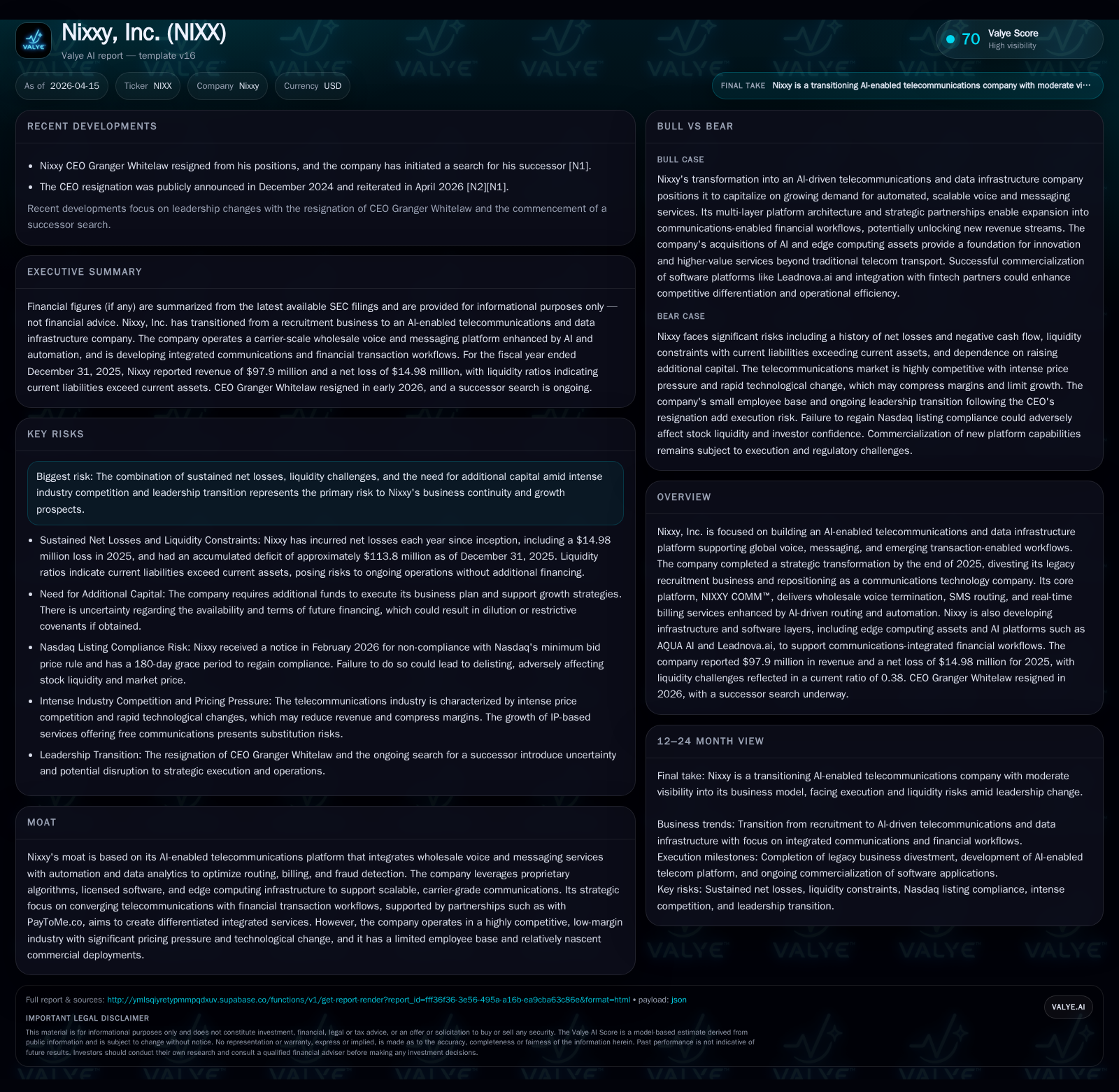
Nixxy, Inc. completed its pivot from legacy staffing operations to an AI-powered telecommunications platform by the end of 2025, marked by a surge in revenue to $97.9 million. Despite this growth, the company remains unprofitable with a net loss of $15.0 million and faces liquidity challenges evidenced by a current ratio of 0.38. With a lean workforce supporting capital-intensive infrastructure investments, Nixxy aims to scale voice and messaging services enhanced by AI automation while expanding into fintech-integrated transaction workflows. Key risks include competitive pricing pressure, regulatory complexities, customer concentration, cybersecurity threats, and recent CEO departure.
Executive Summary
Nixxy, Inc. (Nasdaq: NIXX) has completed a strategic transformation from a recruitment services company into an AI-powered telecommunications infrastructure provider focused on wholesale voice termination and messaging services. This transition was finalized by year-end 2025 through divestitures of legacy staffing assets [S1][S8]. The company now operates its carrier-scale platform NIXXY COMM™, which leverages artificial intelligence for optimized routing, billing accuracy, fraud detection, and traffic mix management.
Despite a significant revenue increase from $612 thousand in 2024 to nearly $98 million in 2025 [F1], Nixxy continues to report substantial operating losses of approximately $11.8 million and net losses around $15 million for fiscal year 2025 [F1]. Liquidity remains a critical concern with current assets of approximately $2 million against current liabilities exceeding $5.2 million at year-end 2025, resulting in a current ratio of only 0.38 [F1]. The company’s lean workforce consists of two full-time employees supported by independent contractors as of December 31, 2025 [S13]. Furthermore, CEO Granger Whitelaw resigned in early 2026 introducing additional leadership uncertainty [N1].
Historical Financial Performance
Historical performance (annual)
| FY | Rev ($mm) | Net ($mm) | CFO ($mm) | OpInc ($mm) | Rev YoY | Net YoY |
|---|---|---|---|---|---|---|
| 2025 | 98 | -15 | -5 | -12 | +15896.5% | +33.7% |
| 2024 | 1 | -23 | -4 | -15 | -80.8% | -239.2% |
| 2023 | 3 | -7 | -1 | -8 | -87.4% | +59.6% |
| 2022 | 25 | -16 | -7 | -17 |
Source: SEC companyfacts cache [F1].
Capital returns and efficiency (annual)
| FY | FCF ($mm) | ROE% |
|---|---|---|
| 2025 | -187.9 | |
| 2024 | -875.6 | |
| 2023 | -1 | -716.1 |
| 2022 | -7 | -324.4 |
Source: SEC companyfacts cache [F1].
Revenue surged notably in FY25 following completion of the company’s repositioning as a telecommunications technology firm. Operating and net losses remain material but showed some improvement on an absolute basis compared to prior years despite the much larger revenue base [F1]. Operating cash flow remains negative reflecting ongoing investment requirements and working capital needs intrinsic to wholesale telecom operations.
Business Model & Industry Positioning
Nixxy generates revenues principally through its carrier-scale telecommunications network providing wholesale voice termination and SMS routing services globally enhanced by AI-based automation [S7][S8]. Its core platform NIXXY COMM™ integrates intelligent routing logic for quality-of-service governance alongside automated billing and fraud detection systems designed to improve margins.
The company is advancing beyond traditional telecom infrastructure into adjacent fintech-enabled transaction workflows that embed financial interactions within communication channels. This includes partnerships such as with PayToMe.co aimed at integrating payment workflows into messaging platforms enabling cross-border transactions supported by AI compliance and routing automation [S20][S24].
Growth Strategy & Outlook
Management’s three-pronged strategy emphasizes:
- Scaling message and voice volumes via expanded carrier partnerships,
- Improving margin profiles through AI-enabled traffic optimization,
- Moving up the value chain by developing infrastructure-driven software and communication-fintech integrated offerings [S7][S11].
Commercial beta initiatives targeting data-driven business process platforms like Leadnova.ai are planned for rollout during 2026 [S24]. However, challenges include intense competition leading to pricing pressure in wholesale telecom markets along with regulatory uncertainties spanning telecommunications compliance and evolving AI regulations [S14][S17][S19]. Network security risks also remain salient due to industry-wide exposure to cyber threats [S19].
Capital Allocation & Financial Condition
As of December 31, 2025 the company reported stockholders' equity of approximately $8 million contrasted with accumulated deficits exceeding $113 million reflective of prolonged losses carried forward [F1][S1]. Return on equity is deeply negative given the net loss relative to equity base.
Operating cash flows continue negative trends (-$4.57 million FY25), while capital expenditures are minimal publicly reported but infrastructure acquisitions underpinning edge computing capabilities have been noted by management [F1][S11][S24]. No dividends or share repurchases have been declared or executed given constrained liquidity conditions; capital allocation prioritizes sustaining core platform development amidst operating losses [S25].
The company faces an urgent need for additional financing due to working capital deficits impacting carrier deposit requirements essential for traffic volume maintenance; however capital raises may involve shareholder dilution or restrictive covenants depending on market conditions and credit terms available [S12].
Risks Summary
Key risks identified include:
- Continued operating losses threatening long-term viability absent sustained profitability or external financing,
- Liquidity constraints underscored by low current ratio limiting operational flexibility,
- Intense price competition compressing margins in commoditized telecom markets,
- Revenue concentration risk due to dependence on relatively few major carrier customers,
- Rapid technological changes requiring ongoing investment,
- Regulatory risks including telecommunications licensing and emerging AI-related compliance costs,
- Cybersecurity vulnerabilities potentially causing service disruptions or reputational damage,
- Leadership transition risk following CEO resignation during critical execution phases [N1][S1][S17][S19].
Conclusion
Nixxy’s transition from recruitment services toward an AI-powered telecommunications platform targeting large-scale wholesale voice/messaging throughput combined with fintech workflow integration represents a significant strategic repositioning validated by strong revenue growth in FY25.
However persistent net losses combined with acute liquidity constraints highlight ongoing challenges in converting technological advances into sustainable profitability within highly competitive markets. The company’s investments in edge computing assets paired with proprietary AI-driven routing reflect efforts to enhance operational efficiency and expand into higher-value service layers.
Stakeholders should closely monitor progress on commercialization milestones for emerging platforms like Leadnova.ai alongside liquidity developments including potential capital raises. Additionally key will be execution on fintech-telco integrations exemplified by partnerships such as PayToMe.co amid evolving regulatory landscapes and competitive pressures.
This analysis is based solely on publicly available filings including Nixxy’s latest annual report dated April 15th, 2026 ([S1]), related news ([N1]), and structured financial datasets ([F1]). It is provided for informational purposes without investment advice.
Disclaimer: This is research-only, informational analysis and not investment advice. It may include AI-generated interpretation and general industry context. Always verify important details using primary sources.

Comments