
EDENOR’s Surge in Revenues and Strategic Adaptation in Argentina’s Power Distribution
EDENOR has significantly increased revenues and improved earnings through tariff adjustments, operational efficiencies, and regulatory navigation within its exclusive concession area in northwest Greater Buenos Aires.
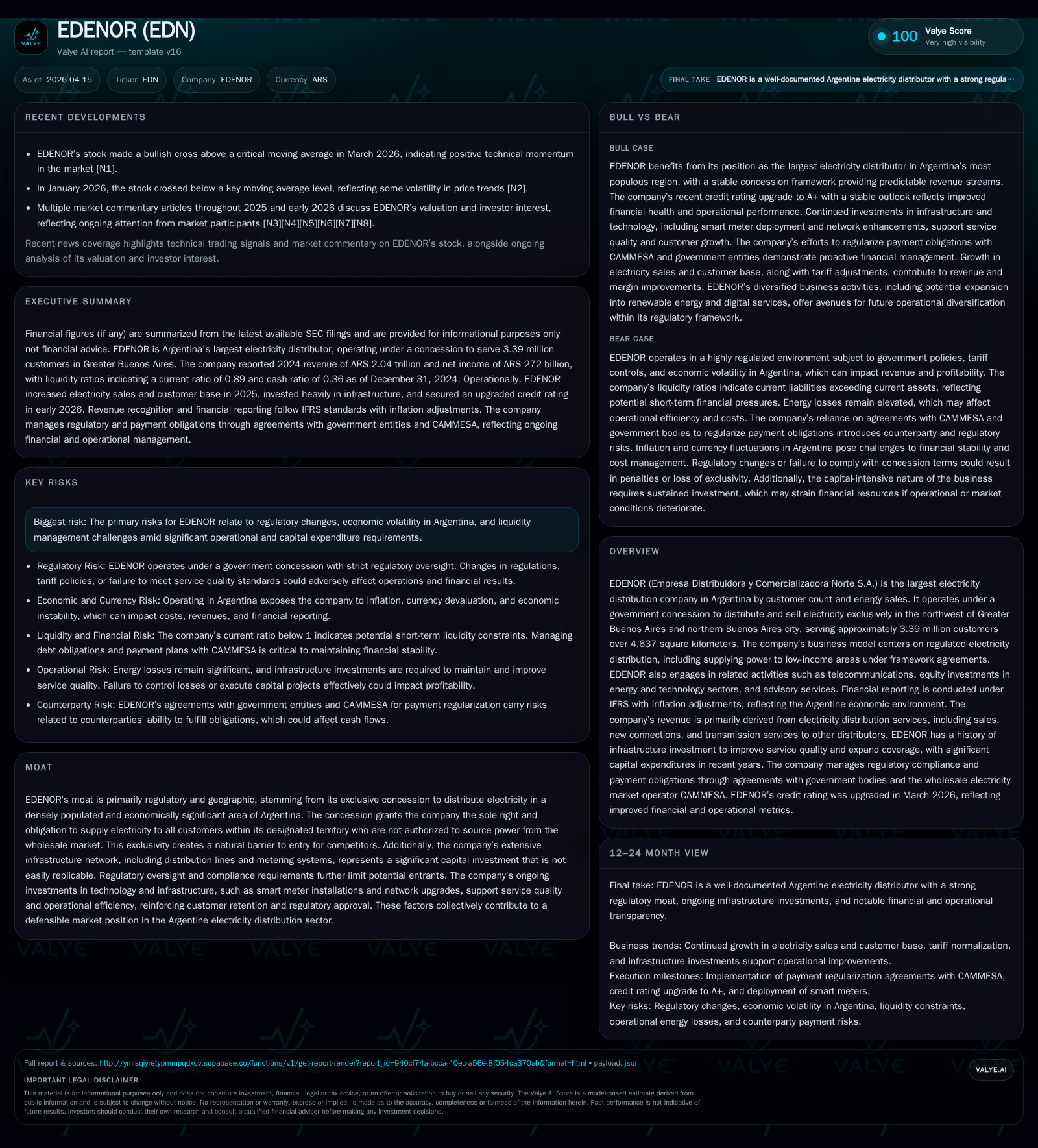
From 2021 to 2024, EDENOR experienced dramatic revenue growth of over 190% alongside a net income turnaround from losses to a strong profit, driven largely by tariff normalization and improved cost control. The company continues investing heavily in infrastructure modernization, including smart meters and substations, while managing regulatory compliance within a challenging Argentine economic environment. Key risks remain tied to national economic volatility and regulatory shifts, but EDENOR’s concession exclusivity and operational initiatives underpin its resilience and future growth potential within its dense service territory.
Historical Financial Performance: Revenue Growth and Expense Evolution
EDENOR's financial trajectory over the past four years marks a striking recovery and expansion within Argentina's volatile power distribution sector. Reported revenues surged from ARS 113.5 billion in FY2021 to more than ARS 2 trillion by FY2024—a near ninefold increase driven by tariff normalization actions implemented post-2023 alongside rising energy demand within its exclusive concession zone ([F1]). Correspondingly, net income shifted dramatically from losses exceeding ARS 21 billion in FY2021 and FY2022 to a robust profit of ARS 272 billion by FY2024. This turnaround embodies both organic operational improvements and the impact of regulatory adjustments.
Analysis of operating expenses reveals key margin drivers. Transmission and distribution expenses (T&D) decreased to represent just 19.1% of revenue for FY2025 compared to 23.7% the previous year ([S1]). This contraction largely reflects lower penalties imposed by Argentina’s energy regulator ENRE following Resolution No. 160/2025, which revised valuation methodologies leading to cost recoveries. Detailed breakdowns indicate significant savings on fees, remuneration for services, and social security tax rates amid efforts to optimize the workforce mix.
Selling expenses also fell by nearly 7% year-over-year as ENRE penalties declined substantially—from ARS ~72 billion in FY2024 down to ARS ~26 billion in FY2025—enabling further margin expansion ([S1]). The consequent gross profit improvement reinforced EDENOR’s solidifying financial footing despite high inflationary pressures embedded in Argentina’s economic milieu.
Historical performance (annual)
| FY | Rev ($bn) | Net ($bn) | Rev YoY | Net YoY |
|---|---|---|---|---|
| 2024 | 2043.1 | 272.1 | +191.4% | +462.6% |
| 2023 | 701.1 | 48.4 | +240.6% | +376.9% |
| 2022 | 205.8 | -17.5 | +81.4% | +18.2% |
| 2021 | 113.5 | -21.3 |
Source: SEC companyfacts cache [F1].
Capital returns and efficiency (annual)
| FY | ROE% |
|---|---|
| 2024 | 18.1 |
| 2023 | 11.0 |
| 2022 | -13.9 |
| 2021 | -29.0 |
Source: SEC companyfacts cache [F1].
Note: Financials reflect constant currency figures restated under IFRS standards with inflation adjustments where applicable ([F1],[S1]).
Key Drivers Behind the Recent Earnings Turnaround
The pronounced earnings improvement owes much to multifaceted factors converging around tariff realignment and operational leverage gains. Foremost among these was the official recognition of cost recoveries following ENRE Resolution No.160/2025 that allowed EDENOR to adjust pricing parameters reflective of actual expenditures including losses ([S1]). The result was manifested not only in reduced penalty expenses but also enhanced distribution margins.
Operationally, EDENOR restructured workforce deployment by balancing its approximately 4,600 direct employees with outsourcing firms employing roughly 6,000 additional personnel—helping contain fixed personnel costs while maintaining agility ([S1]). Additionally, the creation of Edenor Tech S.A.U., a wholly owned affiliate established mid-2024 focused on technological innovation and digital network management, illustrates the company's strategic pivot towards technology-enabled service improvements ([S1]).
Tariff increments that began implementation in August 2024 have continued monthly adjustments averaging around +3.1%, cumulatively bolstering top-line revenues ([S21]). These adjustments align pricing policies closer to market realities after years of politically sensitive under-pricing that strained distributor economics.
Regulatory Context and Its Impact on Operations
EDENOR operates under an exclusive federal concession administered by ENRE—the National Electricity Regulatory Entity—which confers sole rights for electricity distribution within an estimated footprint servicing over three million customers across northwest Greater Buenos Aires ([S18],[S1]). This exclusivity constitutes a significant moat as no other provider may compete directly on distribution delivery within this densely populated region.
Currently the ENRE remains under extended intervention until July 9th, 2026 by governmental decree amid plans to merge it with ENARGAS into the new National Gas and Electricity Regulatory Agency (ENRGE). This transition seeks enhanced regulatory stability but carries inherent uncertainty regarding future tariff methodologies or enforcement rigor ([S1]).
Regulatory oversight governs not just pricing but also quality-of-service obligations including supply reliability, consumer protection provisions, metering accuracy, and penalty assessments for non-compliance—compelling ongoing investments in smart meter rollout and network modernization.
Moreover, EDENOR must comply with federal laws alongside concession terms requiring universal service provision—even subsidizing electricity deliveries to low-income neighborhoods via government framework agreements—which adds social policy complexity beyond pure commercial concerns ([S1],[N1]).
Future Growth Potential within Concession Boundaries
Growth prospects hinge on deepening penetration within EDENOR’s concentrated metropolitan license area comprising about 3.39 million customers spanning residential, commercial, industrial segments plus social neighborhoods ([S18]). Incremental customer additions reached roughly +1% year-over-year through targeted service expansions as well as formalization of informal connections via newly installed meters that convert previously unreported usage into billed volume.
Beyond traditional electricity distribution revenues derived mainly from volumetric tariffs adjusted monthly under regulated frameworks ([N1]), EDENOR is advancing related offerings such as telecommunications services leveraging existing infrastructure as well as consulting activities through dedicated corporate units ([S20],[S22]). These ancillary lines illustrate attempts at business model diversification modestly alleviating dependency on core regulated activities while capturing opportunities related to Argentina’s energy transition agenda.
Yet overarching constraints persist owing to fixed geographic boundaries imposed by the concession; all commercial initiatives must adhere strictly to federal regulatory approvals limiting free-market expansion outside designated zones or wholesale electricity market participation ([S1]).
Capital Allocation: Investment, Cash Flow, and Return Metrics
With profitability restored—achieving an approximate return on equity around 18% based on trailing twelve-month net income versus equity balance at YE24—EDENOR demonstrates effective capital stewardship amidst an inflationary economy ([F1]). Capital expenditures remain material; reported investments totaled around ARS394.9 billion for full year 2025 encompassing network reinforcements such as new substations (e.g., Bancalari expansion), installation of smart meters targeting all T3 class customers plus upgrades reducing technical losses ([S21],[S28]).
These investments prioritize both reliability enhancements aligned with concessional service quality mandates and digital metering enabling better load management—all crucial for long-term sustainable margins given high fixed cost nature of electric utilities.
Cash flow metrics reveal growing operating cash generation supported by collection efficiencies post-tariff revisions although limited disclosure exists on dividend payments or share repurchases for recent periods ([F1],[S22]). Available filings note flexible outsourcing arrangements that support variable cost structures suggesting prudent liquidity management balancing capex commitments with operational needs.
Debt Structure and Liquidity Considerations Amid Market Volatility
As of December 31, 2025, total liabilities approximated ARS3.54 trillion against equity near ARS2.22 trillion reflecting moderately leveraged capital structure consistent with infrastructure-heavy utility profile ([F1],[S13]). Financial debt outstanding comprised notes denominated in USD supplemented by local currency loans partially converted at prevailing exchange rates amid currency volatility ([S17]).
Recent amendments include selective early repayments—such as full prepayment of Class 8 Notes—and reopening of Class 7 Notes increasing USD exposure strategically during refinancing cycles ([S17],[S19]). The company has maintained compliance with covenants reported across multiple filings despite Argentina’s macroeconomic fluctuations featuring high inflation and exchange rate instability.
Liquidity buffers include cash & equivalents totaling over ARS20 billion plus accessible credit facilities enabling working capital sufficiency even during tariff lag periods where government subsidies are sometimes delayed or adjusted ([F1],[S24]). Notably ratings agencies have upgraded long-term issuer rating reflecting confidence in EDENOR’s financial discipline amid sector uncertainties ([S2]).
Operational Efficiencies: Outsourcing and Technology Integration
EDENOR leverages a hybrid labor model balancing about 4,600 direct employees supplemented by approximately 6,000 outsourced workers engaged through third-party contractors managing maintenance, meter reading, customer service activities among others ([S1]). This flexibility offers adaptive cost control necessary given fluctuating demand patterns across residential and commercial accounts.
Technological advances spearheaded through Edenor Tech S.A.U., created July 2024 fully owned subsidiary focused on digital transformation initiatives such as smart metering rollouts have already resulted in over eight thousand intelligent metering units deployed as part of demand-side management programs ([S21]). This subsidiary consolidates R&D functions enhancing monitoring capabilities which bolster reliability compliance while reducing operational disruptions linked historically to manual processes.
The mix supports responsiveness allowing scale adjustments without escalating fixed overheads disproportionately—a critical strategic capability given the company’s regulated context prone to exogenous shocks like regulatory penalties or macroeconomic shifts.
Risks from Economic Volatility and Regulatory Reforms to Monitor
Primary risks facing EDENOR emanate from Argentina’s enduring economic volatility marked by currency instability coupled with inflationary pressures complicating cost forecasting despite IFRS inflation accounting allowances ([F1],[N1],[S1]). Political sensitivity surrounding electricity tariffs keeps pricing vulnerable to policy reversals potentially eroding recently gained profitability.
The pending transition from ENRE intervention regime into the newly established National Gas and Electricity Regulatory Agency (ENRGE) introduces regulatory uncertainty particularly relating to tariff-setting procedures penalties frameworks or service quality enforcement standards impacting financial outcomes ([N1],[S1]).
Operational risks include integration challenges associated with rapid infrastructure modernization efforts together with pressure on maintaining universal service obligations pressing costs higher than average commercial returns may justify.
Overall vigilance toward evolving legal policies plus sustaining harmonic relations with federal regulators remains paramount for preserving EDENOR’s protected market position enabling it to capitalize fully on recent strategic adaptations.
This analysis synthesizes data disclosed through official SEC filings up to April 15th, 2026 [F1],[S#] complemented by material fact releases reporting contemporary company developments [N#]. It does not constitute investment advice or recommendations.
Disclaimer: This is research-only, informational analysis and not investment advice. It may include AI-generated interpretation and general industry context. Always verify important details using primary sources.

Comments