
XTI Aerospace’s Strategic Shift to Integrated Drone Distribution and Domestic Manufacturing
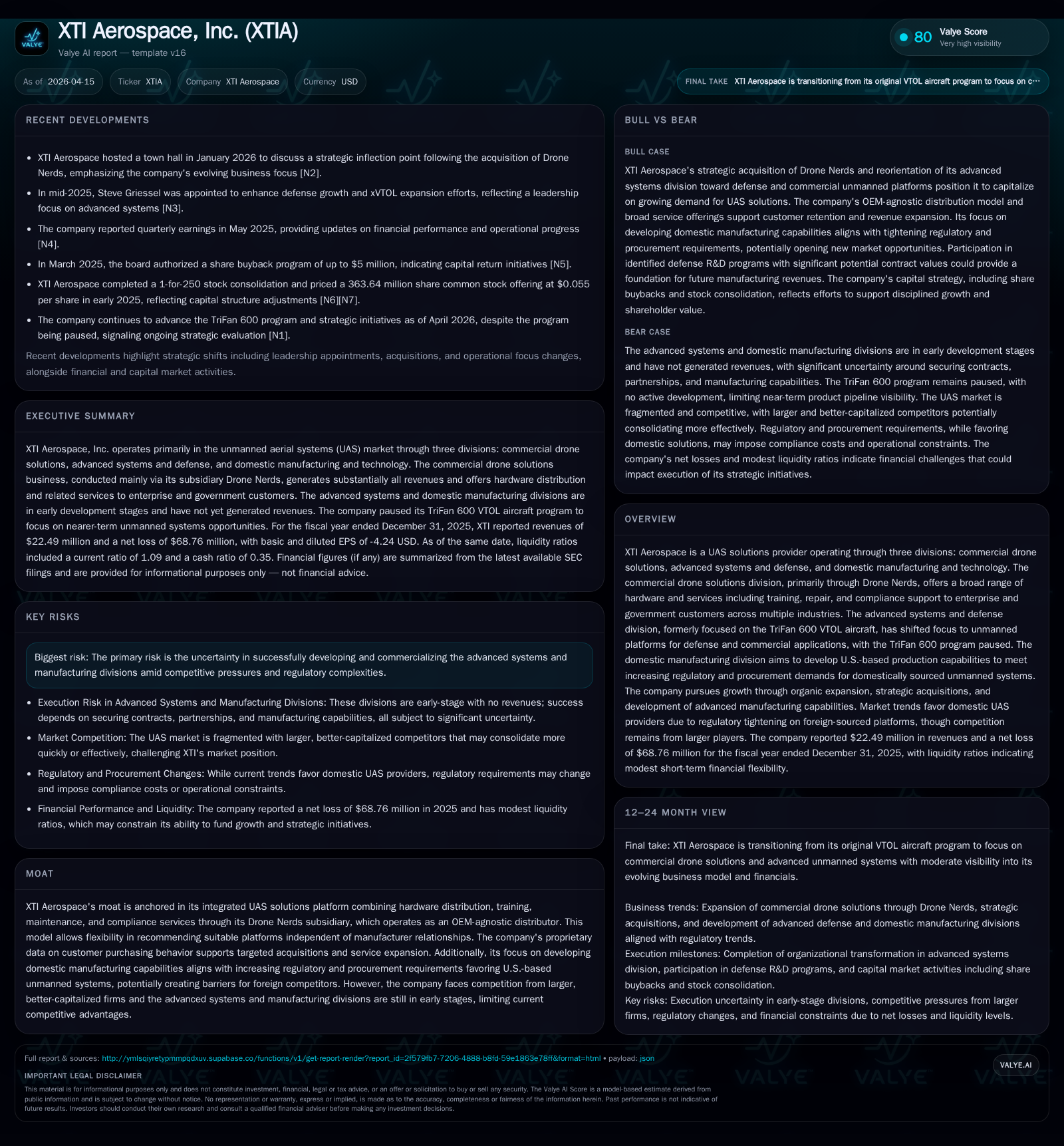
XTI Aerospace has redirected its business focus from manned VTOL aircraft to a comprehensive unmanned aerial systems platform, anchored by Drone Nerds and emerging domestic manufacturing.
Following its 2025 acquisition of Drone Nerds, XTI Aerospace pivoted from developing the TriFan 600 vertical takeoff and landing aircraft to building an integrated UAS solutions platform. The commercial drone solutions division drove a remarkable 602% revenue increase in 2025, yet operating losses deepened, reflecting heavy investment in growth and product enablement. The advanced systems and domestic manufacturing divisions remain nascent but align strategically with tightening U.S. regulatory requirements favoring domestic production. However, significant litigation risks and ongoing losses temper near-term profitability prospects.
Historical Growth and Business Transformation
XTI Aerospace has undergone a marked transformation since its founding focus on the manned TriFan 600 vertical takeoff and landing (VTOL) aircraft. In 2025, through the acquisition of Drone Nerds — a majority-owned subsidiary specializing in commercial drone solutions — XTI significantly reshaped its operational profile toward an integrated unmanned aerial systems (UAS) business model.
This strategic pivot is underscored by the company’s explosive revenue growth: from approximately $3.2 million in 2024 to nearly $22.5 million in 2025, representing a staggering year-over-year increase of over 600% [F1]. This jump primarily reflects Drone Nerds’ contribution as well as expanded product offerings under its commercial drone solutions umbrella.
Despite this top-line surge, operating income deteriorated further into a -$42.8 million loss in 2025 compared to -$37 million in 2024 [F1], highlighting ongoing challenges in managing operating costs within rapid expansion phases.
Diversified Business Model Across UAS Segments
XTI Aerospace currently organizes its UAS activities into three core divisions: Commercial Drone Solutions, Advanced Systems and Defense, and Domestic Manufacturing and Technology.
The Commercial Drone Solutions division—anchored by Drone Nerds—functions as an OEM-agnostic distributor providing a broad portfolio including hardware sales from multiple manufacturers, comprehensive training programs, maintenance services compliant with OEM warranty specifications, fleet management software enablement, regulatory compliance assistance, and procurement financing facilitation [S7][S8]. This diversified service scope supports enterprise customers spanning agriculture, construction, public safety, inspection, mining, insurance, security, energy sectors among others [S10].
Meanwhile, the Advanced Systems and Defense division has realigned efforts away from manned VTOL aircraft development towards unmanned platforms designed for defense applications and commercial use cases. The TriFan 600 program is officially paused but IP rights are retained for potential future reactivation or technology leverage [S1][N1].
The Domestic Manufacturing division stands at an early stage focused on establishing scalable U.S.-based supply chains and production capacity aligned with increasingly stringent federal procurement regulations aimed at minimizing foreign component dependence [S6][S21].
Revenue Surge Driven by Commercial Drone Solutions
The bulk of XTI’s incremental revenue growth derives from scaling Drone Nerds’ operations. By expanding beyond pure hardware distribution into value-added services—such as pilot training certification programs tailored to FAA regulations, time-and-material repair contracts aligned with manufacturer warranties, operational workflow integrations using third-party software platforms, and financing options supported via external credit providers—Drone Nerds aims to deepen customer engagement while enhancing revenue per user metrics [S7][N1].
However,the margin profile remains pressured due to investments in infrastructure scaling and service capability builds necessary for sustaining enterprise-grade delivery models.
Strategic Reallocation from TriFan 600 VTOL to Unmanned Systems
Faced with substantial development cost burdens and protracted timelines inherent to manned VTOL certification processes, XTI elected to pause the TriFan 600 project post-acquisition of Drone Nerds. The strategic reallocations direct engineering resources towards unmanned vehicle design emphasizing systems integration, autonomy software development tailored for defense clients with stringent certification requirements,and advanced mission payload configurations applicable across commercial sectors [S1][N1]. Intellectual property rights underlying TriFan are preserved but no current revenues materialize from these efforts.
Emerging Domestic Manufacturing Capabilities and Their Potential
In response to escalating national security considerations reflected in federal procurement policies favoring domestically sourced unmanned systems,XTI pursues development of manufacturing partnerships alongside investments in technology integration targeted on scalable U.S.-based production lines [S6][S21].
Though this division has yet to generate revenues,it represents a potential strategic moat given increasing government preference for domestically sourced platforms that foreign competitors may find difficult to penetrate. Capital expenditures increased notably in FY2025 relative to prior years despite still being modest overall ($215k vs $68k), signaling early-stage capital deployment focused on capability building rather than volume production [F1].
Financial Performance Analysis: Profitability Still Elusive
FY2025 financial results emphasize XTI’s continued struggle with profitability despite commendable top-line growth:
Historical performance (annual)
| FY | Rev ($mm) | Net ($mm) | CFO ($mm) | OpInc ($mm) | Rev YoY | Net YoY |
|---|---|---|---|---|---|---|
| 2025 | 22 | -69 | -37 | -43 | +602.4% | -93.1% |
| 2024 | 3 | -36 | -22 | -37 | +22.5% | |
| 2023 | -46 | -29 | -27 | +27.5% | ||
| 2022 | 19 | -63 | -34 | -57 | +21.4% |
Source: SEC companyfacts cache [F1].
Capital returns and efficiency (annual)
| FY | FCF ($mm) | ROE% |
|---|---|---|
| 2025 | -37 | -387.6 |
| 2024 | -22 | -541.6 |
| 2023 | -29 | -724.8 |
| 2022 | -34 | -196.9 |
Source: SEC companyfacts cache [F1].
The operating loss deepened by nearly 16%, while net income declined sharply due largely to ramping operating expenses tied primarily to the rapid expansion post-Drone Nerds acquisition along with ongoing R&D investments for future capability development [F1]. Cash flow burn intensified as operating cash flow fell over $14 million sequentially reaching negative $36.6 million in FY2025; when combined with capital spending free cash flow remains deeply negative indicating sustained liquidity strain amid growth initiatives.
Equity increased appreciably reflecting capital raises (from roughly $6.57M end-2024 to $17.7M at end-2025) but return on equity was deeply negative (-388%), illustrating how accumulated losses offset shareholder injections over this period [F1]. The current ratio sits narrowly above parity at ~1.09x highlighting working capital adequacy concerns under sustained cash burn conditions.
Capital Allocation: Balancing R&D Investment and Cash Flow Pressures
Capital deployment focuses heavily on R&D across all divisions supporting platform enablement rather than immediate revenue generation.The commercial drone division invests in technical evaluation protocols for integrating multi-vendor hardware ecosystems alongside enhancing training curriculum responding dynamically to shifting FAA mandates.[S6]
Advanced Systems ramps engineering for autonomy algorithms aligned with military interoperability standards while Domestic Manufacturing commits funds towards qualifying partners capable of compliant domestic production runs.[S6][S21]
Capex remains relatively low compared with cash burn reflecting prioritization of labor-intensive R&D over fixed asset accumulation but surged over threefold between FY2024 ($68k) and FY2025 ($215k) signaling growing manufacturing setup expenditures nonetheless.[F1]
No dividends or share buybacks were declared consistent with conserving cash amid unprofitable operations.[S21]
Regulatory Risks and Ongoing Litigation Impacting Outlook
XTI faces multifaceted regulatory challenges spanning evolving FAA operational frameworks affecting training certification; international trade restrictions governing importation of key components notably those sourced through Chinese suppliers like DJI which comprises nearly half of product purchases; FCC equipment authorizations increasingly scrutinizing foreign-manufactured drones;and stringent government standards mandating domestic content[S4][S11][S13][S20].
From a legal perspective,the company is encumbered by significant lawsuits impacting both historic legacy dealings around TriFan technology (notably multi-year disputes with Xeriant Inc seeking damages exceeding $500 million related to breached joint venture agreements) as well as recent state-level consumer protection claims against Anzu Robotics alleging deceptive trade practices concerning product representations (including purported misstatements about component sourcing/security features)[S4],[S19].[S12],[S14],[S16]
These litigations impose potential material financial liabilities notwithstanding currently indeterminate outcomes,and contribute materially to elevated legal expenses alongside management distraction risk.[S4],[S11],[S22]
Future Growth Drivers and Industry Tailwinds to Watch
Looking forward,XTI’s prospects rest heavily on their ability to leverage proprietary purchasing data gleaned from Drone Nerds’ OEM-agnostic distribution network for targeted acquisitions expanding market reach and capability breadth.[S8],[N1] Successful commercialization paths for advanced unmanned systems technologies will be critical milestones enabling diversification beyond sole reliance on drone distribution revenues.[S6] Additionally,the buildout of fully compliant domestic manufacturing channels aligned with accelerating governmental procurement demand forms an important medium-term moat proposition.[S21] Regulatory developments affecting market access or compliance costs remain key variables warranting close monitoring.[S11],[S13]
Key indicators include expansion trends in enterprise/government customer adoption beyond current sectors,width/depth of service portfolio uptake especially training/repair contracts,and progress milestones announced around advanced systems product prototypes/agreements.[N1] Conversely,duration/impact of ongoing litigation or adverse regulatory rulings could exacerbate financial strain or delay strategic initiatives markedly.[S4],[S16]
This analysis synthesizes publicly available SEC filings dated April 15, 2026 ([S1]-[S29]), Nasdaq coverage ([N1]), and reported financial metrics ([F1]). It refrains from extrapolating undisclosed results or subjectively projecting outcomes beyond documented guidance or corporate statements.
The provided content does not constitute investment advice or recommendations.
Disclaimer: This is research-only, informational analysis and not investment advice. It may include AI-generated interpretation and general industry context. Always verify important details using primary sources.

Comments