
Autohome Inc.: Dissecting Growth Dynamics Amid Regulatory Hurdles
Autohome’s revenue growth moderation, regulatory risks, customer concentration, and capital deployment frame a complex outlook for China’s leading automotive digital platform.
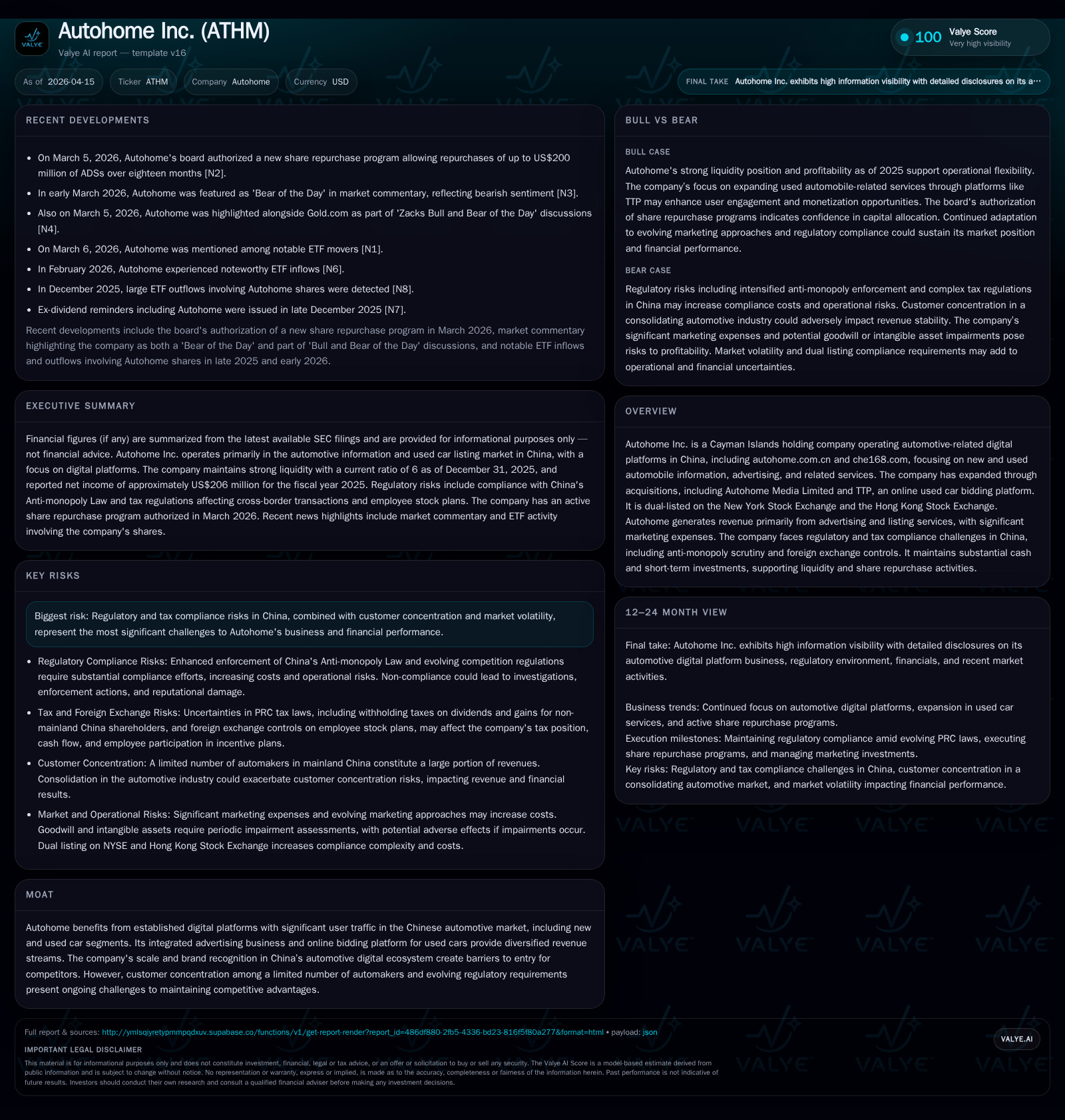
Autohome Inc. has transitioned from rapid revenue expansion to a phase marked by slowing top-line growth and profit margin compression amid intensifying regulatory scrutiny in China’s evolving anti-monopoly landscape. The company’s diversified automotive digital ecosystem, spanning new car advertising and used car online bidding platforms, faces challenges including customer concentration risks and elevated marketing spend that pressures operating income. Robust liquidity supports share repurchases and dividends, but future growth hinges on navigating compliance costs and market shifts. Key performance indicators from 2023 to 2025 show an 11% revenue increase in 2025 contrasted with a 20% decline in operating income, underscoring margin contraction.
From Breakout Revenue Growth to Profit Margins Squeezed: Historical Financial Trajectory
Autohome demonstrated impressive revenue expansion moving from $18.9 million in fiscal year (FY) 2023 to $46.6 million by FY2025 [F1]. However, the cadence of growth moderated notably with only an 11.1% revenue increase year-over-year (YoY) in 2025 compared to prior rapid surges. This deceleration coincided with operating income dwindling sharply by approximately 20% in the same period, declining from $137.5 million in FY2024 to $110.0 million in FY2025 [F1]. Consequently, operating margins compressed materially as elevated sales and marketing expenses consumed a large portion of revenues.
Net income similarly contracted by over 10% YoY to around $206 million in FY2025 [F1], while operating cash flow (CFO) saw a steeper drop of about one-third (-32%), reflecting increasing working capital demands or reduced operational efficiency [F1]. Capital expenditures (Capex) dipped marginally by roughly 12%, indicating moderated investment intensity relative to prior years.
Historical performance (annual)
| FY | Rev ($mm) | Net ($mm) | CFO ($mm) | OpInc ($mm) | Rev YoY | Net YoY |
|---|---|---|---|---|---|---|
| 2025 | 47 | 206 | 127 | 110 | +11.1% | -10.4% |
| 2024 | 42 | 230 | 188 | 137 | +121.5% | -15.5% |
| 2023 | 19 | 273 | 345 | 160 | +1.3% | |
| 2022 | 269 | 372 | 181 |
Source: SEC companyfacts cache [F1].
Capital returns and efficiency (annual)
| FY | Div ($mm) | Buybacks ($mm) | FCF ($mm) |
|---|---|---|---|
| 2025 | 212 | 150 | 110 |
| 2024 | 203 | 31 | 169 |
| 2023 | 69 | 89 | 334 |
| 2022 | 61 | 104 | 355 |
Source: SEC companyfacts cache [F1].
The financial trajectory from FY2023 through FY2025 underscores Autohome's shift from rapid top-line gains toward more constrained profitability metrics attributable largely to intensified marketing efforts and evolving cost structures.
Advertising and Used-Car Platforms: Revenue Engines and Changing Drivers
Autohome operates via dominant digital automotive portals such as autohome.com.cn for new vehicles and che168.com specializing in used car listings complemented by its mobile app platforms [S10]. With the December 2020 acquisition of TTP—an online used car bidding platform—the company broadened its footprint into transactional services with an aim toward boosting monetization beyond traditional advertising and listing services [S10][S11].
This diversification expands revenue bases but introduces execution uncertainties tied to used car supply sufficiency, competitive positioning against peers, and user monetization efficacy [S10]. While the growing consumer-owned vehicle population in China bodes well for used car market expansion, Autohome cautions that significant unknowns remain surrounding user adoption rates and effective transaction facilitation [S10]. Moreover, distinct user interfaces tailored for dealer and individual seller communities present unique operational demands.
The advertising segment still primarily drives Autohome’s revenues through paid listings and display ads targeted at automakers leveraging the vast user traffic on its platforms [S4]. Nevertheless, shifts in consumer engagement patterns necessitate continuous refinement of marketing methods spanning digital channels from search engines to mainstream broadcast media events such as the annual “Singles’ Day” promotion or AR Auto Show campaigns [S10][S21].
Regulatory Winds: Navigating China’s Anti-Monopoly Scrutiny and Foreign Exchange Controls
Intensified regulatory oversight via China’s State Administration for Market Regulation (SAMR) imposes material compliance obligations on Autohome particularly concerning merger reviews and acquisitions under the Anti-monopoly Compliance Guidelines effective since September 2023 [S4]. These guidelines mandate preemptive filings when concentration thresholds are met and entail rigorous review cycles potentially delaying strategic transactions or requiring costly operational adjustments.
Beyond anti-trust compliance, foreign exchange risks emerge given Autohome’s RMB-denominated business operations versus U.S.-dollar denominated ADS trading [S1][S8]. Though direct FX risk is deemed manageable without derivative hedging strategies, significant currency fluctuations impact ADS valuation and dividend conversion mechanics materially [S1]. As of end-2025, RMB-denominated liquid assets approximated RMB16.4 billion (~$2.35 billion USD at prevailing exchange rates), combined with significant USD holdings yielding total cash reserves near $3.1 billion [F1][S8]. However, a hypothetical RMB depreciation of 10% would reduce USD-equivalent liquidity substantially.
Compliance complexities also extend to personnel share ownership plans subject to SAFE registration requirements enacted incrementally since early-2000s and revised recently [S13], with lapses subjecting parties to penalties.
Customer Concentration and Competitive Pressures: Risks Embedded in Market Structure
A defining exposure for Autohome lies in its concentrated customer base dominated by a narrow cohort of large automakers inside mainland China [S10][S4]. Industry consolidation trends risk exacerbating this concentration effect where contract volume reductions or pricing erosions by key customers could sharply curtail revenue flows.
Contracts' alteration risks include outright cancellations or dissatisfaction-driven renegotiations heightening volatility in order book visibility [S10]. Receivables credit risk is amplified correspondingly given this dependence.
Competitive dynamics manifest not only through rival platforms targeting similar ad budgets or used vehicle audiences but also through evolving user interface preferences requiring continuous enhancement to maintain stickiness across buyer-seller interactions [S10]. Failure to innovate digitally could lead to traffic attrition impacting monetizable inventory.
2026 Outlook and Strategic Milestones: What Investors Should Monitor
While explicit earnings guidance is absent, several strategic initiatives illuminate prospective growth vectors alongside constraints [N2][N3][S2][S3]. Continuing investments into the used vehicle vertical—anchored by TTP—and experimental marketing techniques offer avenues for incremental expansion though scaling profitability remains a challenge.
On capital returns frontiers, the March 2026 board authorization of an additional $200 million share repurchase program signals ongoing confidence yet reflects return priorities potentially crowding out investment flexibility amidst regulatory headwinds [N2][S6][S7]. Observers should monitor subsequent filings related to buyback execution pace alongside quarterly traffic trends on core web properties as barometers for operational momentum.
Regulatory developments under SAMR enforcement practice warrant close watch given their potential impact on inorganic growth strategies and cost baselines [S4]. Additionally, foreign exchange movements will continue influencing reported results for investors holding ADSs denominated outside mainland currency frameworks.
Capital Allocation Priorities: Share Repurchases, Dividends, and Cash Flow Resilience
Capital deployment exhibits a dual thrust balancing shareholder returns against internal resource replenishment needs [F1][S5][S6][S7][S9]. From FY2022 through FY2025 dividends paid surged markedly from about $61 million up to over $211 million—reflecting board commitments laid out since late-2019 aiming at semiannual dividend disbursements totaling a minimum RMB1.5 billion per annum through at least FY2026 [S9].
Share repurchases have been substantial but uneven; $104 million buybacks occurred FY2022 followed by $89 million FY2023 spikes culminating at $150 million FY2025 reflecting accelerated buyback activity likely intended to offset dilution concerns or reinforce equity valuations amidst market volatility [F1][S5][S6].
Operating cash flow generation remains positive but has weakened materially (-32%), netting roughly $127 million last fiscal year while free cash flow after Capex stays near $110 million—adequate though not fat reserves relative to payout commitments considering macroeconomic uncertainties [F1]. A return on equity approximation hovers around a modest ~6.3%, underscoring measured capital efficiency given profitability pressures.
Balancing Marketing Spend with Monetization in a Shifting Demand Environment
Marketing intensity is a pivotal lever shaping both revenue capture capacity and margin outcomes for Autohome's automotive marketplaces [S1][S4][S10]. Marketing expenses represented close to two-fifths (~40%) of total net revenues consecutively between FY2023-FY2025 despite absolute declines—from approximately RMB3 billion ($362 million USD) downwards reflecting aggressive promotional campaigns designed for brand strengthening across diverse channels including search engines, mobile apps, navigation sites alongside traditional media like TV broadcasts during high-profile events such as China’s “Singles’ Day.”
Given evolving consumer product marketing modalities blending AI-driven personalization with experiential digital engagement formats such as augmented reality auto shows, maintaining cost-effectiveness amid changing user acquisition economics is an acute management challenge moving forward; missteps here risk eroding net margins further or losing relevance against nimble competitors deploying newer acquisition tactics.
Liquidity Position and Financial Health: Fortress or Facade?
Autohome stands on robust reported liquidity footing featuring $3.1 billion USD equivalent in combined cash & equivalents plus short-term investments at end-December-2025 providing an ample safety cushion versus near-term obligations including debt which appears minimal/non-existent according to filings (no debt securities reported) [F1][S8]. The current ratio calculated around six times further confirms strong working capital positioning minimizing default risk or forced asset disposals under stress scenarios.
Nevertheless, underlying foreign exchange dynamics inject volatility aspects especially around RMB/USD translation impacting dollarized reporting metrics relevant to ADS holders globally while Chinese forex controls add layers of conversion procedural complexity potentially constraining swift repatriation or dividend payments abroad without delays or incremental costs.
In sum, while substantial cash resources afford flexibility including aggressive share repurchase campaigns funded internally without raising external capital currently; monitoring FX trends alongside protracted regulatory compliance expenditures remains crucial for sustained financial health assurance.
This analysis is based solely on publicly available filings from Autohome Inc., supplemented by credible news sources as cited; it does not constitute investment advice or recommendations. Investors should consider multiple factors including broader sector conditions before forming any conclusions regarding company's prospects.
Disclaimer: This is research-only, informational analysis and not investment advice. It may include AI-generated interpretation and general industry context. Always verify important details using primary sources.

Comments