
SATIVUS TECH CORP.: Evaluating Automated Saffron Cultivation and Financial Hurdles
Assessment of SATIVUS TECH CORP.’s proprietary indoor saffron tech alongside its financial performance and liquidity challenges.
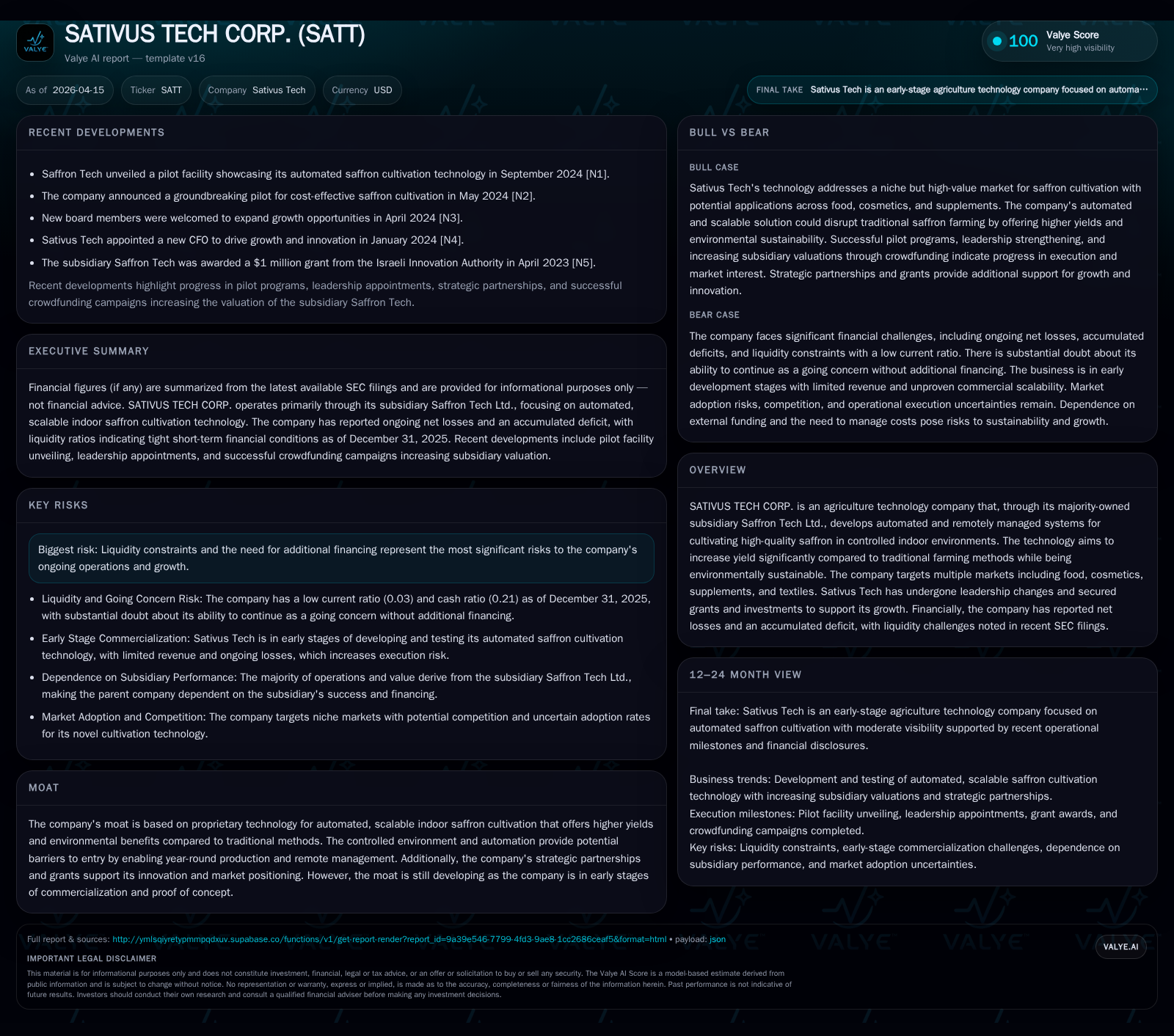
SATIVUS TECH CORP., via its subsidiary Saffron Tech Ltd., pioneers automated indoor cultivation of saffron focusing on enhanced yield and sustainability. Despite technological promise, the company has struggled with steep revenue declines, widening net losses, and negative operating cash flows over recent years. Capital structure complexities and liquidity constraints dominate its current financial landscape, though grants and strategic partnerships offer some growth support. Future progress hinges on successful commercialization and additional financing to sustain operations.
Innovative Core: Automated Indoor Saffron Cultivation Technology
SATIVUS TECH CORP., primarily through its majority-owned subsidiary Saffron Tech Ltd., is positioned at the frontier of controlled environment agriculture (CEA) with a niche focus on saffron cultivation. This technology platform leverages automation and remote operational controls to enable year-round growing cycles in indoor settings—circumventing the seasonal and climatic limitations inherent to traditional saffron farming.
Its proprietary setup aims not only to boost yields significantly over conventional methods but also embeds environmental sustainability into the production process. The system’s remote automation features allow for scalable cultivation without extensive manual intervention, potentially reducing labor costs and enhancing crop consistency. These characteristics form an emerging technical moat that could erect barriers against new entrants by tying production efficiency closely to technological deployment.
The company targets multiple end markets including food flavoring, cosmetics, dietary supplements, and textiles — segments that prize saffron’s high-value properties. However, as the venture remains in the early stages of commercialization, actual market traction and proof-of-concept validation are ongoing.
Historical Financial Performance and Growth Drivers
Financially, SATIVUS’s top-line experienced a dramatic contraction between fiscal years 2016 and 2017 — reported revenues dropped from $137.5k to $36.3k (approximately a 73.6% decline) per [F1]. This sharp revenue fall likely reflects the difficult transition from R&D toward scalable commercial production in a highly specialized AgTech space.
Operating losses have persisted over recent years with operating income deteriorating further to -$1.06 million in FY2025, worsening by about 10.6% compared to the prior year [F1]. Net losses show a similar trend; a net loss of $869k was incurred in FY2025 representing a decline of roughly 27.8% relative to FY2024 results.
Cash flow from operations mirrors this profile of strain with consistent negative output, standing at -$701k for FY2025 alone [F1]. Meanwhile, capital expenditures have sharply diminished by nearly 99% from peaks around $269k in FY2024 down to just $3k in FY2025 — a signal that capacity expansions have paused or capital investment has tightened amid liquidity pressures.
Historical performance (annual)
| FY | Net ($) | CFO ($) | OpInc ($) | Capex ($) | Net YoY |
|---|---|---|---|---|---|
| 2025 | -869000 | -701000 | -1060000 | 3000 | -27.8% |
| 2024 | -680000 | -488000 | -958000 | 269000 | -109.9% |
| 2023 | -324000 | -932000 | -815000 | 79000 | +82.1% |
| 2022 | -1813000 | -986000 | -1333000 | 206000 |
Source: SEC companyfacts cache [F1].
Capital returns and efficiency (annual)
| FY | FCF ($) | ROE% |
|---|---|---|
| 2025 | -704000 | 24.8 |
| 2024 | -757000 | 23.3 |
| 2023 | -1011000 | 14.2 |
| 2022 | -1192000 | 63.7 |
Source: SEC companyfacts cache [F1].
Note: Revenue actuals only available yearly through FY2017; subsequent years reported as unavailable notable losses per [F1].
Analyzing Diminishing Revenue and Worsening Profitability Trends
The precipitous revenue decline early on suggests substantive commercialization hurdles typical of AgTech startups working on novel cultivation technology like CEA-based saffron farming. Conversion of pilot runs into full-scale production often requires overcoming technical refinement issues alongside establishing reliable sales channels targeting premium end markets.
Loss escalation through FY2022-2025 highlights heavy operational burn likely related to ongoing R&D expenses coupled with fixed costs such as leases for indoor farms (noted lease payments approx $60 annually post-December 2024 per [S7]). Furthermore, product commercialization delays or limited market acceptance could depress sales activity further compared to initial business plans.
These factors combined create an adverse profitability backdrop that any nascent agricultural technology must manage during developmental phases amidst stiff capital demands.
Liquidity Constraints and Capital Structure Overview
Liquidity challenges represent one of SATIVUS’s most pressing risks as extensively detailed across quarterly SEC reports ([S3]-[S8], [S24]). The company holds several convertible loans dating back to 2019-2020 that carry annual interest rates near 10%, convertible at prices tied either to fixed rates or discount VWAP triggers — i.e., convertible debt instruments embedded with derivative features valued using complex Monte Carlo simulations employing Black-Scholes-Merton option models.
For example, as of June & September 30th of 2025 the fair value components for these convertible features ranged from ~$33k up to $445k individually depending on loan instrument ([S4], [S6]). These liabilities are marked-to-market regularly reflecting market volatility – share prices noted between $0.038 and $0.13 – highlighting ongoing revaluation impacts on financial statements.
The current ratio stood at an estimated ~0.03 based on December 31, 2022 balance sheet data indicating substantial tightness in current asset coverage relative to short-term liabilities ([F1]). This underpins concerns raised in filings about going concern qualifications due to the need for additional financing over the next twelve months to meet obligations ([S5],[S25]).
Overall debt structure complexity combined with thin liquidity reserves underpins operational risk that must be managed carefully via financing strategies or cost containment.
Future Growth Prospects Backed by Grants and Market Potential
While financial headwinds persist clearly constraining growth momentum thus far, SATIVUS benefits from non-dilutive funding sources such as government grants supporting innovation projects (, [S5]). These grants help offset development costs allowing incremental progress toward scalable commercial deployments.
Moreover,the sizeable addressable markets spanning food flavorings, cosmetics ingredients, nutraceuticals supplements,and textile coloration present meaningful opportunity if production can scale profitably leveraging their automated CEA platform combining higher quality yield advantages sustainably.
Nonetheless,the path forward depends heavily on securing additional capital andreducing operating expenses or achieving commercial revenues sufficientto lessen dependence on capital raises—a typical bottleneck stage within AgTech development lifecycles often dubbed "proof-of-concept" transitioning into "market ramp." Geographical expansion or vertical integration might become relevant strategic options later.
Key Financial Metrics: Operating Cash Flow and Capital Expenditures
Operating cash flow trends underscore continued cash burn reflective of unprofitable operations: CFO was negative throughout recent fiscal years culminating at approximately negative $701k in FY2025 ([F1]).
Capital expenditure scaled back dramatically from FY2024’s ~$269k down almost entirely in FY2025 to about $3k ([F1]). Such capex suppression strongly signals either a pause or slowdown in investment toward growing production capacity or infrastructure modernization possibly forced by cash constraints.
Linking CFO less capex yields free cash flow approximately negative $704k for FY2025 which confirms ongoing outflow pressures risking operational continuity absent external funding initiatives.
Capital Allocation Strategies: ROE, Dividends, and Buybacks Absent
In respect of returns profiles,[F1] reveals absence of dividends or share repurchase programs consistent with SATIVUS’s status as an early-phase growth entity incurring losses and accumulating deficit now exceeding $3.5 million by end-FY2025.
Notably,the approximate return on equity calculation (net income divided by average equity) for FY2025 is positive around ~24.8%. However,this unusual result arises because equity amounts are substantially negative thus mathematically converting heavy net losses into superficially positive ratios; this does not indicate sustainable profitability or shareholder value creation but rather reflects erosion from accumulated deficit.[F1]
At present,the company prioritizes survival via capital preservation instead of capital returns pending scaling viability breakthroughs.
Outlook and Milestones to Monitor in Commercialization Progress
No explicit financial guidance or milestone targets were disclosed recently; therefore,it is prudent analysis practice to delineate "what to watch" elements anchoring expectations:
- Evidence of revenue stabilization or growth reversing multi-year declines would mark key commercial inflection signaling market acceptance.
- Success resolving liquidity challenges via refinancing or new equity issuance remains critical for sustaining R&D activities and operational scale-up efforts ([S5],).
- Continued grant awards or strategic partnerships potentially validate technology efficacy aiding incremental funding cushion.
- Technological achievements verified through third-party validation or customer onboarding would underpin credibility bolstering future expansion prospects.
In summary,SATIVUS embodies the archetype startup AgTech venture: rich technological promise intersecting severe financial hurdles requiring disciplined financing approaches alongside execution precision before sustainable value realization can crystallize.
This analysis is prepared solely for informational purposes drawing exclusively on verified public filings without investment advice implications or price forecasts.
Disclaimer: This is research-only, informational analysis and not investment advice. It may include AI-generated interpretation and general industry context. Always verify important details using primary sources.

Comments