
Elite Health Systems Enters Medicare Advantage Market with Capital and Execution Challenges
Elite Health Systems is launching a Medicare Advantage plan in California, backed by capital raises but with no revenue as it faces substantial operational risks.
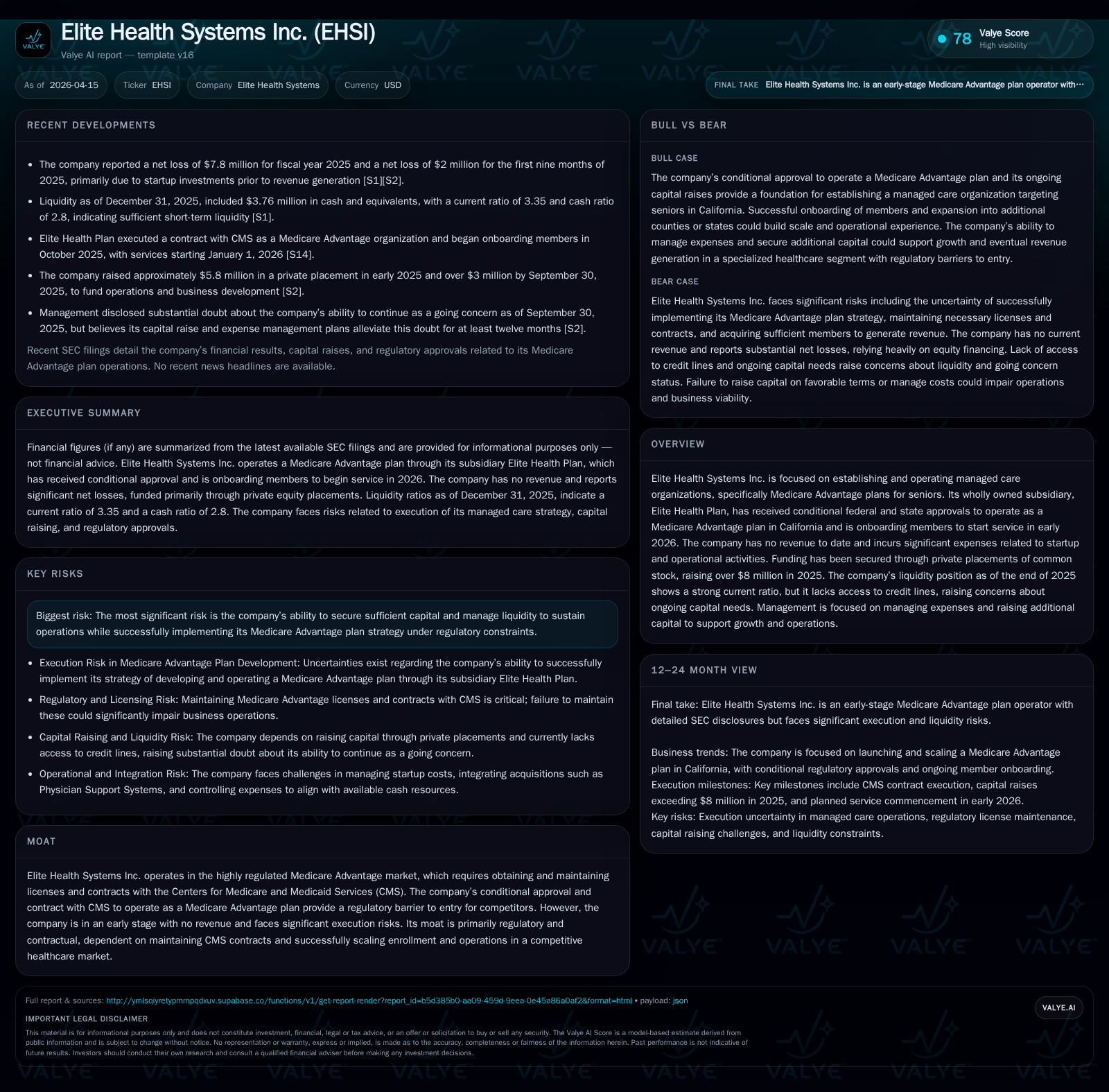
Elite Health Systems Inc. is transitioning from a development stage to an operational phase with its wholly owned Elite Health Plan, which has secured conditional federal and state approvals to begin serving Medicare Advantage members in early 2026 in California. The company has yet to generate revenue, reflecting the typical startup costs associated with entering a tightly regulated healthcare segment. It has funded its operations primarily through private equity placements, raising over $8 million in 2025, but lacks credit access and shows continued net losses that underscore liquidity concerns. Maintaining CMS contracts, scaling enrollment successfully, and securing additional funding are critical to overcoming inherent execution risks tied to market entry and regulatory compliance.
Company Overview and Business Model
Elite Health Systems Inc., through its wholly owned subsidiary Elite Health Plan, is entering the managed care market via Medicare Advantage (MA) plans targeting senior populations primarily within California. The company obtained conditional federal and state approvals including a contract with the Centers for Medicare & Medicaid Services (CMS), qualifying it as a federally recognized Health Maintenance Organization (HMO). This regulatory endorsement establishes significant barriers to entry due to stringent licensing requirements [S1][S6][S23].
The strategic goal is to onboard Medicare beneficiaries starting January 1, 2026, focusing initially on counties such as San Bernadino, Los Angeles, and Riverside. Expansion efforts include exploring licensure in other parts of California and neighboring states like Nevada [S21][S23].
However, Elite faces execution risks related to CMS contract maintenance, bid approvals including formulary acceptance, and completion of pre-implementation system testing necessary before full operations commence [S23].
Historical Financial Performance
As a pre-revenue startup focused on launching MA plans, Elite's financials reflect developmental expenses prior to service delivery.
Historical performance (annual)
| FY | Net ($mm) | CFO ($mm) | OpInc ($mm) | Net YoY |
|---|---|---|---|---|
| 2025 | -8 | -3 | -4 | |
| 2024 | -2 | -2 | ||
| 2023 | -1 | -1 | -1 | +39.0% |
| 2022 | -1 | -1 | -1 | -555.4% |
Source: SEC companyfacts cache [F1].
Capital returns and efficiency (annual)
| FY | ROE% |
|---|---|
| 2025 | -146.9 |
| 2024 | |
| 2023 | -126.5 |
| 2022 | -107.9 |
Source: SEC companyfacts cache [F1].
Net losses expanded substantially in fiscal year 2025 compared to prior years due to increased startup costs associated with Elite Health Plan launch activities including non-cash officer compensation [F1][S2][S12]. Operating cash outflows nearly doubled year-over-year reflecting investments in licensing compliance and infrastructure.
Liquidity Position and Capital Structure
At December 31, 2025, the company held approximately $3.76 million in cash and equivalents against current liabilities of about $1.34 million yielding a current ratio of approximately 3.35 indicating adequate short-term liquidity under normal circumstances [F1]. However:
- The company discloses no access to credit lines or other readily available capital sources apart from equity financing [S4][S10].
- Operating cash flow remains negative consistent with ongoing cash burn during startup [F1].
- Management acknowledges substantial doubt regarding going concern status absent successful additional capital raises [S4][S11].
Equity financing has been the primary source of liquidity with private placements raising more than $8 million during 2024–25 at prices between $0.50 and $0.95 per share including shares issued as officer compensation [S2][S4][S8][S14]. A recent private placement aims to raise an additional $2 million to $5 million to extend operational runway [S8][S21].
No dividends or share repurchases have occurred; capital allocation prioritizes funding startup costs and meeting regulatory milestones [S19][S20][S22].
Future Growth Prospects
Elite’s growth depends on:
- Onboarding Medicare Advantage members beginning early 2026 following CMS contract finalization [S18].
- Growing enrollment within targeted Californian counties leveraging provider networks.
- Managing annual regulatory renewals required by CMS contracts.
- Scaling systems infrastructure post-launch while controlling SG&A expenses.
- Pursuing geographic expansion pending licensure approvals.
- Integrating the anticipated acquisition of Physician Support Systems (PSS), which could broaden services but adds integration risk [S21][S28].
The absence of historical revenue highlights a long path before profitability; timely member acquisition will be key amid competition from established incumbents benefiting from scale and entrenched provider relationships.
Management emphasizes cost discipline and targeted capital deployment as priorities to align spending with available funding [N/A]. However significant risks remain around market acceptance and regulatory compliance.
Milestones and Outlook
While management has not provided explicit financial guidance yet [N/A], upcoming milestones include:
- Commencement of membership enrollment expected Q1 2026.
- Completion of required system testing enabling full CMS contract activation.
- Outcomes of private placement fundraises planned through late 2025 supporting initial commercialization.
- Shareholder votes on equity issuance authorizations critical for further capital raises [S20].
- Progress toward closing PSS acquisition subject to due diligence and shareholder approval.
Monitoring CMS renewal cycles will be crucial given their impact on license continuity alongside tracking member onboarding progress post-launch.
Capital Allocation and Returns Analysis
Return metrics remain negative reflecting pre-revenue investment phase:
- Approximate Return on Equity stands near negative 147% based on latest annual net loss relative to shareholders’ equity balances [F1].
- No free cash flow generation; operating cash outflows exceed capital expenditures indicating upfront licensing infrastructure investments rather than asset accumulation [F1][S12].
- Given lack of earnings distribution capacity coupled with liquidity constraints no dividends or repurchases are feasible currently.
Capital allocation focuses exclusively on operational readiness funded by equity without debt leverage illustrating reliance on investor confidence for sustained funding [S4][S21]. Failure to meet fundraising targets could jeopardize ongoing operations given persistent net losses.
Industry Context (Analysis)
Entry into the Medicare Advantage sector involves navigating demanding regulatory requirements including CMS licensing that extends beyond financial capability assessments to IT readiness and clinical network adequacy. While the aging population drives demand growth opportunities for MA plans targeting seniors, the competitive landscape features established players with scale advantages and integrated provider networks that pose challenges for new entrants like Elite Health Systems focused initially on regional penetration. Balancing cost structures while driving enrollment uptake is particularly difficult without established brand recognition or comprehensive provider integration.
Conclusion
Elite Health Systems is transitioning from a developmental stage into operational rollout for Medicare Advantage offerings in California—a highly regulated healthcare segment marked by formidable entry barriers yet intense competition. Recent private equity raises provide near-term runway but liquidity remains fragile absent further capital infusions or operational breakeven achievement post-launch.
The conditional CMS contract offers legitimacy but requires successful annual renewals matched by effective member recruitment under disciplined expense management. The pending Physician Support Systems acquisition adds strategic breadth but also integration complexities warranting close observation.
Stakeholders should track membership onboarding progress along with liquidity updates as key indicators of whether Elite can surmount typical early-stage hurdles faced by new health plan operators competing against entrenched incumbents within the expansive Medicare Advantage market.
This report is prepared solely for informational purposes based exclusively on publicly filed SEC documents dated through April 15th, 2026 and does not constitute investment advice or recommendations regarding security transactions. Readers should consider inherent uncertainties associated with startups entering regulated healthcare markets before drawing conclusions about future performance.
Disclaimer: This is research-only, informational analysis and not investment advice. It may include AI-generated interpretation and general industry context. Always verify important details using primary sources.

Comments