
Cullen/Frost Bankers: Regional Strength, Capital Management, and the Stakes of Texas-Centric Banking
Cullen/Frost Bankers’ Q3 2026 results highlight robust profitability and liquidity, a disciplined approach to capital management, and a Texas-focused franchise navigating both operational rigor and exposure to economic swings. The planned transfer to the Texas Stock Exchange underscores a strategic emphasis on deepening regional relevance.
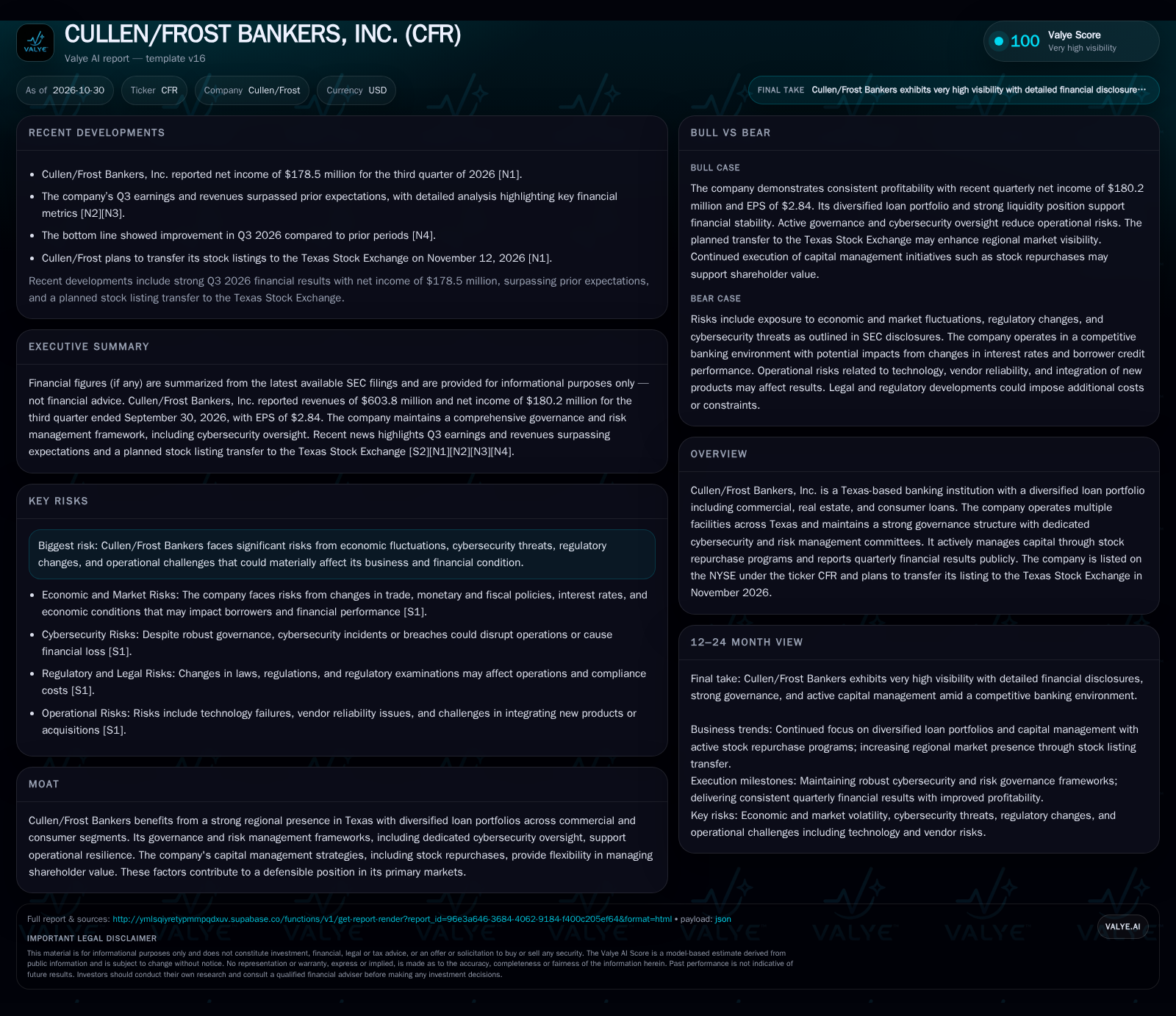
Cullen/Frost Bankers, a Texas-based financial institution, reported Q3 2026 revenues of $603.8 million and net income of $180.2 million. The company maintains a diversified loan portfolio, strong governance (including cybersecurity oversight), and recently authorized a $300 million stock repurchase plan. It will transfer its stock listing to the Texas Stock Exchange in November 2026. Key risks include economic volatility, regulatory change, and operational threats such as cybersecurity and technology reliability. [S2] [N1] [N3] [N4]
Cullen/Frost Bankers, Inc. stands out as a Texas-focused regional bank with a strong record of profitability, disciplined capital management, and a robust risk governance structure. Its Q3 2026 results surpassed expectations, with management signaling continued emphasis on shareholder value through opportunistic stock repurchases and a major upcoming stock exchange transfer. Yet, the company’s fortunes remain tied to regional economic dynamics, operational execution, and evolving regulatory and cybersecurity landscapes—making the next phase of its Texas franchise both a strength and a source of strategic risk.
Q3 Earnings, Liquidity, and Strategic Moves Shape Cullen/Frost’s Outlook
Cullen/Frost Bankers reported Q3 2026 revenues of $603.8 million and net income of $180.2 million, with basic and diluted EPS of $2.84—figures that surpassed prior analyst expectations and marked a positive inflection in bottom-line performance. The company’s liquidity position was significant, with $4.56 billion in cash and cash equivalents as of September 30, 2026. In January 2026, the board authorized a $300 million stock repurchase plan, executed to manage capital and offset dilution. Looking ahead, Cullen/Frost will transfer its stock listing to the Texas Stock Exchange on November 12, 2026, signaling a strategic push to deepen its regional identity and potentially attract a more localized investor base. [S2] [N1] [N3] [N4]
How Cullen/Frost Makes Money: Loan Mix, Spread Dynamics, and Operating Leverage
Cullen/Frost’s business model is rooted in traditional banking: it generates revenue through net interest income on a diversified portfolio of commercial, real estate, and consumer loans. The bank’s Texas-centric footprint enables it to serve a broad array of local businesses and households, which can help balance risk across economic cycles. Net interest margins are a critical driver of profitability, sensitive to both the yield on loans (influenced by regional economic activity and competitive lending rates) and the cost of deposits. Non-interest income, while likely present, is not specified, but typically includes fees from treasury, wealth management, and transaction services.
Operating leverage is a core feature: fixed costs for infrastructure, compliance, and technology are significant, but incremental revenue from loan growth or fee income can drive disproportionate gains in profitability. The company’s capital management—visible in its stock repurchase program—suggests a focus on optimizing capital ratios and returning excess capital to shareholders when organic growth opportunities are limited. Funding needs are largely met through deposit bases, which may be stable in a strong regional economy but could face pressure in downturns or from digital competitors.
Technology and risk management investments (including cybersecurity) represent ongoing costs but may also enable efficiency gains and protect against operational disruptions. The degree to which Cullen/Frost can maintain or grow its net interest margin, manage credit quality, and leverage its operating base will shape future earnings power.
Texas Banking Landscape: Regional Loyalty Versus Scale and Disruption
Cullen/Frost’s competitive strength is anchored in its deep Texas roots, brand recognition, and longstanding relationships with local businesses and consumers. In a state characterized by economic dynamism but also cyclicality, this proximity can confer informational advantages, customer loyalty, and pricing power—especially among small and medium-sized enterprises that value relationship banking.
However, the bank operates in a market crowded with national and super-regional banks, credit unions, digital-first challengers, and non-bank lenders. Larger competitors often have lower funding costs, more diversified revenue streams, and greater technology budgets, while fintech entrants may appeal to younger or price-sensitive customers with seamless digital experiences and higher deposit rates.
Switching costs in commercial banking can be substantial due to integrated services and lending relationships, but consumer segments may be more vulnerable to churn if rivals offer superior digital convenience or promotional rates. Regulatory changes, particularly around capital or lending standards, could also reshape the competitive playing field. Cullen/Frost’s defensibility will depend on its ability to deliver differentiated service, invest in technology, and maintain asset quality through cycles.
If Regional Growth and Disciplined Lending Drive Outperformance
The most favorable scenario for Cullen/Frost is one in which Texas’s economy continues to expand, supporting strong loan demand and credit quality. In this case, the bank’s deep relationships and regional expertise could enable it to capture profitable lending opportunities ahead of larger, less nimble competitors. If net interest margins remain stable or improve, and operating leverage kicks in with limited incremental costs, earnings could grow faster than the broader sector.
Successful execution of the $300 million stock repurchase plan—at attractive valuations—would enhance per-share value and signal capital discipline. The transfer to the Texas Stock Exchange could attract incremental regional investor interest, potentially supporting valuation multiples.
Confirmation of this scenario would require evidence of sustained loan growth, stable or improving credit metrics (such as nonperforming loan ratios), positive trends in net interest margin, and continued outperformance in quarterly results relative to peers. Expansion of fee-based income streams and demonstrable efficiency gains from technology investments would further strengthen the case.
Sustaining Profitability as Economic Tailwinds Moderate
The most plausible outcome is that Cullen/Frost maintains solid profitability but faces a gradually normalizing operating environment. Loan growth could moderate as the Texas economy matures or if interest rates remain high, pressuring both loan demand and net interest margins. Credit quality may deteriorate slightly but remain manageable if underwriting discipline holds.
The bank’s established customer base and diversified loan book help buffer against localized shocks, while ongoing investment in risk management and cybersecurity reduces operational risk. Capital returns via buybacks are likely to continue at a measured pace, balancing shareholder returns and regulatory capital requirements.
Evidence supporting the base case would include modest but steady revenue and net income growth, stable deposit balances, manageable credit losses, and continued execution of governance and cybersecurity initiatives. Signs of competitive encroachment or rising funding costs would challenge this trajectory.
Economic Shocks or Operational Failures Could Derail Momentum
In a downside scenario, a Texas-focused loan book exposes Cullen/Frost to concentrated economic risk—such as a sharp downturn in energy, real estate, or regional employment. A spike in nonperforming loans or credit losses would impair profitability and could force reductions in lending or capital returns.
Operationally, significant technology failures, cybersecurity breaches, or vendor disruptions could result in service outages, regulatory penalties, or reputational harm—especially as digital banking becomes more critical to customer retention. Regulatory changes or adverse examination findings could also increase compliance costs or restrict growth.
This negative scenario would be confirmed by a material deterioration in credit metrics, rising provisions for loan losses, sustained net interest margin compression, or evidence of deposit outflows. Operational red flags would include disclosure of major security incidents, customer attrition, or regulatory sanctions.
What Will Shape Cullen/Frost’s Texas Banking Thesis Going Forward?
Quarterly trends in net interest margin and their drivers—whether from loan yields, funding costs, or competitive pricing shifts—would help test earnings durability.
Sustained or accelerating loan growth, particularly in commercial and real estate segments, would validate regional economic strength and franchise relevance.
Credit quality indicators, such as nonperforming asset ratios and loan loss provisions, if disclosed, are critical to assessing risk management.
Deposit base stability and mix—especially in a rising rate or competitive environment—would signal funding resilience.
Execution and pace of the $300 million stock repurchase program, including average repurchase price and impact on share count, would reveal capital discipline.
Progress on technology and cybersecurity investments, with updates on incidents or regulatory reviews, would clarify operational risk posture.
The impact of the Texas Stock Exchange transfer on trading volume, investor composition, and share liquidity would help gauge the success of this regionalization strategy.
If disclosed, trends in fee-based (non-interest) income would offer insight into revenue diversification beyond traditional lending.
Disclaimer: This is research-only, informational analysis and not investment advice. It may include AI-generated interpretation and general industry context. Always verify important details using primary sources.

Comments