
Hanover Insurance Group: Profit Pressures and Earnings Strength in a Challenging P&C Landscape
Hanover Insurance Group, a U.S. property and casualty insurer, posted Q3 2026 results that exceeded revenue and earnings expectations but showed a year-over-year profit decline.
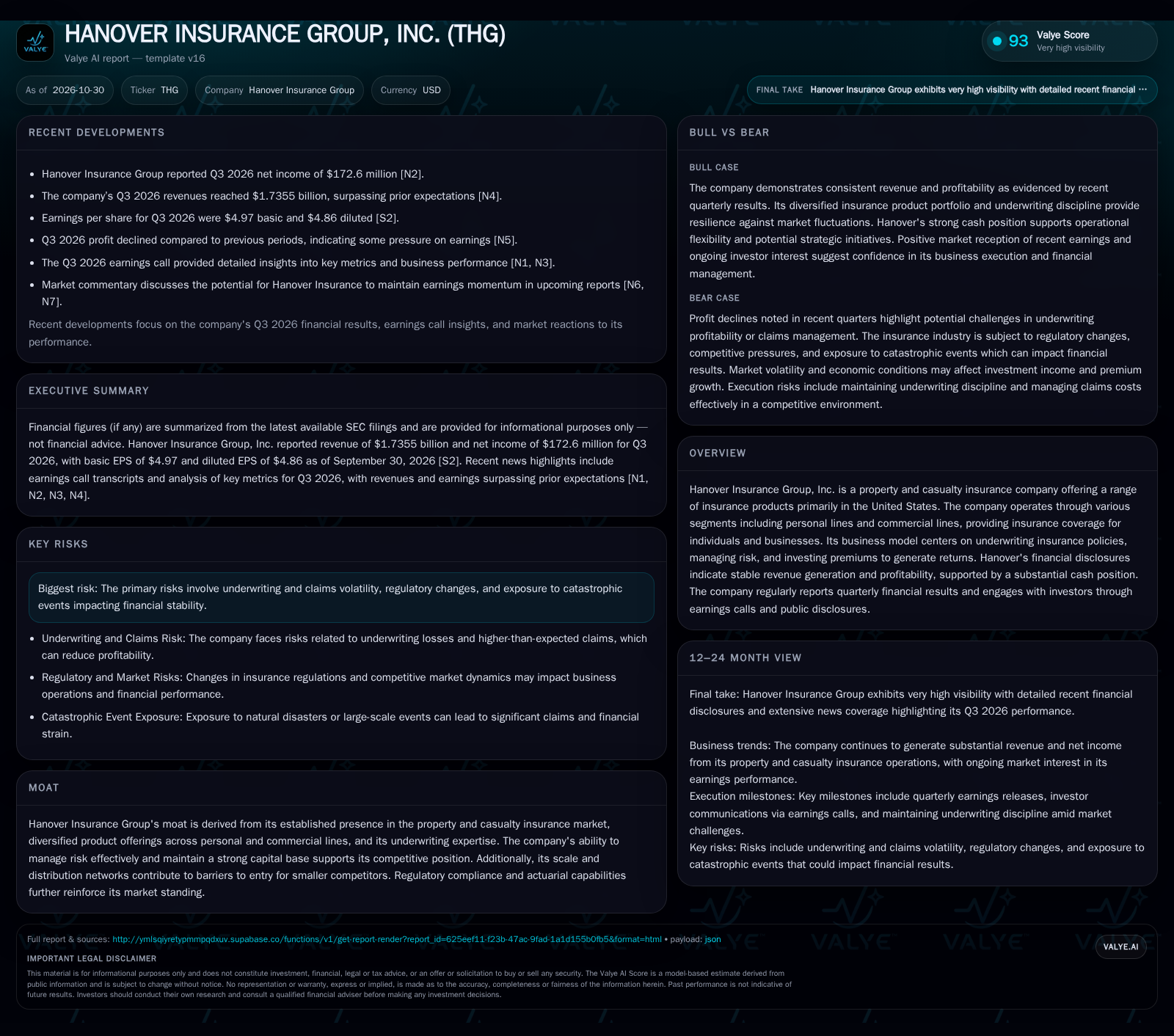
Hanover Insurance Group reported Q3 2026 revenue of $1.7355 billion and net income of $172.6 million, beating consensus expectations but with profits down from prior periods. The next phase for Hanover centers on sustaining earnings momentum while navigating competitive and catastrophe-driven headwinds. [S2] [N2] [N4] [N5]
Hanover Insurance Group’s third quarter 2026 performance captures the crosscurrents facing U.S. property and casualty insurers: the company delivered revenues and earnings that beat expectations, yet its net profit declined compared to prior periods. With a $1.7355 billion top line and $172.6 million in net income, Hanover remains a sizable player with a diversified portfolio and notable cash reserves. However, the interplay of underwriting discipline, claims management, and exposure to catastrophic risk will determine whether Hanover can translate its operational strengths into sustained profitability as competitive and macroeconomic pressures persist.
Earnings Beat Despite Margin Squeeze
Hanover Insurance Group reported Q3 2026 revenue of $1.7355 billion and net income of $172.6 million, translating to basic EPS of $4.97 and diluted EPS of $4.86. These results surpassed analyst expectations, reflecting operational resilience and effective risk management in the short term. However, the company’s profit level declined year-over-year, indicating that while top-line growth or investment returns may have been robust, underlying underwriting margins or claims experience likely faced pressure. Hanover’s cash and cash equivalents stood at $506.3 million as of September 30, 2026, affording a degree of operational flexibility but not eliminating long-term risk. [S2] [N2] [N4] [N5]
Underwriting Discipline and Claims Trends Define Profitability
The core economics of Hanover’s business are defined by its ability to profitably underwrite property and casualty insurance policies while generating investment returns on collected premiums. Revenue is driven by premium volume and pricing discipline across personal and commercial lines, with mix shifts between these segments affecting both growth and margin profile. The company’s cost base is dominated by claims paid and loss adjustment expenses, which can spike due to catastrophic events or adverse trends in frequency and severity. Fixed costs are moderate, with scale effects in underwriting, distribution, and regulatory compliance. Investment income provides a secondary, but sometimes volatile, profit lever. Effective risk selection and prudent reserving are critical for maintaining underwriting profitability. If claims costs rise faster than premium growth or investment returns, operating leverage can swing negative, compressing margins as observed in the recent quarter.
The interplay between underwriting discipline and claims trends is further complicated by the evolving risk landscape, including emerging exposures such as cyber risks, climate change impacts, and shifts in consumer behavior. If Hanover adapts its underwriting models to incorporate these dynamic risk factors effectively, it could sustain or even enhance profitability despite broader market challenges. Conversely, failure to accurately price or reserve for these evolving risks could exacerbate loss volatility and margin compression. Additionally, the timing of premium adjustments relative to claims experience is critical; delayed rate increases can lead to temporary margin erosion, while proactive pricing strategies may improve profitability but risk customer attrition in highly competitive segments.
Competitive Strength Rooted in Scale, Diversification, and Expertise
Hanover operates in a highly competitive U.S. property and casualty market, contending with national multiline carriers, regional specialists, and insurtech entrants. Its competitive strengths rest on product diversification—spanning both personal (auto, home) and commercial (business owners, specialty) lines—and its underwriting expertise, which is essential for managing portfolio risk and pricing. Distribution is achieved through established agent and broker networks, creating some stickiness but also exposing Hanover to channel competition. Larger peers may benefit from broader geographic diversification and deeper technology investment, while niche players can attack specific customer segments. Regulatory barriers, actuarial sophistication, and brand credibility create moderate switching frictions, yet persistent margin pressure and exposure to catastrophic events act as equalizers across the sector.
Hanover’s competitive positioning also hinges on its ability to leverage data analytics and technology to refine underwriting accuracy and improve customer segmentation. In a market where insurtech firms are disrupting traditional distribution and pricing models, incumbents with scale must balance legacy system constraints against the need for digital transformation. If Hanover invests effectively in technology to enhance underwriting precision and customer engagement, it could differentiate itself and reduce loss costs. However, the capital intensity and implementation risks of such initiatives, coupled with potential channel conflicts, mean that gains may be gradual and uneven. The company’s ability to maintain agent and broker loyalty amid shifting customer preferences remains a critical factor in sustaining its market share.
Claims Improvement and Pricing Leverage Could Boost Margins
Hanover’s earnings momentum could accelerate if claims costs moderate—either due to benign catastrophe activity or improved risk selection—and the company successfully raises premiums to offset inflation and loss trends. An upside scenario would be confirmed by a sequential improvement in combined ratios (a key insurance profitability metric), evidence of favorable reserve development, and premium rate increases outpacing claims growth. Enhanced investment returns driven by higher interest rates could further bolster net income, provided asset-liability matching remains prudent. Watch for management commentary on underwriting actions, positive trends in loss frequency/severity, and continued outperformance versus industry peers as signs that margin recovery is underway.
Growth and Margin Stability Face Industry Challenges
The most plausible outlook is for Hanover to maintain stable premium growth and moderate profitability, with underwriting margins pressured by ongoing claims volatility and competitive pricing. This scenario would be characterized by a steady combined ratio near industry averages, periodic earnings beats or misses depending on catastrophe events, and investment income providing a partial buffer. Confirmation would come from relatively flat or slightly improving loss ratios, stable expense ratios, and management reiterating guidance without major revisions. Falsification would occur if claims costs trend persistently higher, premium growth decelerates, or the company is forced to strengthen loss reserves. The ongoing challenge is to balance growth ambitions with risk discipline in a market where both regulatory and weather-driven shocks remain ever-present.
Catastrophe Losses and Pricing Pressure Threaten Profits
Hanover’s earnings could deteriorate materially if the company faces a surge in catastrophe-related claims—such as from hurricanes, wildfires, or other large-scale events—or if competitive pressures force it to underprice risk in order to maintain or grow market share. This scenario would be confirmed by a sharp deterioration in combined and loss ratios, significant adverse reserve development, and management guiding down expectations or taking corrective actions such as portfolio pruning or risk reinsurance at higher cost. A prolonged soft pricing environment, unfavorable regulatory changes, or outsized investment losses could compound the pressure. Watch for large quarterly swings in profitability, negative surprises in reserve development, and external factors like regulatory shifts or climate-driven event frequency as early warning signs.
In addition to catastrophe losses and pricing pressure, regulatory developments pose a material downside risk that could constrain Hanover’s operational flexibility. Changes in capital requirements, mandated coverage expansions, or rate approval processes could increase costs or limit pricing agility, particularly in personal lines. If regulatory environments tighten simultaneously across multiple states where Hanover operates, the cumulative impact could be significant. Furthermore, macroeconomic factors such as inflationary pressures on claims costs or investment portfolio devaluations could compound earnings challenges. A scenario where these factors coincide with elevated catastrophe frequency would likely necessitate more aggressive capital management actions, such as increased reinsurance spending or capital raises, which could dilute returns and investor confidence.
Evaluating Hanover’s Resilience Through Company-Specific Developments
Combined ratio trends—particularly sequential changes and performance relative to industry benchmarks—would provide direct evidence of underwriting discipline and claims management.
Premium growth by segment (personal vs. commercial lines), if disclosed, would help clarify whether Hanover is gaining share in attractive markets or accepting lower-margin business to drive top-line expansion.
Reserve development—favorable or adverse—serves as a key indicator of actuarial accuracy and the adequacy of prior loss estimates.
Net investment income trends and portfolio yield, given the importance of investment returns in supplementing underwriting results, especially in a rising or volatile interest rate environment.
Catastrophe loss disclosures and the company’s use of reinsurance, which affect both earnings volatility and capital protection.
Expense ratio movements, as persistent increases may signal competitive pressure, operational inefficiency, or unproductive growth.
Management’s forward guidance and commentary on market conditions, pricing actions, and risk appetite, offering qualitative signals of strategic direction and confidence.
If disclosed, customer retention rates and channel mix (independent agents vs. direct), which would provide insight into franchise stickiness and vulnerability to channel disruption.
Disclaimer: This is research-only, informational analysis and not investment advice. It may include AI-generated interpretation and general industry context. Always verify important details using primary sources.

Comments