
Crane Co: Integration Focus and Industrial Cycles Shape Post-Portfolio Outlook
Crane Co’s recent divestiture of its Engineered Materials segment and ongoing integration of acquired industrial businesses sharpen its focus on process flow technologies. With Q3 2026 results showing solid profitability and liquidity, the company’s future trajectory hinges on its ability to manage industrial cyclicality, capture synergies, and defend margins in a competitive landscape.
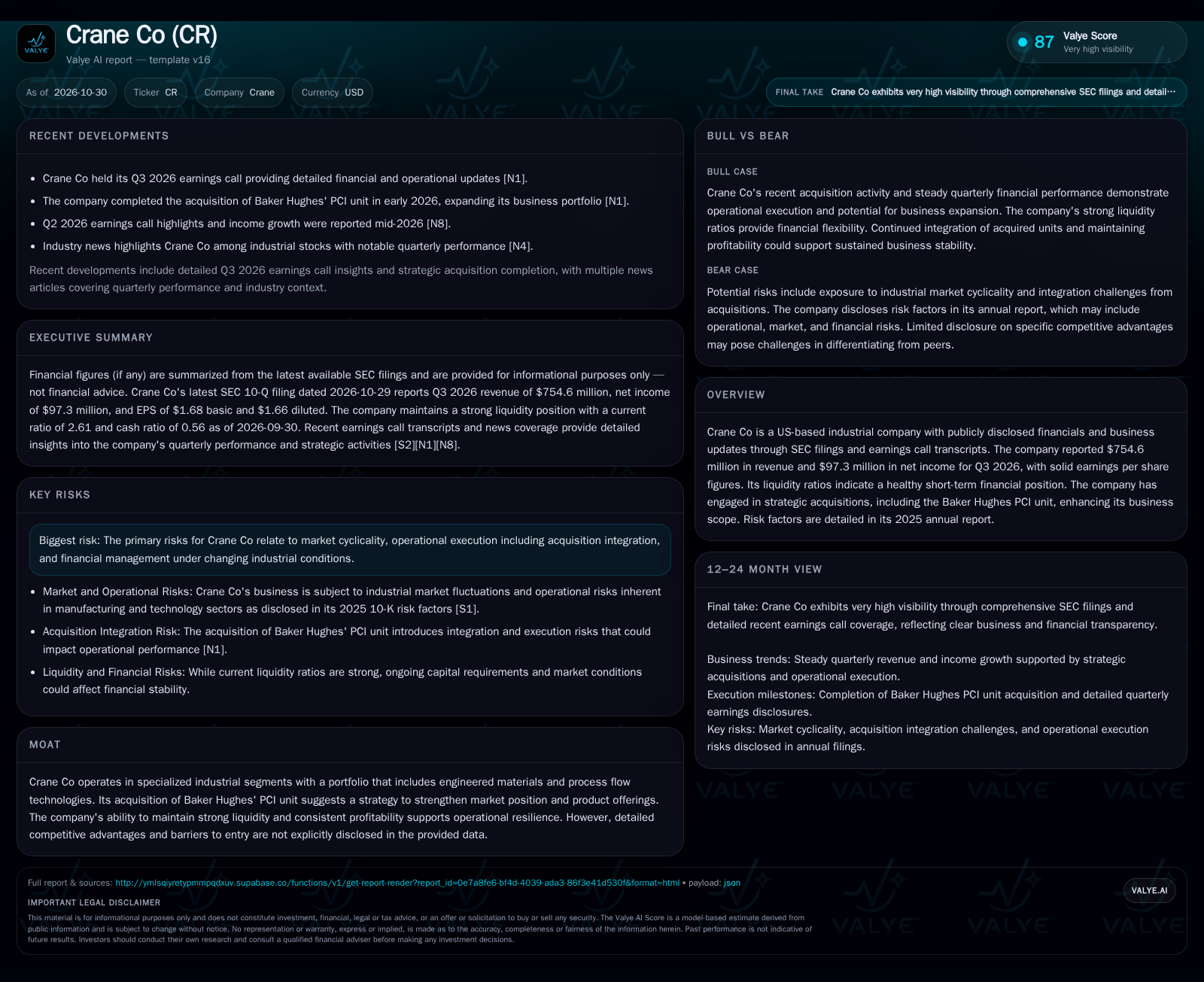
Crane Co reported Q3 2026 revenue of $754.6 million and net income of $97.3 million, following the sale of its Engineered Materials segment and recent acquisitions in process flow technologies. Margin stability and synergy realization are key watchpoints as Crane Co seeks to maintain earnings momentum in a cyclical sector. [S2]
Crane Co is navigating a pivotal transition: after divesting its Engineered Materials segment and acquiring new process flow and measurement businesses, the company now operates with a more focused industrial portfolio. Q3 2026 results demonstrated strong profitability, but the company’s medium-term fortunes will be shaped by its ability to integrate acquisitions, achieve targeted synergies, and withstand the cyclical pressures typical of industrial end markets. As Crane Co moves forward, investors must weigh its operational discipline and potential financial flexibility against risks of integration drag and market volatility.
Q3 2026 Financials Reflect Impact of Portfolio Adjustments
Crane Co reported Q3 2026 revenue of $754.6 million and net income of $97.3 million, resulting in diluted earnings per share of $1.66 [S2]. These results come after a period of significant portfolio change: the company completed the sale of its Engineered Materials segment in early 2025, generating a pre-tax gain of $43.5 million and sharpening its focus on process flow and measurement technologies [S2]. Recent business scope expansion includes the acquisition of pressure and flow technology units, positioning Crane Co more squarely in specialized industrial markets. The company reported cash and liquidity metrics for the period; these figures do not by themselves establish operating runway, investment capacity, financial flexibility, or financing capacity. [S2] The current context is defined by strong reported profitability, a streamlined business mix, and ongoing integration of new assets.
Economic Factors Influencing Crane Co After Key Transactions
Following the divestiture of its Engineered Materials segment, Crane Co’s earnings profile is now more closely tied to the economics of process flow, measurement, and control technologies. These businesses typically offer a mix of original equipment sales and higher-margin aftermarket or service revenues. If Crane Co’s acquired units have meaningful recurring service or parts revenue, this could enhance gross margins and reduce volatility compared to pure equipment cycles. Pricing power in these segments often depends on technological differentiation, switching costs, and customer mission-criticality—factors that can sustain premium margins if successfully executed.
Operating leverage is likely to be a central consideration: industrial companies with high fixed costs can see significant margin expansion in upcycles, but face risk of sharp contraction in downturns if volumes drop. The company’s ability to realize synergies from recent acquisitions—by consolidating manufacturing, optimizing procurement, or cross-selling—will directly affect its cost structure and profitability. Capital requirements may increase in the short term as integration investments are made, but could moderate if Crane Co achieves scale advantages and operational efficiencies. The balance between variable and fixed costs will determine how much of incremental revenue converts to profit as demand fluctuates.
Navigating Differentiation Through Specialization and Technology
Crane Co operates in highly specialized industrial markets, where differentiation often hinges on engineering expertise, reliability, and the ability to meet stringent customer specifications. Its recent acquisitions in process flow and measurement technologies suggest a strategic focus on segments with high technical barriers and mission-critical applications. However, the competitive environment includes large diversified industrials, niche technology specialists, and global suppliers—many with significant R&D and scale advantages.
Barriers to entry in these markets can be substantial due to qualification requirements, long sales cycles, and the need for established service networks. That said, customer loyalty is not absolute—switching costs may be meaningful but not prohibitive if a competitor offers superior performance or cost savings. The risk is that, without clear technological or cost advantages, Crane Co could face pricing pressure, especially during cyclical downturns. The company’s ability to continuously innovate and deepen customer integration will be crucial to defending share and maintaining margin.
Earnings Growth Fueled by Synergies and Service Mix Optimization
If Crane Co successfully integrates its recent acquisitions and shifts its revenue mix toward higher-margin aftermarket and service offerings, it could achieve structurally higher profitability. Realized synergies—such as consolidated supply chains, manufacturing efficiencies, and cross-selling opportunities—would support both margin expansion and cash generation. If the company is able to leverage technological differentiation to command premium pricing, this could further insulate margins from commodity-like competition.
Evidence supporting this scenario would include sustained improvements in gross and operating margins, growth in service/aftermarket revenue as a percentage of total sales (if disclosed), and positive commentary on integration progress from management. Additional confirmation would come from new contract wins with major industrial or infrastructure customers, and a track record of stable or rising free cash flow through multiple quarters.
Consistent Results Anchored by Disciplined Operational Execution
The most plausible scenario is that Crane Co delivers steady, if unspectacular, performance as it consolidates recent acquisitions and operates through normal industrial cycles. Revenue and earnings may show some quarter-to-quarter volatility consistent with end-market demand swings, but disciplined cost control and a diversified customer base could help limit downside. Integration efforts may yield gradual cost savings, though the full benefit may take time to materialize.
This scenario would be confirmed by consistent, if incremental, margin performance, ongoing generation of operating cash flow, and absence of major integration setbacks or cost overruns. Moderate organic growth and retention of key customer relationships would further support the thesis. Evidence to the contrary would include persistent margin erosion, operational disruptions, or loss of material contracts due to competitive pressure.
Margin Pressures from Integration Challenges and Industry Cyclicality
If Crane Co encounters significant challenges integrating its acquisitions—such as systems incompatibility, cultural friction, or unexpected cost overruns—the anticipated synergies may not materialize, weighing on margins and cash flow. Compounding this, a broad industrial downturn could drive sharp declines in equipment orders, while fixed costs remain elevated post-acquisition. The company’s earnings could become more volatile, particularly if aftermarket/service revenue does not scale as expected.
Downside evidence would include declining gross and operating margins, negative operating cash flow, or a spike in restructuring and integration costs. Additional warning signs would be management guidance cuts, customer attrition, or increased reliance on short-term financing to support working capital. Failure to defend pricing or loss of key contracts to competitors would further undermine the company's earnings stability.
Crane Co’s Transformation: Key Developments to Monitor
Gross and operating margin trends over the next several quarters: sustained improvement would support the synergy and service-mix thesis.
Progress on integration milestones—such as cost savings, facility consolidation, or IT systems harmonization—if disclosed by management.
Organic revenue growth rates in core process flow and measurement businesses, separate from acquisition contribution.
Aftermarket and service revenue as a share of total sales, if disclosed, to gauge margin resilience.
Contract win announcements or major customer renewals, particularly in infrastructure, energy, or industrial verticals.
Working capital trends and free cash flow generation, especially during periods of demand volatility.
Any commentary or disclosure of pricing dynamics and competitive landscape shifts in earnings calls or filings.
Disclaimer: This is research-only, informational analysis and not investment advice. It may include AI-generated interpretation and general industry context. Always verify important details using primary sources.

Comments