
ACCO Brands: Margin Expansion, Strategic Diversification, and the Stakes of Consumer Product Reinvention
ACCO Brands enters late 2026 with improved operating margins and a key expansion into gaming and computer accessories through its Trust acquisition. The company’s challenge now is to realize integration benefits and defend profitability in a competitive, commoditizing sector with rising costs and evolving consumer behaviors.
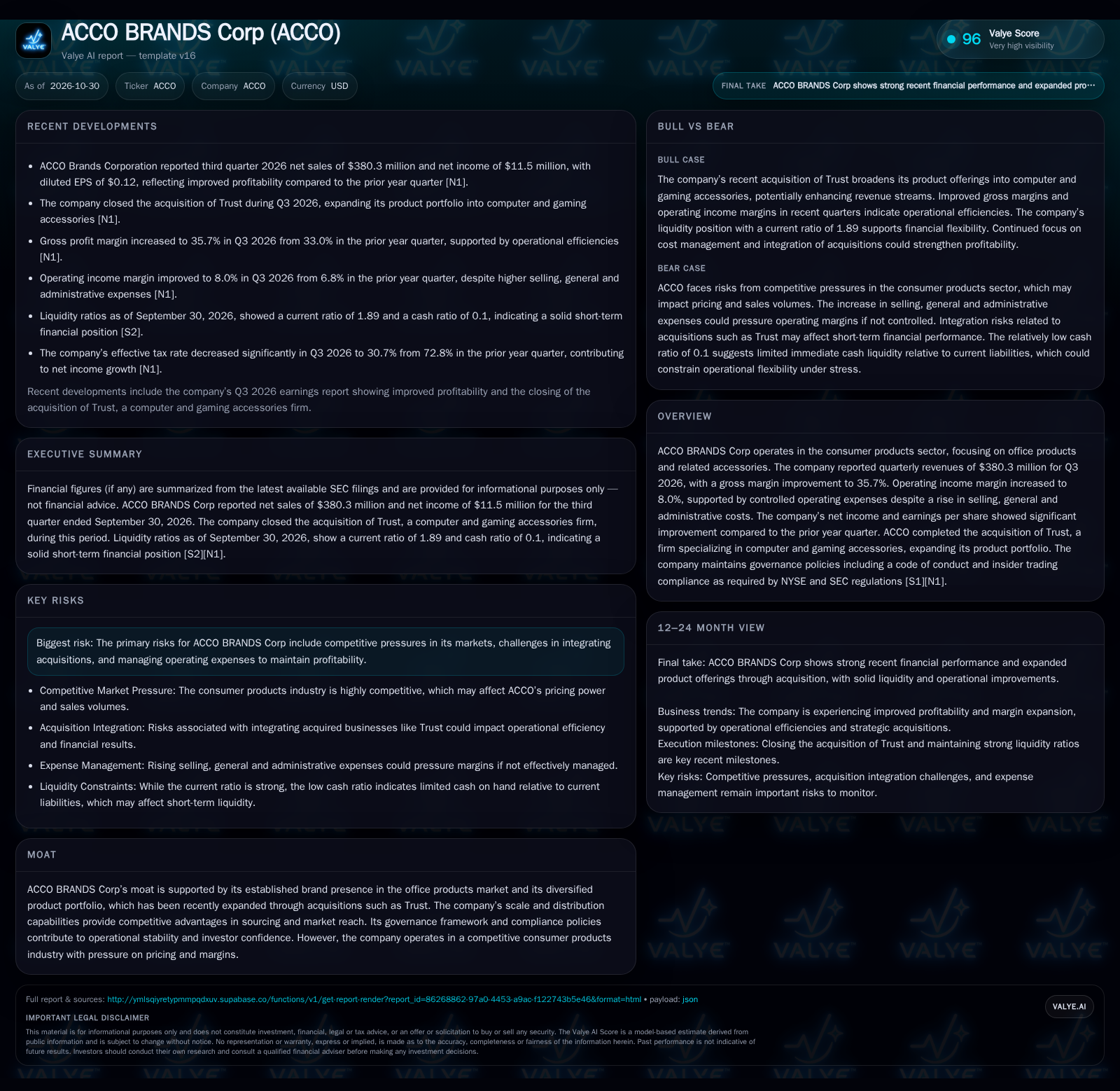
ACCO Brands reported Q3 2026 net sales of $380.3 million, with operating income margin improving to 8.0%. The acquisition of Trust extends ACCO’s reach into computer and gaming accessories. While operational leverage and cost control have supported margin gains, the company faces competitive pressure and integration risks as it shifts toward higher-growth adjacencies. [S2] [N1]
ACCO Brands’ latest quarter shows a company in transition. While legacy office product sales remain sluggish, operational discipline and margin improvement are evident—most notably, an 8.0% operating income margin in Q3 2026. The recent acquisition of Trust signals a strategic pivot toward higher-growth segments like gaming and computer accessories, but also introduces new integration and competitive risks. As ACCO seeks to balance cost pressures with portfolio diversification, its ability to translate scale and distribution advantages into sustainable profitability will be tested.
Recent Results and Strategic Moves Reshape the Outlook
ACCO Brands reported Q3 2026 net sales of $380.3 million, a slight year-over-year decline of 0.9%. Yet, for the first nine months of 2026, sales grew 3.9%, signaling some underlying growth momentum despite quarterly fluctuations [S2] [N1]. Operating income margin improved significantly to 8.0% from 6.8% in the prior year, reflecting operational efficiencies and cost management. The company completed its acquisition of Trust, a firm specializing in computer and gaming accessories, during Q3 2026, marking a deliberate expansion beyond traditional office products [N1]. The company reported cash and liquidity metrics for the period; these figures do not by themselves establish operating runway, investment capacity, financial flexibility, or financing capacity. [S2]
Margin Leverage, Product Mix, and the Challenge of Portfolio Transition
ACCO’s business model historically relies on high-volume, low-to-mid margin office products distributed through mass retail, e-commerce, and direct channels. Gross margin expansion to 35.7% in Q3 2026 and improved operating margin suggest the company is capturing some operational leverage, possibly through procurement, supply chain optimization, or product mix shift [S2] [N1]. However, rising selling, general, and administrative expenses—$93.7 million in Q3 2026, up from $87.4 million—underscore ongoing cost inflation and the resources required for integration and expansion [S2].
The Trust acquisition brings access to the faster-growing computer and gaming accessories market, which typically offers higher margins and less seasonality than legacy office supplies. However, these adjacencies often demand more R&D, marketing, and channel investments, making fixed costs less scalable and introducing new margin volatility. Capital needs may rise as ACCO invests in product development and inventory for the expanded portfolio, potentially putting pressure on free cash flow if integration synergies are slow to materialize.
Further complicating the margin dynamics is the inherent tension between scale economies and the diversification into product categories with distinct cost structures. While ACCO’s legacy office supplies benefit from streamlined manufacturing and established supplier relationships, the newer gaming and computer accessories segment may require more specialized components and shorter product life cycles, increasing the risk of obsolescence and inventory write-downs. This shift necessitates a more agile supply chain and potentially higher working capital intensity, which, if not managed carefully, could offset margin gains achieved through operational efficiencies. Moreover, the balance between fixed and variable costs may shift, with higher R&D and marketing expenses diluting margins in the near term before scale benefits accrue.
Competitive Pressures and the Search for Defensible Growth
ACCO’s core office products face commoditization and price pressure from both branded and private label competitors, including global consumer products conglomerates and regional specialists. The company’s scale, distribution reach, and established brands have historically supported its share in mature channels, but these advantages are eroding as digital workflows reduce paper-based demand and as retailer consolidation strengthens buyer power.
The move into gaming and computer accessories via Trust pits ACCO against specialized peripherals brands and consumer electronics giants, many of whom can outspend on innovation and marketing. While the Trust acquisition offers portfolio diversification and access to higher-growth segments, success will depend on ACCO’s ability to differentiate through brand, channel execution, and integration speed. If ACCO can leverage its distribution and procurement scale, it may offset some of the margin pressure endemic to both legacy and new categories. However, the risk of integration missteps or underinvestment in innovation remains high.
The competitive landscape in gaming and computer accessories is characterized by rapid innovation cycles and strong brand loyalty, which can create entry barriers despite ACCO’s distribution strengths. Success in these segments often depends on continuous product refreshment and responsiveness to consumer trends, which may require a cultural and organizational shift within ACCO. Additionally, channel dynamics differ; e-commerce and specialty retailers dominate gaming peripherals, demanding tailored marketing and customer engagement strategies. If ACCO’s existing sales and marketing infrastructure cannot adapt effectively, the company risks underperforming relative to incumbents. Conversely, leveraging data analytics and consumer insights could enable more targeted product development and inventory management, potentially creating a defensible competitive position over time.
If Integration Succeeds and Mix Shifts, Margin Expansion Could Outpace Expectations
A favorable outcome would see ACCO quickly and effectively integrating Trust, leveraging its distribution network to scale sales of higher-margin computer and gaming accessories. If the company successfully cross-sells to existing retail and e-commerce partners, it could accelerate top-line growth and achieve operating leverage as fixed costs are spread over a broader base. Sustained gross margin improvement, continued improvement in operating income margin, and a decline in SG&A as a percentage of sales would confirm this scenario.
Evidence supporting this view would include consecutive quarters of mid-single-digit or better sales growth, stable or rising gross and operating margins, and explicit management commentary on realized synergies from the Trust integration. A reduction in inventory days and improved free cash flow would further support the thesis that ACCO is managing the transition efficiently and capturing incremental value from its expanded product mix.
Operational Progress, but Growth and Margin Gains Remain Incremental
The most plausible trajectory is that ACCO delivers modest sales growth, with margin improvement primarily driven by ongoing cost management and gradual portfolio diversification. Legacy office product sales are likely to remain flat or decline, partially offset by gains in the computer and gaming accessories segment. Integration costs from the Trust acquisition could weigh on near-term profitability, and SG&A may remain elevated as the company invests in new category marketing and channel development.
This scenario would be confirmed by quarterly revenue growth in the low single digits, stable operating margins in the 7–8% range, and periodic increases in working capital requirements as the company adjusts to new inventory and distribution needs. Management’s ability to hold or improve margins despite cost inflation and competitive pricing pressure would be a key indicator that ACCO is managing the transition effectively, but without a breakthrough in either growth or profitability.
Integration Headwinds or Category Slowdown Could Reverse Margin Gains
If the integration of Trust is slower or costlier than anticipated, or if the gaming and computer accessories market underperforms, ACCO could see operating margins erode as SG&A rises faster than revenue.
Downside confirmation would include flat or declining total revenue, margin contraction, negative free cash flow, and rising days sales outstanding or inventory days. Management discussion of integration challenges, missed synergy targets, or competitive losses in key categories would further validate this scenario.
Benchmarks for Testing ACCO’s Portfolio Transition and Profitability Ambitions
Quarterly revenue growth in the computer and gaming accessories segment (if disclosed) would help determine if the Trust acquisition is driving material expansion.
Gross and operating margin trends, especially in the context of rising SG&A, will test whether cost management and mix shift are sustainable.
Inventory turnover and days sales outstanding metrics would clarify whether working capital is being managed efficiently post-acquisition.
Explicit disclosure of realized synergies and integration costs related to Trust in management commentary or filings would validate the pace and effectiveness of portfolio integration.
Trends in free cash flow and capital expenditures will signal whether the company can self-fund growth and weather category volatility.
Market share estimates in both legacy office and new accessory categories (if available) would indicate competitive positioning and the success of diversification.
Any changes in customer concentration or channel mix could reveal risk exposure to large retailers or e-commerce platforms.
Disclosures regarding new product launches, channel partnerships, or innovation investment would help gauge ACCO’s ability to differentiate in new markets.
Disclaimer: This is research-only, informational analysis and not investment advice. It may include AI-generated interpretation and general industry context. Always verify important details using primary sources.

Comments