
BrasilAgro in 2026: Real Estate Scale, Merger Integration, and the Challenge of Value Creation in Brazilian Farmland
BrasilAgro’s recent merger with Agrifirma Agro Ltda., R$30 million interim dividend, and steady liquidity ratios spotlight a company navigating Brazilian regulatory complexity while seeking scale in agricultural real estate. The question is whether operational integration and disciplined asset management can outpace regulatory and market headwinds.
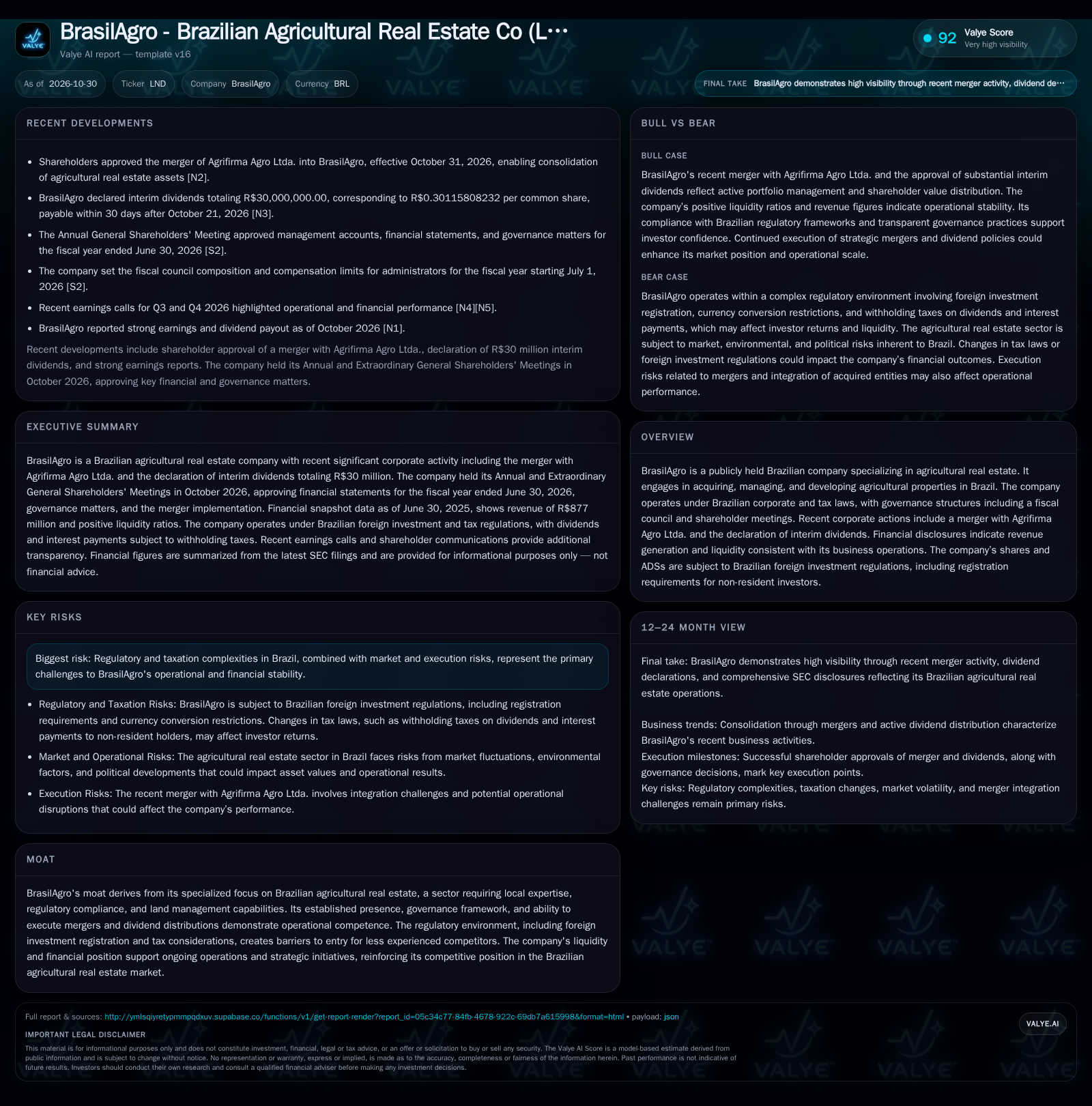
BrasilAgro is consolidating its presence in Brazilian agricultural real estate with a completed merger and robust dividend payout. The thesis turns on successful merger execution and sustained real estate value growth against a backdrop of complex Brazilian tax and investment rules. [S2] [N1] [N3]
BrasilAgro, a leading player in Brazilian agricultural real estate, is in a critical phase marked by its recent merger with Agrifirma Agro Ltda. and the distribution of R$30 million in interim dividends. As BrasilAgro pursues growth through scale and capital returns, its ability to manage merger execution, navigate Brazil’s intricate tax environment, and sustain land value appreciation will determine whether it can deliver superior returns in a volatile sector. [S2] [N1] [N3]
The cited source reports dividend-related activity; that disclosure alone does not establish dividend-policy continuity, management confidence, or a material constraint on capital
BrasilAgro completed its merger with Agrifirma Agro Ltda., a move that expands its agricultural land portfolio and may diversify its operational base. Shareholders approved the merger and related governance matters at the October 2026 Annual General Meeting. [S2] [N2]
The company declared interim dividends totaling R$30 million, or R$0.30 per common share, to be paid within 30 days of October 21, 2026. This payout underscores a willingness to return cash to shareholders while managing ongoing integration. [N3]
Financial data as of June 30, 2025, show revenue of R$877 million, a current ratio of 2.05, and a cash balance of R$142.9 million. These metrics suggest a relatively reported balance sheet position amid corporate transformation. [S1]
Dividend and interest payments remain subject to Brazilian withholding taxes and foreign investor regulations, which could influence net returns for international shareholders. [S1]
How Scale and Asset Management Drive Value in Agricultural Real Estate
BrasilAgro’s core economics depend on acquiring, improving, operating, and divesting agricultural properties. Revenue is generated from a mix of land sales, crop production, and potentially leasing, though the report does not specify the revenue mix or contract structures. If land sales remain a primary driver, results may be lumpy and sensitive to the timing and size of transactions.
The merger with Agrifirma Agro Ltda. could provide operating leverage if fixed costs are spread over a larger asset base, but this depends on effective integration and cost discipline. Improvements in land productivity or asset repositioning may unlock incremental value, especially if acquired properties have underutilized potential.
Brazil’s tax and regulatory regime, including withholding taxes and currency controls, shape net returns for both local and foreign investors. These factors influence the attractiveness of holding agricultural real estate as an asset class and may affect the company’s ability to access global capital efficiently.
A crucial factor influencing BrasilAgro’s value creation is the elasticity of land prices relative to macroeconomic variables such as commodity prices, interest rates, and inflation. If commodity prices remain robust, demand for productive farmland may increase, supporting land appreciation. Conversely, rising interest rates could elevate the cost of capital and reduce investment appetite, potentially dampening land price growth. Additionally, inflationary pressures might raise input costs, constraining operating margins unless offset by higher crop prices or land value gains. The interplay of these macro factors conditions the timing and scale of asset sales, affecting revenue volatility and cash flow predictability.
Barriers, Local Expertise, and the Realities of Brazilian Land Investment
BrasilAgro’s competitive position rests on its ability to navigate Brazil’s complex land ownership, regulatory, and environmental frameworks. Local expertise in land acquisition, regulatory compliance, and agricultural management provides an edge over less experienced or foreign entrants, especially given restrictions on foreign land ownership and investment registration requirements.
The recent merger may bolster scale advantages, but integration risk is non-trivial. Larger property portfolios may offer improved bargaining power with suppliers and buyers, but also expose the company to greater operational and weather-related risks.
Competition comes from other large-scale Brazilian landowners, agricultural operators, and investment funds targeting farmland as an asset class. Substitutes include direct farming by multinationals, alternative land investments, and financial instruments tied to agricultural production. The ability to consistently generate above-market returns depends on disciplined asset selection, operational efficiency, and regulatory agility.
Environmental, social, and governance (ESG) concerns are increasingly material in the sector, with potential for regulatory tightening or reputational risk affecting access to capital and customer relationships.
If Integration Yields Synergies and Land Values Appreciate
The most optimistic outcome for BrasilAgro is that the integration of Agrifirma Agro Ltda. proceeds smoothly, capturing synergies through shared best practices, economies of scale, and cost rationalization. If property values in Brazil continue to rise—due to structural demand for food, biofuels, or export crops—BrasilAgro could realize outsized gains on future land sales or leasing.
A successful track record of post-merger operational improvements and asset monetizations would likely be confirmed by above-trend revenue growth, margin expansion, and repeat dividend increases. Evidence would include sustained high returns on invested capital, a rising asset base without proportional increases in costs, and continued shareholder payouts without balance sheet strain.
Further, if regulatory conditions remain stable or improve (e.g., streamlined foreign investment processes or tax incentives), BrasilAgro could broaden its pool of potential investors and lower its cost of capital.
Disciplined Execution Amid Regulatory and Market Volatility
The most plausible outcome is that BrasilAgro achieves moderate growth through disciplined management of its expanded portfolio, with periodic land sales and steady operational improvements offsetting integration costs and regulatory friction.
Revenue and earnings may remain volatile, reflecting the timing of significant land transactions and agricultural production swings. Management’s ability to navigate Brazilian tax and investment rules remains a critical differentiator but does not fully insulate the company from macroeconomic or policy shocks.
Material deviation from this pattern—such as a sharp drop in asset values or a spike in integration costs—would challenge the base case.
Integration Setbacks or Regulatory Shocks Undermine Value
In an adverse scenario, merger integration proves more disruptive than expected, resulting in operational inefficiencies, missed synergies, or unanticipated costs. If land or commodity prices decline, or if environmental or political developments reduce property values, revenue could fall short of expectations and dividend payouts may be reduced or suspended.
A sudden tightening of Brazilian foreign investment regulations, increases in withholding taxes, or new currency controls could further erode investor returns—particularly for non-resident shareholders. Such regulatory shocks could also limit access to external capital or force asset sales at unattractive prices.
Confirmation of this scenario would come from missed financial targets, deteriorating liquidity metrics, one-off impairment charges, or the need to raise dilutive capital.
Milestones and Metrics That Will Validate or Challenge the BrasilAgro Thesis
Progress reports on the operational and financial integration of Agrifirma Agro Ltda., including synergy realization and cost control, would help test whether the merger delivers value.
Land transaction volumes and realized prices—if disclosed—would clarify whether BrasilAgro is capturing value from its property portfolio or facing market headwinds.
Changes or disruptions in Brazilian tax, currency, or foreign investment regulations that materially affect net returns, capital access, or investor sentiment.
Management commentary on property pipeline, asset improvement projects, and capital allocation priorities in quarterly or annual reports.
Any reported impairments, write-downs, or material delays in asset sales or project execution could serve as early indicators of downside risk.
Updates on ESG compliance, land use, or environmental litigation would help assess reputational and regulatory risk in an evolving sector.
Disclaimer: This is research-only, informational analysis and not investment advice. It may include AI-generated interpretation and general industry context. Always verify important details using primary sources.

Comments