
Sensient Technologies in 2026: Natural Color Transition, Margin Dynamics, and the Stakes of Ingredient Differentiation
Sensient Technologies is advancing its transition from synthetic to natural colors, posting rising profits and an increased FY26 EPS outlook. The critical question is whether its investments in natural ingredient capacity and R&D can drive sustainable pricing power and defend margins amid rising input costs and intensifying global competition.
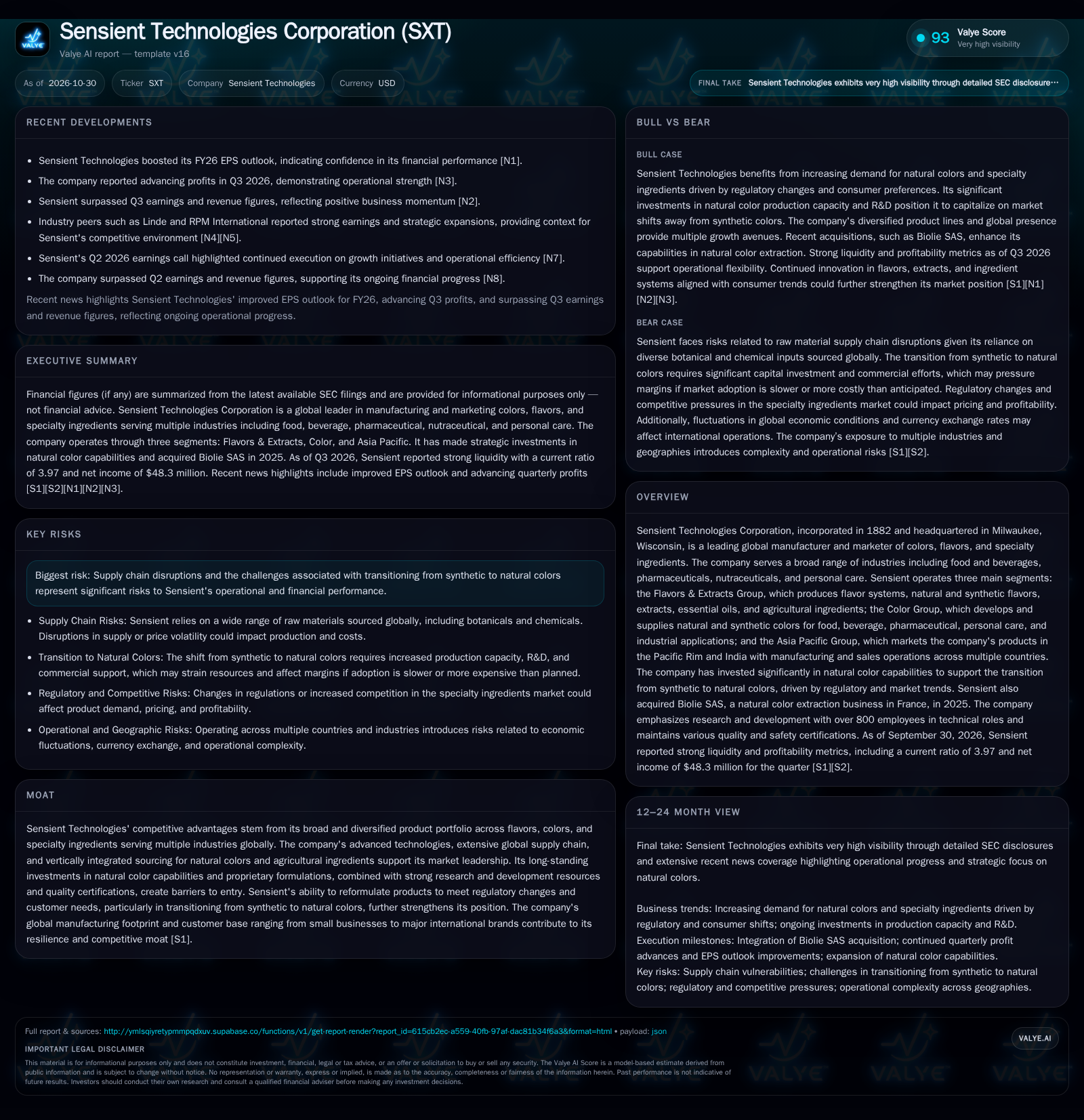
Sensient Technologies is capitalizing on the global shift toward natural colors and specialty ingredients, posting strong Q3 2026 profits and raising its EPS outlook. The company’s investments in natural color capacity, amplified by the 2025 Biolie SAS acquisition, position it for further growth if adoption accelerates. However, supply chain complexity and the cost of transition present ongoing risks, with long-term margin resilience hinging on the company’s ability to leverage its R&D and vertical integration.
Sensient Technologies stands at a strategic crossroads as it advances through 2026: the company is not only reporting rising profits and a more optimistic EPS outlook, but also doubling down on its transition from synthetic to natural colors in response to regulatory and market demand. Its recent acquisition of Biolie SAS and heavy R&D investment underscore a commitment to specialty ingredient innovation. Yet, as Sensient juggles the challenges of global supply chains and the economics of natural ingredient production, the central question is whether these investments will translate into durable margin expansion and defensible market share—or if intensifying competition and cost pressures will erode the company’s edge.
Profitability and Strategic Investment Shape Sensient’s 2026 Trajectory
Sensient Technologies reported net income of $48.3 million for Q3 2026, with basic EPS of $1.14 and diluted EPS of $1.13, reflecting a period of advancing profitability [S2]. The company boosted its full-year 2026 EPS outlook, supported by operational gains and the continued execution of growth initiatives [N1] [N3]. Notably, Sensient’s recent acquisition of Biolie SAS in France enhances its natural color extraction capabilities, a move aligned with both regulatory trends and evolving consumer preferences for natural ingredients [S1]. The company’s commitment to R&D, with over 800 employees in technical roles, further signals a focus on innovation and quality [S1]. These developments matter because they highlight Sensient’s dual strategy of near-term profit delivery and long-term positioning in higher-value, regulation-driven market segments.
How the Shift to Natural Ingredients Could Reshape Sensient’s Margin Structure
Sensient’s core business economics hinge on the ability to command premium pricing for specialty ingredients—especially natural colors and flavors—while balancing the capital and operational costs of global sourcing, R&D, and quality assurance. In the traditional synthetic color and commodity flavor markets, gross margins are typically pressured by price-based competition and customer bargaining power. The pivot to natural ingredients, however, introduces the potential for higher margins if Sensient’s proprietary extraction processes, certifications, and vertical integration can translate into product differentiation.
The company’s investment in natural color capacity and the acquisition of Biolie SAS suggest a bet on both volume and mix: capturing incremental demand from customers reformulating away from synthetics, and upselling more complex, higher-value ingredient systems. However, this transition is capital intensive—requiring not just new extraction facilities but also supply chain investments and potentially higher raw material costs due to agricultural volatility. Fixed costs in R&D and quality infrastructure may create operating leverage if adoption scales, but also increase downside risk if demand is slower than expected. Ultimately, Sensient’s economic model will be tested by its ability to secure price premiums, maintain supply reliability, and defend its margins against input cost inflation and competitive pricing pressure.
Differentiation in a Crowded Specialty Ingredients Market
Sensient competes in a global landscape populated by large ingredient conglomerates, regional specialty players, and emerging natural color startups. Its competitive strengths include a diversified product portfolio, vertical integration in selected agricultural ingredients, and a global manufacturing and sales footprint [S1]. The company’s ability to formulate custom solutions and secure quality certifications (e.g., ISO, GFSI) can serve as a barrier to entry, especially in regulated food, pharma, and personal care markets.
A central question is whether Sensient’s investments in R&D and proprietary extraction processes will yield genuine switching costs or customer lock-in. If its natural color and flavor systems can be tightly integrated into customer products—requiring complex reformulation to change suppliers—Sensient may enjoy superior retention and pricing power. However, competition is intensifying as both established multinationals and newer entrants ramp up their own natural offerings. Regulatory changes that mandate or incentivize natural ingredients could expand the addressable market, but may also lower differentiation if natural colors become commoditized. Sensient’s long-term moat will depend on maintaining a technology and quality lead, as well as deepening relationships with strategic customers.
Accelerated Natural Color Adoption Unlocks Margin Expansion
If regulatory mandates and consumer preferences drive a rapid, global shift from synthetic to natural colors, Sensient’s recent investments could pay off with outsized growth and margin gains. The Biolie SAS acquisition and ongoing capacity expansions would allow the company to capture incremental volume as major customers reformulate their product lines. In this scenario, Sensient leverages its R&D scale and vertically integrated supply chains to deliver differentiated, high-purity natural colors at a premium price.
Confirmation of this upside would come from sustained double-digit growth in natural color sales (if disclosed), evidence of new multi-year supply agreements with major food and beverage companies, and expanding gross margins in the Color Group segment. Additional signals would include successful integration of Biolie SAS, continued innovation in proprietary extraction technologies, and rising R&D productivity—such as a high rate of new product launches or patents. The thesis would be challenged if adoption stalls, price premiums erode, or if new competitors commoditize the natural color segment.
Incremental Progress Amid Supply Chain and Margin Pressures
The most plausible path for Sensient is steady, moderate growth as natural color adoption continues but at a gradual pace, punctuated by ongoing supply chain and cost challenges. The company’s diversified portfolio and global reach provide resilience, but also expose it to operational complexity and input volatility. Margin expansion is incremental as Sensient captures some pricing power in higher-value natural ingredients, offset by rising costs for botanical raw materials and the need for ongoing investment in R&D and quality systems.
Evidence supporting this scenario would include stable or modestly rising Color Group revenues, consistent profitability (as reflected in recent quarterly results), and continued, but not explosive, growth in natural ingredient sales. Watchpoints include the ability to maintain customer relationships in the face of new entrant offerings and the sustainability of price premiums as the market matures. The base case would be undermined if cost inflation outpaces pricing, if regulatory or consumer momentum toward natural slows, or if operational disruptions erode reliability.
Cost Overruns and Supply Shocks Undermine Natural Ingredient Ambitions
Sensient’s downside risk is concentrated in the complexity and cost of its global supply chains, particularly for natural raw materials. If agricultural price volatility, weather events, or geopolitical disruptions drive up input costs or constrain supply, the company could face margin compression—especially if it cannot pass through higher prices to customers. Furthermore, if the transition from synthetic to natural colors proves slower than anticipated, Sensient could be left with underutilized capacity and stranded capital.
Confirmation of this scenario would include declining Color Group margins, inventory write-downs, or missed earnings targets due to cost overruns. Additional red flags would be customer defections to lower-cost or more reliable competitors, delays in integrating acquired businesses like Biolie SAS, or regulatory changes that dampen demand for natural ingredients. The thesis would be challenged if Sensient demonstrates the ability to flex its supply chain, secure alternative sourcing, or rapidly adjust its cost structure in the face of shocks.
Evidence That Will Clarify Sensient’s Margin and Growth Thesis
Trends in Color Group revenue and margin—especially the share attributable to natural colors—if disclosed, would help test the scale and profitability of the transition.
The pace and success of Biolie SAS integration, including contributions to new product launches or capacity utilization rates.
Gross margin evolution across all segments, separating the effects of pricing, input cost inflation, and mix shift.
R&D productivity indicators, such as the rate of new product introductions, patents, or customer wins tied to proprietary ingredient systems.
Evidence of multi-year supply agreements or customer retention rates in the natural color and flavor businesses, if disclosed.
Raw material cost trends and supply chain reliability, particularly for key agricultural inputs.
Operational disruptions or inventory write-downs that could indicate execution risk in scaling natural ingredient capacity.
Regulatory developments or consumer behavior shifts that accelerate or slow the adoption of natural ingredients in end markets.
Disclaimer: This is research-only, informational analysis and not investment advice. It may include AI-generated interpretation and general industry context. Always verify important details using primary sources.

Comments