
Fortinet in 2026: Platform Expansion, Market Sensitivity, and the Stakes of Integrated Cybersecurity
Despite robust Q3 financials and continued revenue growth, Fortinet’s stock declined sharply post-earnings, highlighting the company’s exposure to market expectations and competitive pressures.
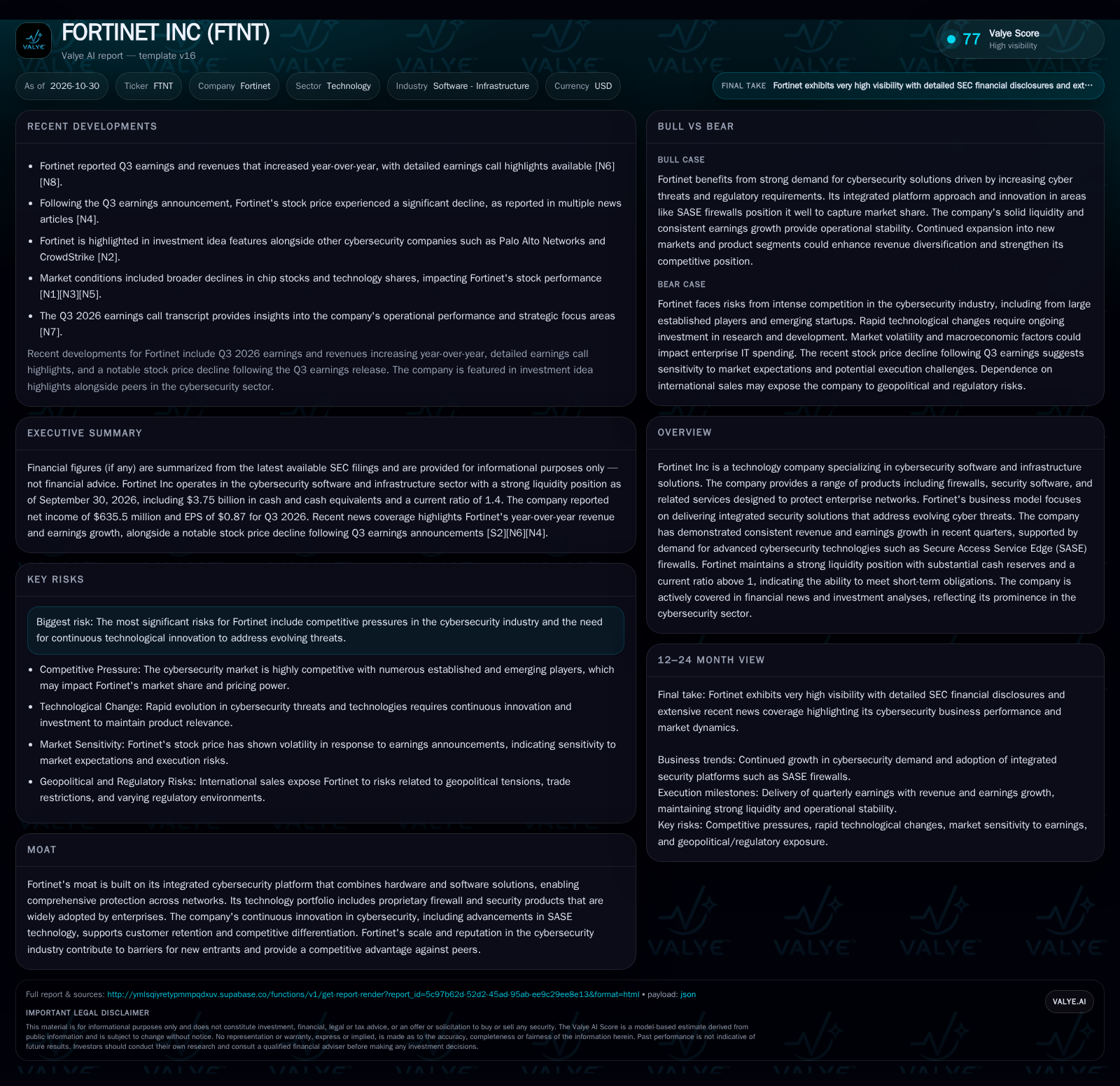
Fortinet delivered Q3 2026 net income of $635.5 million and year-over-year revenue growth, yet experienced a notable post-earnings stock drop. The key question is whether Fortinet’s integrated platform and SASE innovation can sustain growth amid intensifying industry dynamics and shifting customer expectations. [S2] [N6] [N4]
Fortinet enters the final quarter of 2026 with a robust operating profile—solid profitability, a substantial reported cash balance, and consistent revenue growth. Yet, the company’s sharp stock price decline following Q3 earnings underscores a growing disconnect between reported financial strength and investor expectations. As Fortinet doubles down on integrated cybersecurity solutions and SASE innovation, the real test will be its ability to convert platform momentum into durable competitive advantage, while navigating a fiercely contested market and the ever-present risk of technological obsolescence.
Q3 Results: Robust Growth Meets Market Skepticism
For the quarter ending September 30, 2026, Fortinet reported net income of $635.5 million, with basic EPS of $0.87 and diluted EPS of $0.86. Year-over-year, both revenue and earnings increased, with earnings and revenue exceeding analyst estimates [S2] [N6] [N8]. The company reported cash and liquidity metrics for the period; these figures do not by themselves establish operating runway, investment capacity, financial flexibility, or financing capacity. [S2] Despite this, Fortinet’s stock price dropped sharply after the Q3 earnings release—an outcome widely discussed in financial media [N4]. This juxtaposition of strong fundamentals and negative market reaction highlights the company’s heightened exposure to investor sentiment and execution risk.
How Fortinet’s Integrated Model Shapes Revenue Streams and Margins
Fortinet’s business model centers on selling integrated cybersecurity solutions, combining hardware (such as firewalls) and proprietary software. The company’s value proposition is the unification of network security, endpoint protection, and cloud-based controls within a single ecosystem—a strategy that aims to reduce customer complexity and increase cross-sell opportunities. Revenue is likely derived from a mix of product sales (typically upfront), recurring software licenses, and subscription-based services, though the exact contract structures are not disclosed in the current report.
From an economics perspective, hardware tends to generate lower gross margins but can serve as a wedge for higher-margin software and services. As large enterprises and mid-market customers migrate to Secure Access Service Edge (SASE) architectures—a trend Fortinet emphasizes—there is potential for increasing the share of recurring revenues, which could improve margin stability and earnings visibility over time. However, the capital and R&D intensity remain high, given the necessity to continually innovate against evolving threats and to maintain compatibility across hybrid cloud and on-premise deployments.
Operating leverage in this model is a double-edged sword: scaling software and subscription revenue can drive margin expansion, but a slowdown in product volume or price pressure from competitors would quickly expose the fixed cost base tied to ongoing platform development and customer support.
Where Fortinet Stands in a Crowded Cybersecurity Arena
Fortinet operates in a hyper-competitive sector, with well-capitalized rivals ranging from pure-play cybersecurity firms to platform giants expanding into security. It is frequently benchmarked against peers like Palo Alto Networks and CrowdStrike, which also emphasize integrated, cloud-delivered security solutions [N2]. The company’s moat rests on its proprietary technology stack, the breadth of its platform (spanning hardware and software), and its reputation for reliability and performance.
Customer switching costs may be material where Fortinet’s products are deeply embedded, especially in enterprises with complex, multi-site networks. However, the pace of technological change and the rise of cloud-native competitors make this moat vulnerable: customers increasingly expect seamless integration, rapid feature updates, and usage-based pricing models. In this environment, Fortinet’s scale, channel reach, and ongoing investment in SASE and AI-driven security analytics are essential for defending share—but they are not guarantees of sustained pricing power.
Substitution risk is also present as organizations adopt multi-vendor security postures or shift toward cloud hyperscaler security offerings, which could pressure both growth and margins if Fortinet cannot differentiate on outcomes or cost of ownership.
Integrated Platform Adoption Accelerates and Drives Margin Expansion
In a favorable scenario, enterprise and mid-market customers accelerate adoption of Fortinet’s integrated platform, particularly its SASE and next-generation firewall offerings. This drives a higher mix of recurring software and subscription revenue, improving gross margins and earnings visibility. The company leverages its cash resources to invest in R&D and go-to-market without diluting shareholders or taking on debt, allowing it to outpace competitors in delivering new features and threat intelligence.
Evidence that would confirm this scenario includes: continued double-digit revenue and earnings growth, rising gross margins, and an increasing proportion of revenue from software and services (if disclosed). Additional confirmation would come from new large enterprise wins, growing deferred revenue or backlog (if reported), and positive customer retention or net expansion metrics.
Falsification would occur if reported growth slows materially, if gross margins stagnate or decline, or if customer wins begin to skew toward smaller, lower-margin deals. A shift in product mix back toward hardware, or a visible loss of large accounts to competitors, would also undermine this scenario.
Sustained Growth Amid Competitive and Execution Headwinds
The most plausible outcome is that Fortinet sustains moderate revenue and earnings growth, driven by ongoing demand for integrated cybersecurity solutions and incremental share gains in the SASE segment. However, price competition, longer enterprise sales cycles, and the need to keep pace with rapid innovation temper both top-line momentum and margin expansion.
Fortinet maintains its position as a top-tier security provider, but must continually reinvest to defend against both traditional and emerging competitors.
Confirmation would come from single-digit to low double-digit revenue growth, stable or modestly improving margins, and a steady cadence of product launches and customer renewals. Falsification would be visible if revenue growth drops into the low single digits, if margins begin to compress, or if the company is forced to materially increase promotional spending or discounting to retain business.
Competitive Disruption or Execution Missteps Trigger Margin Compression
A negative scenario would see Fortinet’s growth stall due to intensified competition, technological disruption, or internal execution failures. Large enterprise customers begin to adopt multi-vendor or cloud-native security stacks, eroding Fortinet’s platform stickiness and forcing price concessions. At the same time, the company may face challenges integrating new features or keeping up with the rapid pace of threat evolution, leading to product gaps or security incidents that damage its reputation.
Evidence confirming this scenario would include: declining or flat revenue, shrinking gross and operating margins, and negative trends in customer renewal or retention rates (if disclosed). Additional signs would be increased turnover in the sales or product teams, a spike in promotional activity, or high-profile customer defections to key competitors.
Falsification would occur if Fortinet continues to win large, multi-year deals, posts consistently positive revenue and margin trends, and demonstrates resilience against new market entrants or pricing pressure.
Milestones and Metrics That Will Shape Fortinet’s Competitive Narrative
Quarterly revenue growth rates, especially the mix between hardware product sales and recurring software/services revenue, would help test the thesis.
Gross margin trends, as a rising margin could signal successful platform adoption and software mix improvement.
Customer retention and net expansion rates (if disclosed), providing insight into platform stickiness and upsell opportunities.
Deferred revenue or backlog growth (if reported), as a proxy for future visibility and renewal dynamics.
Updates on SASE platform adoption rates or customer wins, indicating traction in this strategic growth area.
Competitive win/loss disclosures, especially in large enterprise or government accounts, would help assess share shifts.
R&D spending trends as a percentage of revenue, revealing the company’s investment discipline and innovation pace.
Management commentary on pricing trends, discounting, or sales cycle length—signals of market pressure or demand elasticity.
Disclaimer: This is research-only, informational analysis and not investment advice. It may include AI-generated interpretation and general industry context. Always verify important details using primary sources.

Comments