
Southern First Bancshares: Relationship Banking, Tech Investment, and the Economics of Regional Growth
Southern First Bancshares is executing a relationship-focused, technology-enabled banking strategy across key Southeastern metros, with recent earnings growth reflecting operational discipline—but the durability of its model will be tested by competitive and economic crosscurrents as it expands.
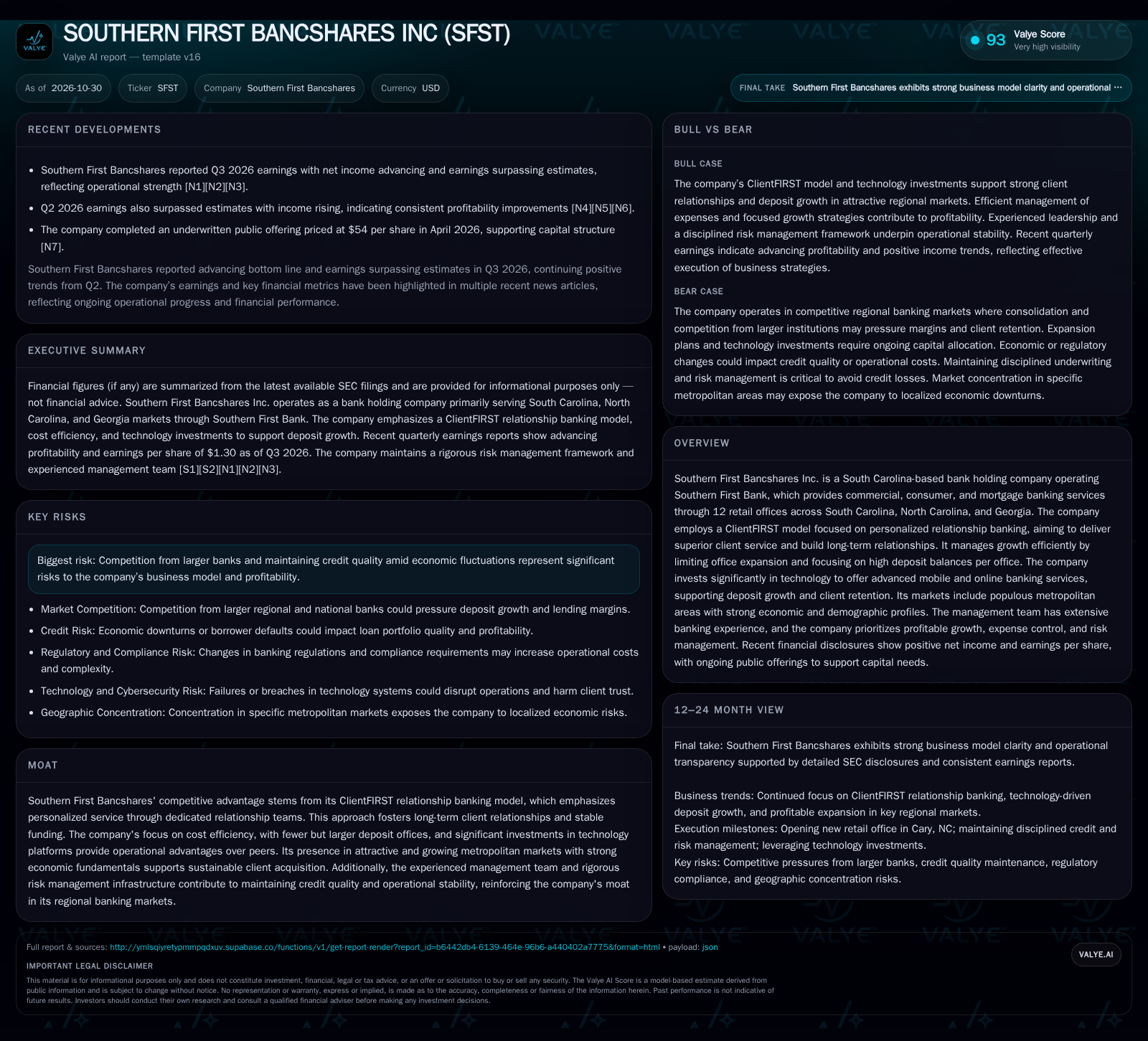
Southern First Bancshares has delivered two consecutive quarters of earnings above expectations, underpinned by a ClientFIRST relationship model, cost-efficient office strategy, and significant technology investment. As the bank expands into high-growth Southeastern markets, its ability to maintain credit quality, manage costs, and differentiate from larger competitors will determine whether recent profitability gains are sustainable in a more competitive and technologically dynamic banking landscape. [S1] [S2] [N1] [N2] [N3]
Southern First Bancshares is pursuing a distinctive regional banking strategy, blending high-touch relationship banking with a lean branch footprint and robust technology investments. Recent quarters have seen the bank outpace earnings expectations, suggesting that its ClientFIRST model and cost discipline are resonating in core Southeast markets. Yet as the company prepares to open new offices and deepen its digital offerings, the real test will be whether it can sustain margin and credit quality advantages amid intensifying competition, evolving client expectations, and the cyclical risks inherent to its concentrated geographic footprint.
Recent Earnings Momentum and Strategic Expansion Shape Near-Term Outlook
Southern First Bancshares reported net income of $12.227 million and basic EPS of $1.30 as of Q3 2026, with both Q2 and Q3 earnings surpassing analyst estimates. This outperformance points to effective execution on profitability and operational efficiency goals. The bank continues to expand its Southeast footprint, with a new retail office set to open in Cary, NC by late 2026. These facts matter because they signal not only current operational momentum but also the company's commitment to growth in populous, economically robust markets, setting the stage for potential scale benefits and increased market relevance. [S1] [S2] [N1] [N2] [N3] [N4] [N5] [N6]
How Southern First’s Model Drives Profits: Branch Leverage, Technology, and Margin Management
Southern First’s core business generates revenue through interest income from commercial, consumer, and mortgage lending, and fee income from deposit and treasury services. Its ClientFIRST approach consolidates client relationships with dedicated teams, which allows the bank to run fewer but larger offices, achieving a 64.0% efficiency ratio in 2025—a figure that compares favorably to many community bank peers. This structure limits fixed overhead while maximizing deposit balances per location, which in turn supports funding cost advantages.
Technology investment is central to the bank’s economics. By offering competitive mobile, online, and cash management services, Southern First aims to attract and retain low-cost deposits, reduce branch staffing needs, and automate back-office processes. If successful, this leverages fixed IT investment across a growing base of clients, potentially enhancing operating leverage as digital adoption rises.
On the funding side, the bank’s low-cost, relationship-driven deposit base may help protect net interest margins in rising or volatile rate environments. However, the sustainability of margin expansion depends on the bank’s ability to avoid pressure from larger competitors bidding up deposit rates, and to maintain asset quality as it grows its loan book. Capital needs are managed through organic profit generation and periodic capital raises, with technology and risk management investments likely requiring ongoing allocation.
Relationship Banking Versus Scale: The Competitive Stakes in the Southeast
Southern First operates in fast-growing metropolitan areas such as Greenville, Charleston, Columbia, Raleigh, Greensboro, Charlotte, and Atlanta—markets that are magnets for both regional and national banks, as well as non-bank digital competitors. Its main competitive advantage is its ClientFIRST model, which emphasizes personalized service and long-term client relationships, supported by a technology stack that rivals larger peers among community banks.
However, the regional banking landscape is evolving rapidly. Larger banks offer broader product suites, greater technology budgets, and sometimes more aggressive pricing, while fintechs and neobanks are eroding traditional service advantages with digital-first offerings. Southern First’s ability to retain and grow high-value relationships depends on its ongoing investment in technology, the efficacy of its risk management, and whether its service differentiation truly translates into lower attrition and higher wallet share.
The bank’s focus on fewer, larger offices could provide cost and operational advantages, but it also concentrates risk and may limit visibility in new markets. As consolidation and digital transformation accelerate in banking, Southern First must continually justify its value proposition to both clients and investors.
If Relationship Banking and Digital Investment Compound: What Sustained Outperformance Looks Like
The most favorable scenario is one in which Southern First’s ClientFIRST teams succeed in attracting and retaining affluent clients and businesses in Southeast metros, supported by a differentiated technology experience. This would drive strong low-cost deposit growth, high loan demand, and superior credit quality—enabling the bank to expand both interest and noninterest income while keeping the efficiency ratio below peers.
Operating leverage would increase as digital channels scale, allowing the bank to maintain or even improve margins despite competitive pressure. Confirmation of this scenario would involve continued earnings outperformance, rising deposit balances per office, stable or improving credit metrics, and growing noninterest income from digital and treasury services. Evidence falsifying this scenario would be an uptick in attrition to larger or digital-only banks, margin compression, or a spike in nonperforming loans.
Growth in a Competitive Market: Profitable Expansion but With Margin and Loan Quality Pressures
The most plausible medium-term outcome is that Southern First continues to grow profitably by leveraging its relationship model and technology investment, but faces incremental pressure on net interest margins and credit quality as competition intensifies. Deposit and loan growth remain solid, but the ability to command premium pricing gradually erodes as larger banks and fintechs target the same client segments with improved digital offerings and competitive rates.
Efficiency gains from technology and office strategy offset some of the margin pressure, but the bank may need to invest more in digital capabilities and risk management, slightly raising its expense base. Confirmation would come from steady but modest earnings growth, a stable efficiency ratio, and manageable (but not improving) credit metrics. Falsification would involve a significant deterioration in margins or a notable rise in charge-offs.
When Local Scale Isn’t Enough: Adverse Outcomes if Competition or Credit Cycles Turn
A negative chain could unfold if Southern First’s concentrated metro strategy exposes it to a localized economic downturn, or if larger banks and digital competitors erode its deposit base and compress spreads more rapidly than anticipated. In this scenario, the bank could face declining deposit balances per office, margin compression from rising funding costs, and increased credit losses if underwriting standards slip or the local economy weakens.
Further downside would materialize if technology investments fail to keep pace with client expectations, leading to attrition among key client segments. Confirmation would include missed earnings estimates, a rising efficiency ratio, higher nonperforming loans, and negative operating leverage. Falsifying this scenario would be demonstrated resilience in deposit and loan growth, stable credit trends, and continued earnings outperformance despite market turbulence.
Concrete Developments That Will Reveal Southern First’s Competitive Durability
Deposit growth per office—tracking whether the bank continues to outperform peers in deposit gathering as it expands into new markets would help test the sustainability of its business model.
Net interest margin trends—if disclosed, this metric would indicate how well Southern First is managing funding costs and loan yields amid competitive and rate-cycle changes.
Efficiency ratio performance—ongoing improvement or stability would signal successful cost control and operating leverage as technology investments scale.
Credit quality indicators—such as nonperforming loan rates or charge-offs, if reported, will be critical to assessing risk management as the loan book grows.
Growth in noninterest income—a useful metric would be the contribution from digital and treasury services, shedding light on the bank’s ability to diversify revenue streams.
Attrition or client retention rates—if disclosed, these would reveal whether the ClientFIRST model is translating into durable client relationships in the face of larger or digital-focused competitors.
Pace and success of new office openings—observing the ramp-up of the Cary, NC location and future expansions will clarify the scalability of the bank’s operating model.
Disclaimer: This is research-only, informational analysis and not investment advice. It may include AI-generated interpretation and general industry context. Always verify important details using primary sources.

Comments