
Analog Devices Q3 2026: Operating Income and Net Income Surge Amid Strong Liquidity
Analog Devices reported a $794.9 million increase in operating income and higher net income in Q3 2026, supported by robust liquidity and credit facilities.
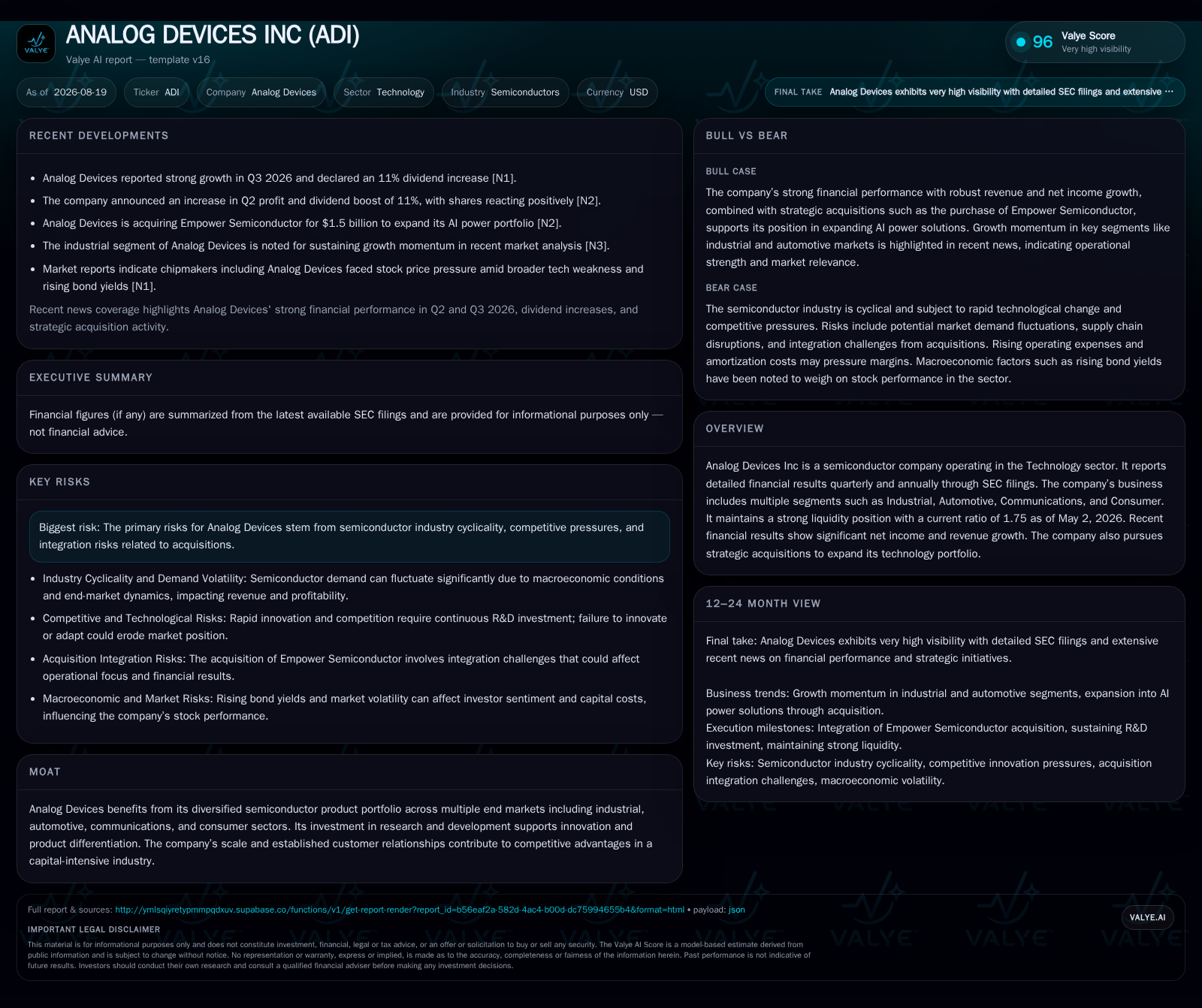
Analog Devices Inc delivered a significant rise in operating income by $794.9 million in the third quarter ended August 1, 2026, compared to the prior year quarter, driving net income growth aided by a $39.1 million reduction in income tax provision. The company’s working capital expanded with a 66% increase in accounts receivable and a 17% rise in inventory since the prior fiscal year-end, reflecting higher sales activity or inventory positioning. Analog Devices maintains substantial financial flexibility through unsecured revolving credit facilities totaling up to $6.0 billion and holds $2.17 billion in cash and equivalents, supporting its capacity to invest and manage operational demands amid semiconductor industry cyclicality.
Q3 2026 Operating Performance and Income Growth
Analog Devices Inc reported a substantial increase in operating income during the third quarter ended August 1, 2026, with operating income rising by $794.9 million compared to the same period in the prior fiscal year [S2]. The net income for the quarter also increased, supported by the higher operating income and a $39.1 million reduction in the provision for income taxes relative to Q3 2025 [S2]. These factors combined to enhance the bottom-line performance, reflecting stronger operational execution.
The semiconductor industry, in which Analog Devices operates, is characterized by cyclicality and capital intensity. In this environment, operating income growth signals effective management of product portfolio, manufacturing efficiency, and scale. For Analog Devices, whose revenue is driven by sales of analog, mixed-signal, and digital signal processing integrated circuits across diversified end markets such as industrial and automotive sectors, this improvement suggests resilience during fluctuating demand [S1]. Sustained operating income growth is critical for generating cash flow and supporting capital allocation decisions.
Working Capital Trends and Cash Flow Implications
Alongside income growth, Analog Devices experienced notable increases in working capital components. Accounts receivable rose by 66% to $2.39 billion as of August 1, 2026, compared to November 1, 2025, while inventory increased by 17% to $1.93 billion over the same period [S2]. Days sales outstanding increased modestly from 44 to 50 days, and days cost of sales in inventory remained stable around 130-131 days [S2].
These working capital changes may indicate higher sales activity or strategic inventory buildup [S2]. While rising accounts receivable and inventory tie up cash and could temporarily pressure cash flow, they also reflect demand strength or positioning in the supply chain. In the semiconductor sector, managing working capital efficiently is essential due to the capital-intensive nature of manufacturing and the need to balance supply availability with market demand. The increase in working capital could be consistent with growth phases or preparation for anticipated customer demand.
Liquidity Position and Credit Facilities
As of August 1, 2026, Analog Devices held $2.17 billion in cash and cash equivalents [F1]. Current assets totaled approximately $7.07 billion, while current liabilities were about $5.66 billion, resulting in a current ratio of 1.25 [F1]. These figures indicate the company's liquidity levels at that date but do not alone confirm sufficiency for all operational or strategic needs.
Further enhancing financial flexibility, Analog Devices has access to two unsecured revolving credit facilities totaling up to $6.0 billion. These include a five-year revolving credit agreement entered into in April 2025 and a 364-day revolving credit agreement initiated in July 2026, both administered by Bank of America N.A. and other lenders [S2]. Such credit arrangements reduce refinancing risk and provide the company with capacity to fund working capital needs, capital expenditures, acquisitions, or share repurchases as market conditions permit.
Business Model and Industry Context
Analog Devices operates in the semiconductor industry, supplying analog, mixed-signal, and digital signal processing integrated circuits to customers across industrial, automotive, communications, consumer, and other sectors [S1]. The company’s revenue is primarily generated through product sales, with recurring demand driven by diversified end markets. Margins and cash conversion depend on product mix, manufacturing efficiency, scale, and operational execution.
The semiconductor sector is cyclical, influenced by technology transitions, product lifecycles, and end-market demand variability. Analog Devices’ diversified customer base and product portfolio provide some structural stability against industry cyclicality. Key performance indicators for companies in this sector include operating income growth, net income trends, working capital efficiency, liquidity ratios, and access to credit facilities.
Analytical Conclusions and Outlook
The substantial increase in operating income and net income in Q3 2026 reflects improved operational execution, as evidenced by the $794.9 million operating income increase and lower income tax provision compared to the prior year quarter [S2]. This improvement enhances the company's earnings power.
The growth in accounts receivable and inventory suggests increased sales activity or inventory buildup, which may temporarily pressure cash flow but also signals demand strength or supply chain positioning [S2]. Efficient working capital management will be critical to sustaining free cash flow and supporting capital allocation.
As of August 1, 2026, Analog Devices had $2.17 billion in cash and cash equivalents and maintained revolving credit facilities totaling up to $6.0 billion [F1][S2]. These resources may contribute to the company's ability to manage semiconductor industry cyclicality and pursue growth opportunities, depending on how they are utilized.
Watchpoints
Investors should monitor upcoming quarterly filings for sustained operating income and net income trends to assess the durability of recent profitability gains. Additionally, tracking liquidity ratios and credit facility utilization will help evaluate financial flexibility. Changes in the effective tax rate and income tax provisions may also influence net income trends.
The company’s ability to manage working capital and maintain operational momentum will be key to sustaining this positive trajectory amid the semiconductor industry's inherent cyclicality.
Disclaimer: This is research-only, informational analysis and not investment advice. It may include AI-generated interpretation and general industry context. Always verify important details using primary sources.

Comments